So just to clafiry the next steps:
- Get a configuration that logs
- Examine the logs and take a look at what's getting sent
- Patch your app to send confirming URIs
- Recommend that your enteprise customers license the ActiveX Flash Player from HARMAN if they need the ActiveX Flash Player for more than the next couple months.
I'm super curious about the URIs that are getting sent. There's no possibility of pushing out an update at this point that would change the behavior, but at that point, we can have an informed look at what's happening. If there's an edge case that we didn't think of, I can at least debug it and see if there are any useful recommendations.
In terms of addressing this, you probably just want to update your application to normalize those paths to RFC 3986 compliant URIs.
This is what Caspar (the software from the case study above) did. You might be able to just crib the normalization code from their Github repo. This is optimal (at least IMO), because your customers on Win8+ probably aren't on a version of Flash Player that supports EnableInsecureAllowListLocalPathMatching, and their only option to get it is to license a maintained Flash Player from HARMAN moving forward. It's much more cost-effective to just patch the application to pass in a valid URI in the first place.
At that point, you should be able to look at the logs and write matching AllowListUrlPattern directives that work.
It's also worth pointing out that MSFT will be removing the ActiveX Flash Player that they distributed to Windows 8 and higher via a future mandatory Windows Update. That package is currently optional, but the next big roll-up update (scheduled around summer) will require it.
Licensing the ActiveX Flash Player from HARMAN is ultimately going to be necessary for enterprises on Windows 8 and higher. Adobe was never able to distribute an installer for the ActiveX Flash Player on that platform, so you can't just reach back and get and old version. HARMAN built an installer that works on Win8+ systems, AFTER the Microsoft Update that removes their Flash distribution has been applied.
Deploying a licened version from HARMAN confers some meaningful benefits -- those builds continue to get functional and security updates. For enterprises that need to keep Flash deployed, this is the best approach from both a security and operational perspective (they can/should still leverage the AllowList to limit their attack surface).
Without requiring users to license the HARMAN player, using confirming URIs buys you a few months to replace those Flash dependencies with something else before that mandatory MSFT patch gets deployed.
I basically gave up on this case. It's a cold case for me now. I see that getting to the ground of it would require to log the pathes and setup a vm and track everything but that's not in my area. I'm not the coder of the program tbh I'm more a middleman trying to find a soultion for 2 parties.
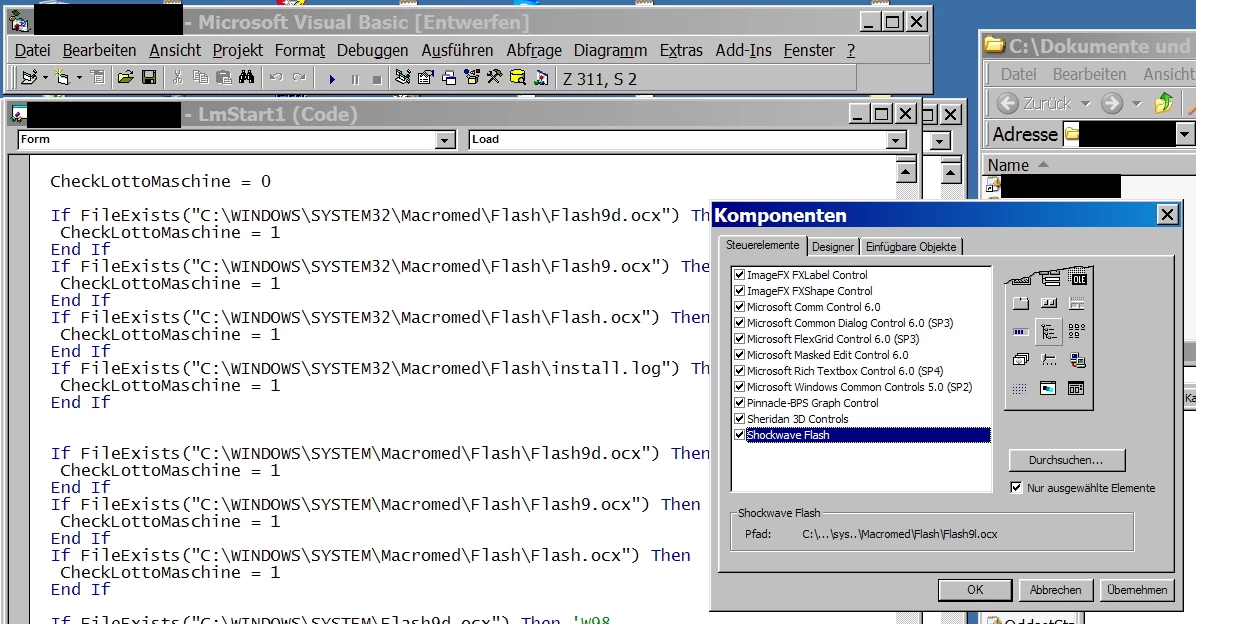
All I can say is that my "path" worked for Google Chrome. I could tun the local file in the browser with using my mms.cfg setup but could not let it run with the software. I thought AllowListUrlPattern=file:* will allow all softwares to play anything on my local drive. It does not. Maybe because of the EnableInsecureAllowListLocalPathMatching which is not working on Windows 10 unless you get the HARMAN Flash Player. Or maybe it's not reading the mms.cfg. But I can sent you how it was integrated. Maybe it helps some other people when looking for this thread. I guess there are many people having problems and looking for a good solution.
ShockwaveFlash1.Height = 9000 '15 * 400
ShockwaveFlash1.Width = 12000 '15 * 480
ShockwaveFlash1.Top = 0
ShockwaveFlash1.Left = 0
ShockwaveFlash1.Movie = svp & "swf\lottogross\lottogross.swf"
ShockwaveFlash1.Playing = True
ShockwaveFlash1.Visible = True



 AdChoices