
Participant
January 30, 2017
Question

Double clicking .swf file opens a blank Flash Player screen.

  • January 30, 2017
  • 1 reply
  • 6578 views

Hello,

I work in the I.T. department at a community college.  Every year when we update our Adobe software we end having to re-associate the .swf file extension with the standalone Flash Player.  In the past I've been able to set the .swf file extension to C:\Program Files\Adobe\Adobe Animate (used to be adobe Flash)\Players\FlashPlayer.exe.  Unfortunately this way does not work anymore.

Upon doing research on a couple of other forums it was suggested to update and get the standalone Flash Player version 24 and paste it into C:\Windows\SysWOW64\Macromed\Flash and then set the file association to that Flash Player exe.  Now when we go to double click (or right - click -> Open) a .swf file the Adobe Flash Player opens with a blank screen instead of the thing that we want to play.

The instructor had told me that Adobe Animate CC 2017 only publishes .swf up to Adobe Flash version 23 so I've even gotten the standalone version 23, pasted it into the SysWOW64\Macromed\Flash folder, remade the association, and still only get a blank screen upon double clicking the .swf file.

Once the Flash Player is open we can manually open the file by going File -> Open and browsing for the .swf file, but it seems we should be able to just double click and open it without issues.
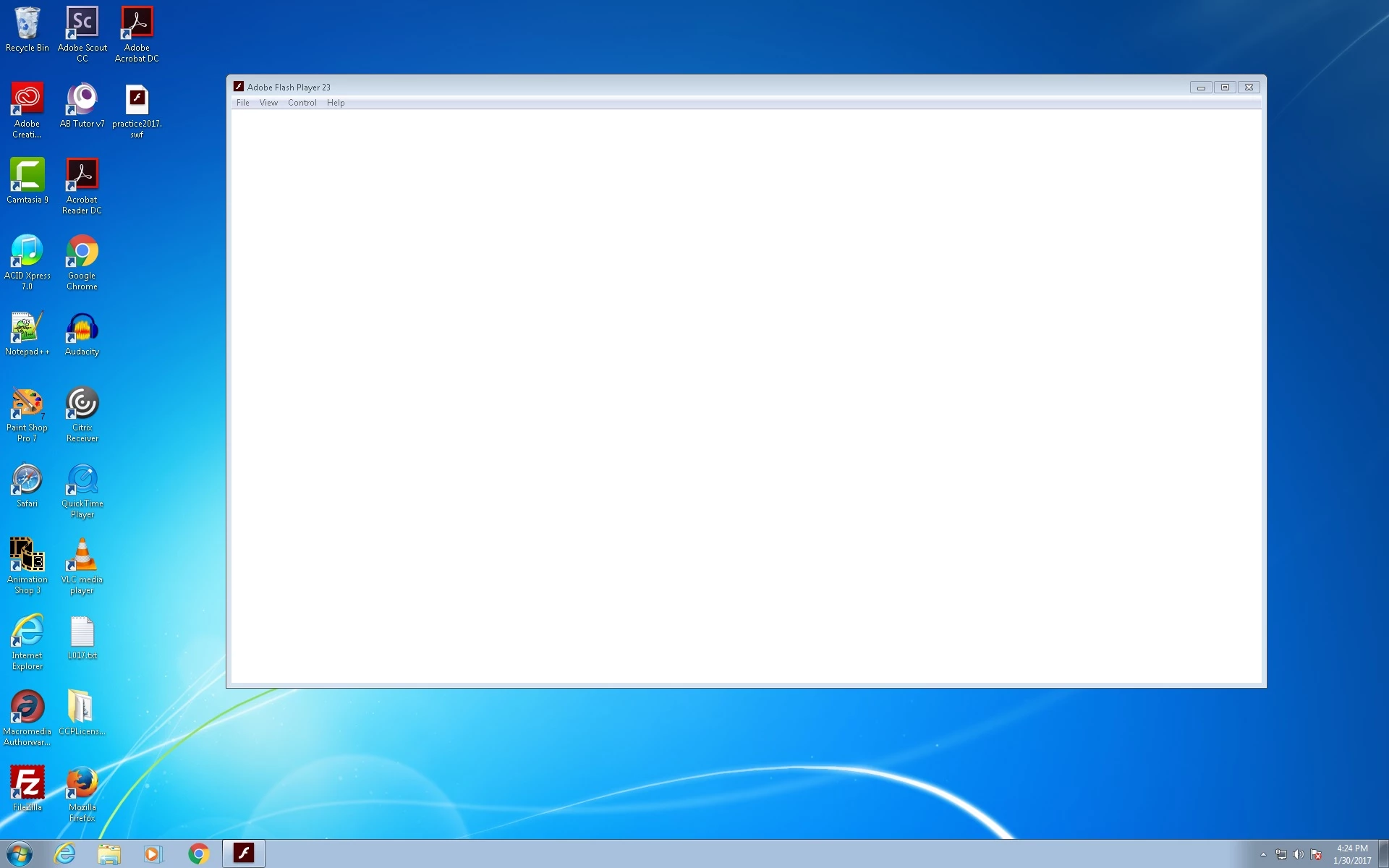
The computers experiencing this are Windows 7 Enterprise running Adobe Creative Cloud 2017.

This topic has been closed for replies.

1 reply

jeromiec83223024
Inspiring
January 31, 2017

I'm wondering if you're running into the following security change.  If the SWF you're loading then loads other assets from the local system, but now lacks permission, that could definitely explain why you're just getting a blank screen.

Disabling local-with-filesystem access in Flash Player by default

Beginning with Flash Player 23, local-with-network permissions will now be applied to all local SWF content, regardless of the preference chosen at compile time.

Background:
When playing Flash (SWF) content from local filesystem, developers have historically been able to configure content to exclusively read from the filesystem, or communicate to the network. When this functionality was introduced over a decade ago, it enabled an interesting array of use-cases ranging from simple games to interactive kiosks. In context of modern web security, we believe that it is time to retire local filesystem functionality in the browser plugin. At the same time, Adobe AIR has been established as a robust, mature solution for delivering ActionScript-based content as a standalone application.

Vast majority of Flash Player users and content will be unaffected by this change. This change only impacts Flash content played from the local filesystem, using the browser. Flash content hosted on the internet and local webservers, as well as the Standalone Flash Player remains unaffected.If you are a user who requires this functionality, these files can be added to the list of Trusted Locations in Flash Player.

Workarounds for Legacy Content:
We highly recommend that you only circumvent these controls to enable content from sources that they trust.

For Individuals:
For Internet Explorer, Edge, Firefox, Opera and Safari:
On the affected system, go to the Flash Player Settings Manager:
• Mac: System Preferences > Flash Player
• Windows: Control Panel > Flash Player
Select the Advanced tab
In the Developer Tools section, click the Trusted Location Settings button
Click the "Add..." button and add relevant files and folders to the list


For Google Chrome (and other PPAPI browsers):

Navigate to the Settings Manager page
Choose Edit Locations > Add Locations from the popup list
In the text field that appears, type or paste the file/folder path that you'd like to trust
Click the "Confirm" button
Note: Please be aware that the "Browse for files" and "Browse for folder" buttons do not function properly. You must manually type or copy/paste your path into the text field above the buttons to add the file or folder to the trusted list.

For System Administrators:
The legacy behavior can be restored by applying the EnableInsecureLocalWithFileSystem=1 flag to mms.cfg.