

BenPleysier
Community Expert
Community Expert
January 29, 2017
Question

Float, Inline-block, Flexbox, Table and Grid - which one?

  • January 29, 2017
  • 8 replies
  • 5314 views

A lazy Sunday afternoon, decide to experiment with different layout methods

The code

<!doctype html>

<html>

<head>

  <meta charset="utf-8">

  <title>Untitled Document</title>

  <style>

  body {

  background: #222;

  color: white;

  font-weight: 300;

  font-family: sans-serif;

  font-size: 85%;

  line-height: 1.4;

  margin: 0;

  padding: 1rem;

  }

  body h2 {

  font-weight: 500;

  margin: 0 0 0.5rem 0;

  }

  body a {

  color: white;

  align-content:

  }

  body [class*='-block'] {

  background: green;

  padding: 1rem;

  max-width: 20rem;

  margin: 0 0 1rem 0;

  }

  .float-block {

  overflow: hidden;

  }

  .float-block img {

  width: 75px;

  float: left;

  }

  .float-block> div {

  width: calc(100% - 75px - 1rem);

  float: right;

  }

  .inline-block {}

  .inline-block> img {

  /* defaults to inline-block */

  width: 75px;

  margin: 0 calc(1rem - 4px) 0 0;

  /* remove strange white space */

  }

  .inline-block> div {

  display: inline-block;

  vertical-align: top;

  width: calc(100% - 75px - 1rem);

  }

  .flex-block {

  display: flex;

  align-items: flex-start;

  }

  .flex-block> img {

  width: 75px;

  margin: 0 1rem 0 0;

  }

  .flex-block> div {

  flex: 1;

  }

  .table-block {

  display: table;

  }

  .table-block> img {

  display: table-cell;

  width: 75px;

  margin: 0 1rem 0 0;

  }

  .table-block> div {

  display: table-cell;

  vertical-align: top;

  }

  .grid-block {

  display: grid;

  grid-template-columns: 75px auto;

  grid-template-rows: auto;

  grid-column-gap: 1rem;

  }

  .grid-block> img {

  align-self: start;

  }

  .grid-block> div {

  vertical-align: top;

  }

  </style>

</head>

<body>

  <div class="float-block">

  <img src="http://lorempixel.com/output/abstract-q-c-75-70-5.jpg" alt="">

  <div>

  <h2>Float</h2>

  <p>Lorem ipsum dolor sit amet, consectetur adipisicing elit. Nisi voluptate iure nostrum debitis quae nihil, id fugiat consequatur quo, laborum, non eligendi dolore expedita minima voluptates repudiandae</p>

  </div>

  </div>

  <div class="inline-block">

  <img src="http://lorempixel.com/output/abstract-q-c-75-70-5.jpg" alt="">

  <div>

  <h2>Inline</h2>

  <p>Lorem ipsum dolor sit amet, consectetur adipisicing elit. Nisi voluptate iure nostrum debitis quae nihil, id fugiat consequatur quo, laborum, non eligendi dolore expedita minima voluptates repudiandae</p>

  </div>

  </div>

  <div class="flex-block">

  <img src="http://lorempixel.com/output/abstract-q-c-75-70-5.jpg" alt="">

  <div>

  <h2>Flexbox</h2>

  <p>Lorem ipsum dolor sit amet, consectetur adipisicing elit. Nisi voluptate iure nostrum debitis quae nihil, id fugiat consequatur quo, laborum, non eligendi dolore expedita minima voluptates repudiandae</p>

  </div>

  </div>

  <div class="table-block">

  <img src="http://lorempixel.com/output/abstract-q-c-75-70-5.jpg" alt="">

  <div>

  <h2>Table</h2>

  <p>Lorem ipsum dolor sit amet, consectetur adipisicing elit. Nisi voluptate iure nostrum debitis quae nihil, id fugiat consequatur quo, laborum, non eligendi dolore expedita minima voluptates repudiandae</p>

  </div>

  </div>

  <div class="grid-block">

  <img src="http://lorempixel.com/output/abstract-q-c-75-70-5.jpg" alt="">

  <div>

  <h2>Grid</h2>

  <p>This example needs a Grid-aware browser to render as intended, see <a href="https://developers.google.com/web/updates/2014/03/Get-on-the-CSS-Grid" target="_blank">Get on the CSS Grid!</a>

  </p>

  </div>

  </div>

</body>

</html>

The result
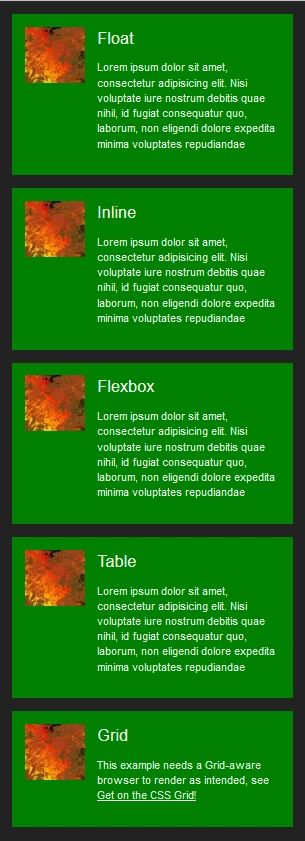
After much discussion in various topics, I am wondering what the feeling of this forum is regarding the correct layout method.

For my input, I regard each method as being the correct one, I tend to use the one that is most convenient at the time. Having said that, I also think that Table the easiest one is to work with. Strange that Table has never been considered as a viable layout mechanism.

    This topic has been closed for replies.

    8 replies

    pziecina
    Legend
    January 30, 2017

    Floats are now included in the Updated 2.1 specs in regards to positioning, because of css exclusions -

    https://www.w3.org/TR/css3-exclusions/

    Exclusions where originally called 'positioned floats' in the original draft, and must be declared as floated elements for them to work. Currently it is only implemented in IE10+, but other browsers, (except FF) are working on an implementation.

    pziecina
    Legend
    January 29, 2017

    BenPleysier

    just a though Bem.

    Given all the discussions over the last few months, (or maybe that should be years) why are you asking this question?

    After all, we have covered all this previously.

    pziecina
    Legend
    January 29, 2017

    Remember your complaint about flexbox being only one direction, and the link to the article you used that said do not use?

    Well the author wrote another article 5 months later saying use -

    https://jakearchibald.com/2014/dont-use-flexbox-for-page-layout/

    Legend
    January 29, 2017

    BenPleysier wrote:

    Strange that Table has never been considered as a viable layout mechanism.

    I think it has by any developer that has a reasonable insight into coding. I was using it to resolve certain layout issue before Flex came along and I know of many a good developer that still use it frequently, although I'm not sure why now to be honest, given Flex can do it much better, maybe they don't want to pack their css with vendor prefixes, that's the only real reason  I can think why I would want to use 'table' over 'flex', unless I needed to support a lesser browser, but that decsion has to be made by the individual.

    I'll go with flex as its here an now, suits my workflow and I like to try and remain current. I dont think theres any point in putting off what can be used today until tomorrow or next year, once something has major browser support and those browsers that dont support are insignificant regarding user numbers, move on.

    pziecina
    Legend
    January 29, 2017

    As a thought on which layout to use, and i have said this often over a number of years.

    Without support in whatever editor or ide, only professional coders will use ithe newer layou methods, this efectively means 90% of web or app creators have no idea how to use anything beyond floats.

    pziecina
    Legend
    January 29, 2017

    As Rob says, it all depends on the layout, and mix and match of layout methods has been the norm for the last few years.

    One layout method you did not mention is multi-column, which i have found essential for layouts with lots of text, no matter which main layout method one decides to use.

    As a little bit of history though. The reason table layouts never recieved the attention they deserved, was because of a bug in Chrome and Android browsers, which was not fixed until the same version that introduced the the 'new' flexbox syntax. Effectively placing all the attention on flexbox.

    Of course all new layout methods that would not work in IE8, without a polyfill or falback css, many talked down as unworkable, or not untill 2021, to complexed and every other objection one can think of was put forward.

    All the objections and reasons for not using anything new, has left us with a situation of some coders using the new methods, and not enough overall experiance of their use(s) making its way into public forums such as this.

    Rob Hecker2
    Legend
    January 29, 2017

    Your example is very simple, so it hardly puts any method to the test. If you make it a requirement to horizontally align the elements, then most of those methods will drop out and flexbox will prevail.

    Another criteria to play with would be responsiveness. Here again flexbox has capabilities other methods don't have.

    ALsp
    Legend
    January 29, 2017

    Rob Hecker2 wrote:

    Another criteria to play with would be responsiveness. Here again flexbox has capabilities other methods don't have.

    For anyone knowledgeable to even know there are so many methods... making any one of the responsive is extremely easy... especially considering that you would need to write extra CSS and likely at least one media query even for a flexbox design.

    Legend
    January 29, 2017

    What's the trick in making display: table; go from 3 col to 2 at 768px to 1 col at 480px? Below it just gets shunted into 1 col at 480px.

    <style>

    .boxes {

      display:table;

      width: 100%;

      height: 100%;

    }

    .box {

      display: table-cell;

      text-align: center;

      vertical-align:middle;

      line-height: 13em;

    }

    .box1 {

      background: orange;

    }

    .box2 {

      background: green;

    }

    .box3 {

      background: red;

    }

    @media (max-width: 420px) {

    .box {

    display: block;

    width: 100%;

    }

    }

    </style>

    <div class="boxes">

    <div class="box box1">Box 1</div>

    <div class="box box2">Box 2</div>

    <div class="box box3">Box 3</div>

    </div>

    ALsp
    Legend
    January 29, 2017

    I think you answered most of your questions :-)

    We use display: table in some products, primarily to support equal height columns. Your use of it is perfectly reasonable. One thing that might be helpful is to set the table parent to "table-layout: fixed", which allows all modern browsers to scale images using max-width... among other things.