


Inspiring
May 11, 2012

P: PDF import show edge artifacts on tiled PDF images (bug in PDF creation)

  • May 11, 2012
  • 262 replies
  • 4156 views

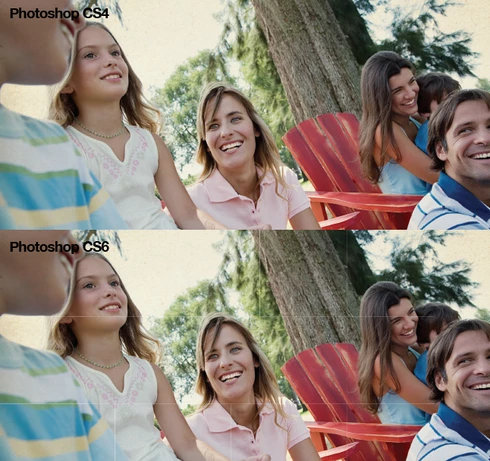
When importing a PDF with images, Photoshop CS6 adds faint outlines to the PDF image segments in the file. Prior versions of Photoshop render the PDF correctly. See the attached image for an example.
This topic has been closed for replies.

262 replies

Inspiring
January 18, 2013
No news, unfortunately. I keep trying to push the other groups to work on a solution, and several of them just don't get it.
Inspiring
January 18, 2013
The paste problem is probably because you have the "snap transforms to pixel boundaries" enabled - which will distort fractional pixel dimensions to whole pixel dimensions (as designers asked).

And we still haven't gotten the PDF folks on the other teams to discuss the problem (despite the rasterization folks repeatedly telling them that the files can't be rasterized without artifacts).
Inspiring
January 18, 2013
So, after my last post is allready one (in numbers: 1) month old, I celebrate this anniversary with a little "remind me"-post.
Chris: if you still read this thread, can you tell us something new? I think everybody who subscribes to this thread is eager to hear something from Adobe!

Regards,

Markus
Inspiring
January 18, 2013
Same issue..
Still waiting for fix from adobe.. because this is not cool in professional application to have such bugs..
And in my opinion its only normal to have some PDF with flattened transparency..
Its not only PDF problem.. its not possible to copy vector objects from illustrator without those "glitches"
Same with PDFs from quark etc.
In CS5 i could open print PDF and check if there will be everything ok in print.. but now its not possible in CS6.. So only solution i found was to use CS5.5

AND other bug i have found is if you copy vectors from illustrator (5x5mm square) than in photoshop after paste it's in some 104% x 96%.. bigger the object smaller difference.. for objects below 2mm its even biger.. so if you making some web object 20x20px and paste in small square from illustrator.. in photoshop its not square any more..

I think photoshop CS6 have some problem between millimeter and pixel convertations

Whats the reason to add more effects and features without thinking about main functions. World is starting to go down 🙂 everyone wants just profit without giving enough quality...
Inspiring
December 17, 2012
Hi Chris,

then, could you hand this thread over to someone of the other teams who's in charge of fixing this problem (and - of course - willing to talk about it with us customers)?
That would be nice!
Inspiring
December 13, 2012
Sadly, my team's priority does not match up with the priorities of the InDesign, Illustrator, rasterizer, AGM parser, PDF flattener, etc. teams that need to be involved. Again, we are trying to get everyone together to work this out.
Inspiring
December 13, 2012
The PDFs are broken, and cannot be rasterized without artifacts unless you use a higher resolution, or turn off antialiasing (and even that might have some artifacts depending on the resolution - I haven't done enough testing without antialiasing to be confident that it'll always work).

I appreciate that you can't always fix the files. But we don't have a choice here. CS5 and earlier still showed artifacts on these files - just at different resolutions from CS6. The files have always been bad, you just didn't notice it as often in earlier releases. Having done more testing and been looking for it -- I've seen the artifacts all over the place with these tiled image PDF documents.

We cannot go back to the CS5 antialiasing because it had huge problems with artifacts in many documents. Right now the CS antialiasing only has problems with some PDFs that contain tiled images (aka bad PDF files that can't rasterize well). CS6's antialiasing is still the better choice overall, even if it does not work well for your particular files.

We've tried to find a way to rasterize these tiled images without artifacts, and have not found a way to do so (despite having the best people in the business working on the problem). We are still trying to get all the different groups together to work out the issue - but it's not an easy issue since many of these bad PDFs are already out there.
Inspiring
December 13, 2012
Hi Chris,

your last sentence (including the one in brackets) is something we, your customers, want to hear: "yes, we are working on it - we did this and this to eliminate the error".
Please provide us with updates on a regular basis, so we can see that something happens.
Once more: don't take this easy! I guess if all users which are concerned by this issue would post here, the thread would burst.
Saying this: can you tell us something about the priority, this issue has on your scedule?
Participant
December 13, 2012
I have read what you have written and understand what you are saying. But, the issue is that the tool we're relying on to produce acceptable results (ie Photoshop) is no longer doing so. We do not always have the option of being able to redo the PDFs, often having to work with PDFs generated by somebody else some time ago and therefore beyond our control. As someone else said these are often pre-press PDFs made as PDF 1.3 compatible for PDF-X/1a (as still used by a large section of the print industry). I appreciate that the PS CS6 rasteriser is sharper than the previous version and looking forward I would love to see PDFs that never have white lines on them, but for the time being my immediate problem is that PS CS6 cannot produce a decent rasterised image from certain PDFs, therefore I can't use it for that purpose. It's fine saying the rasteriser is improved, but if that creates another problem then that needs to be addressed.
Inspiring
December 13, 2012
PLEASE read what I have written. The problem is, 100%, the PDF files.
We have been working on this, looking at all the issues and options -- and with the files written as they are: they cannot be rasterized without artifacts except at resolutions higher than the original resolution of the images.
Whomever made the choice to slice up the images in the files made mistakes - they did not consider what would happen when the document was rasterized at other resolutions.

Photoshop is not broken. The files are broken and Photoshop is simply showing that more often now because of the improved antialiasing (improved quality overall, when the PDF file isn't fundamentally broken).

We are still working with the groups that produce the broken files to see what can be done (we've already exhausted ideas for how to render the broken files - nothing worked).