
Inspiring
May 9, 2018
Answered

Centering Asymmetrical Audio?

  • May 9, 2018
  • 1 reply
  • 5048 views

I have a vocal recording that is quite asymmetrical - most of the waveform is on the top part of the center line. Here is a pic of it:
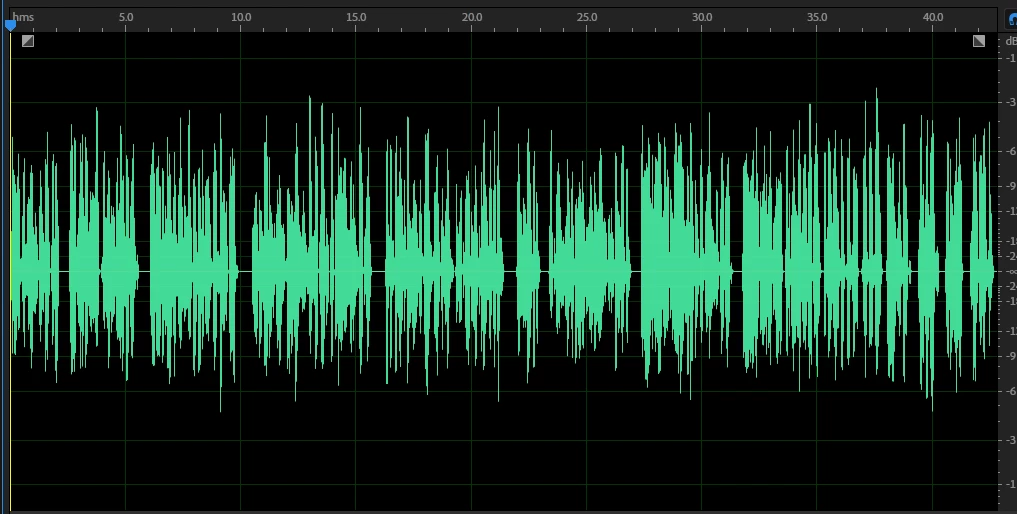
I've never seen this before. Is there a way to center it, making it symmetrical, such that an equal amount of the waveform appears above and below the center?

The audio sounds OK. And Normalizing putting a tick in the DC Bias box at 0% does nothing other than normalize the level. Symmetry remains same.

Thoughts?

Thanks!

    This topic has been closed for replies.
    Correct answer SteveG_AudioMasters_

    It's supposed to be like that! When people breathe and speak at the same time, the forward motion of the air has the effect of shifting the microphone's response to accentuate the positive side of the waveform. The same thing happens with a brass instruments, and indeed any sound with the same carrier properties.

    Generally it isn't an issue, but it can in some circumstances limit the peak amplitude that you can use. Generally a little light limiting will overcome this. It's also possible to reduce the effect using an all-pass filter (alters the phase response), but that sometimes sounds a little strange to my ears; limiting, if applied sensibly, can yield other improvements too, and is a much better way of increasing the effective overall level of the speech.

    1 reply

    SteveG_AudioMasters_
    Community Expert
    SteveG_AudioMasters_Community ExpertCorrect answer
    Community Expert
    May 10, 2018

    It's supposed to be like that! When people breathe and speak at the same time, the forward motion of the air has the effect of shifting the microphone's response to accentuate the positive side of the waveform. The same thing happens with a brass instruments, and indeed any sound with the same carrier properties.

    Generally it isn't an issue, but it can in some circumstances limit the peak amplitude that you can use. Generally a little light limiting will overcome this. It's also possible to reduce the effect using an all-pass filter (alters the phase response), but that sometimes sounds a little strange to my ears; limiting, if applied sensibly, can yield other improvements too, and is a much better way of increasing the effective overall level of the speech.

    Inspiring
    May 10, 2018

    Thanks Steve. That does make sense from a theoretical point of view. But I've not seen it to quite this degree before. Like you say, though, it isn't a problem from an audio quality standpoint. The only real issue is like you said, it limits how much headroom you have to play with for normalizing, say. And also as you said, that can always be dealt with by a little dynamics adjustment.

    But I recently bit the bullet and purchased iZotope RX 6 and used the Phase tool to "rotate the signal phase." Their preset of "adaptive phase rotation" makes the audio symmetrical with no audible artifacts. That leaves a more balanced amount of space on BOTH sides to use for level increases if desired. I wondered if Audition had a similar tool to RX's phase rotation tool?

    BTW, just for context, this is not my vocal. I help VO folks with home recording and of all the files I've worked with, I've not seen one this off-center to date.

    Thanks!

    SteveG_AudioMasters_
    Community Expert
    Community Expert
    May 10, 2018

    KenTheriot  wrote

    I wondered if Audition had a similar tool to RX's phase rotation tool?

    No it doesn't, but you might want to look at this: PhaseNudge | Airwindows

    BTW, just for context, this is not my vocal. I help VO folks with home recording and of all the files I've worked with, I've not seen one this off-center to date.

    I've seen them that bad before! You have to bear in mind that there are several factors at work that will determine how extreme this will be. How close, what sort of angle the talent has WRT the mic, and the type of mic itself all play a factor. Technically you are more likely to see this from an omni mic, as these are the ones that have an extended bass response and would be more sensitive to pressure effects. Also, the form of windshield can influence this; the less shielding there is, the more likely you are to see it.