
Participant
July 2, 2019
Question

Selective Frequency Trimming Question

  • July 2, 2019
  • 1 reply
  • 438 views

I wonder if CC Audition has a way to trim frequency while keeping high dB sound at a higher frequency.

If you look at the image, you will see that the trim is at 12kHz which are the white background noise while the frequency of the louder sound is at 16kHz consistently throughout the entire audio. The input is a pair of condenser mics (rode NT1a, binaural) and the recorder is Zoom H6.

I tried using filters (FFT, notch, scientific parametric) as well as compression and I have no luck. Any help to achieve such a selective frequency trimming based on dB would be appreciated. Thanks!

(The following picture is an audio I found online using the setup mentioned above.)
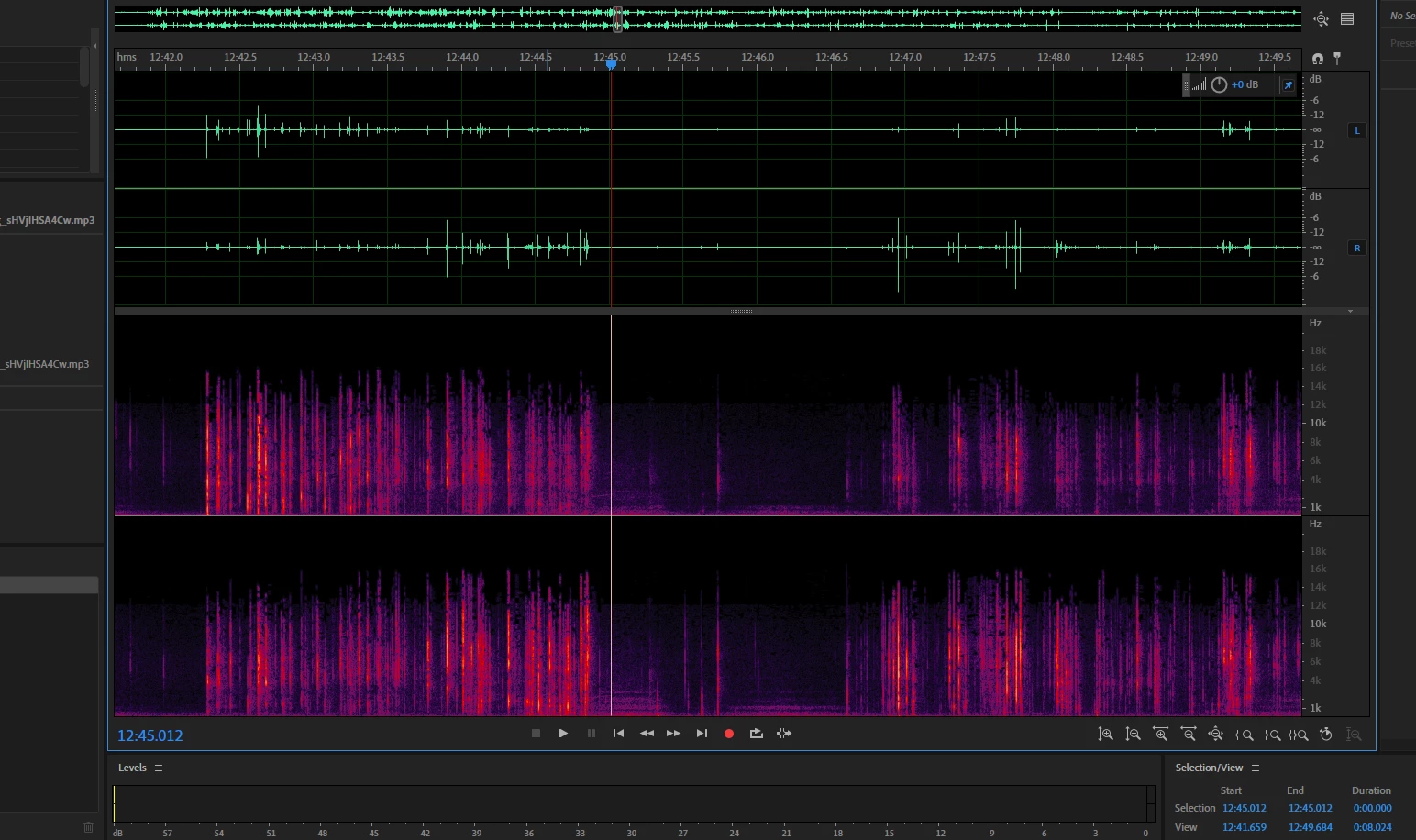
This topic has been closed for replies.

1 reply

SteveG_AudioMasters_
Community Expert
Community Expert
July 2, 2019

If you just use Noise Reduction (the process one, not the adaptive one) on the noise content, it will leave the signal alone. You will have to be careful how you set it up though, and you may need to use more than one pass.

Participant
July 2, 2019

I think noise reduction would "dim" the purple color in the frequency chart rather than totally eliminating them based on the decibel. I've attached another image to show the different levels of trims below. In the picture I highlighted the trimming at 20kHz, 16kHz, and 12kHz. The noise can be described more of a "removed" rather than "reduced."

I heard something called dynamic equalizer and I am not sure whether it will do the job. Is there such plug-in I can download for cc audition?

SteveG_AudioMasters_
Community Expert
Community Expert
July 2, 2019

MrTerrence  wrote

I think noise reduction would "dim" the purple color in the frequency chart rather than totally eliminating them based on the decibel.

So you haven't actually tried this then? Noise reduction is not determined by what you can see, or what you can measure, but what you can hear - that's the only important thing.

The whole purpose of noise reduction is to reduce the noise, and not the wanted signal. The way it's done is by analysing what's different between the noise and the signal statistically using a FFT. It's not the same as just reducing the levels at the frequencies you mentioned (or any others, come to that) and is the only way you can treat that sort of issue. No form of dynamic anything is going to do this job at all, never mind any better.