Hi @optimisticperson, as others have rightly said, there is no other way than adjusting by hand because Illustrator has no capability to judge properties such as the "visual weight" of an object. No doubt one day it will! Making disparate logos sit comfortably together is a task involving significant skill.
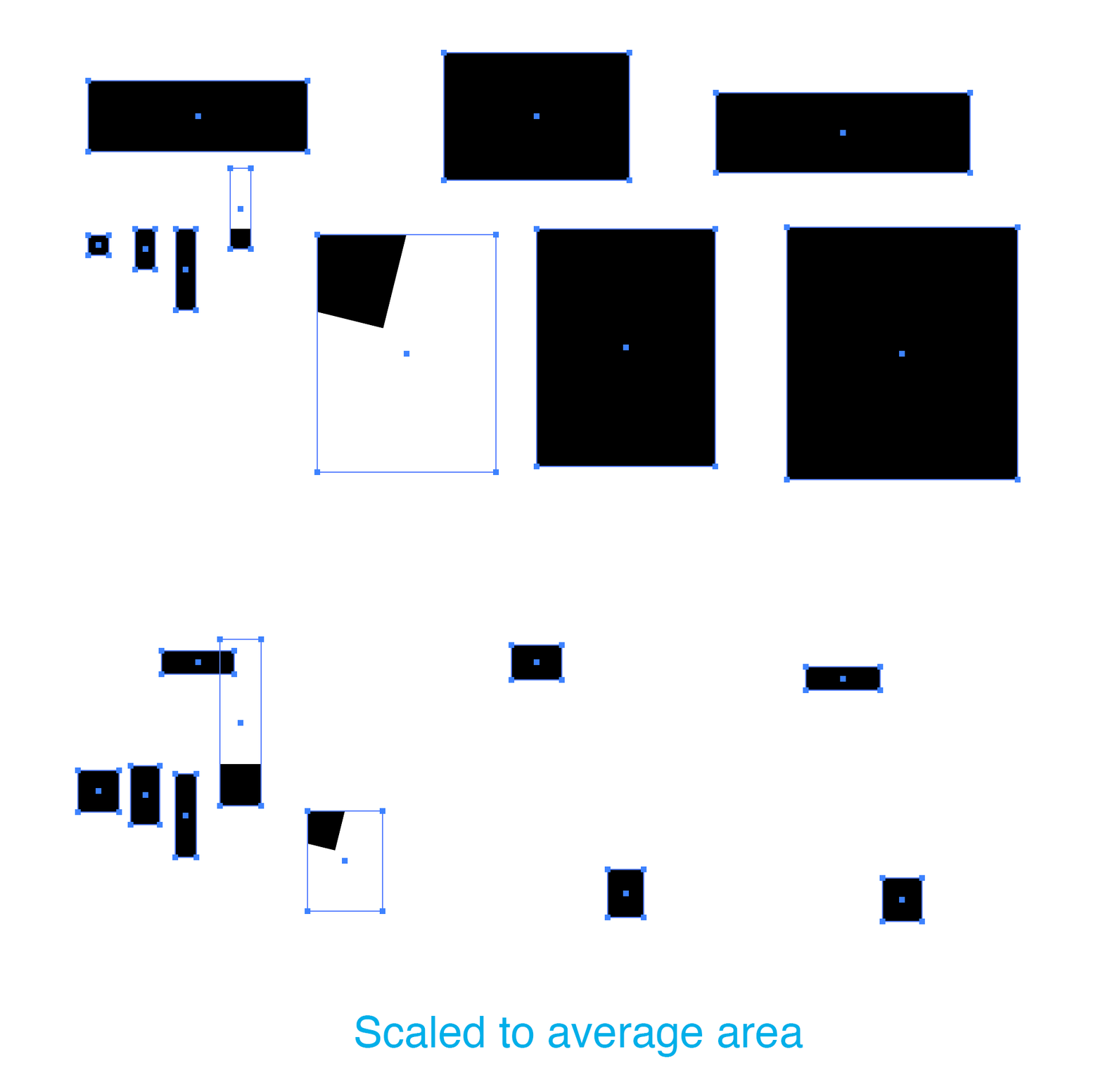
However, perhaps it would still save some time to give a rough approximation? I have written a script that scales the selected page items such that the area of each item's bounds matches the average area of all the items.
It won't do a great job, because the bounds of a logo isn't a good metric for the visual weight, but it might provide a starting point. Let me know if it is helpful.
- Mark
/**
 * @file Scale To Average Area.js
 *
 * Scales the selection such that the area
 * of each item's geometric bounds match
 * the average area of the selected items.
 *
 * @author m1b
 * @version 2025-02-24
 * @discussion https://community.adobe.com/t5/illustrator-discussions/how-to-automatically-resize-a-bunch-of-logos-so-they-re-visually-proportional/m-p/15168811
 */
(function () {

    var doc = app.activeDocument,
        items = doc.selection;

    if (0 === items.length)
        return alert('Please select some items and try again.');

    scaleItemsToAverageArea(items);

})();

/**
 * Scales each page item in `items` such that the area
 * of each item's geometric bounds match the average area
 * of the selected items.
 * @date 2025-02-24
 * @param {Array<PageItem>} items - the items to scale.
 */
function scaleItemsToAverageArea(items) {

    var areas = [],
        areaSum = 0;

    for (var i = 0, bounds, area; i < items.length; i++) {

        bounds = getItemBoundsIllustrator(items[i], false);
        area = (bounds[2] - bounds[0]) * -(bounds[3] - bounds[1]);

        areas[i] = area;
        areaSum += area;

    }

    var averageArea = Math.sqrt(areaSum) / items.length;

    for (var i = 0, scaleFactor; i < areas.length; i++) {
        scaleFactor = averageArea / Math.sqrt(areas[i]);
        items[i].resize(scaleFactor * 100, scaleFactor * 100);
    }

};

/**
 * Returns bounds of item(s).
 * @author m1b
 * @version 2024-03-10
 * @param {PageItem|Array<PageItem>} item - an Illustrator PageItem or array of PageItems.
 * @param {Boolean} [geometric] - if false, returns visible bounds.
 * @param {Array} [bounds] - private parameter, used when recursing.
 * @returns {Array} - the calculated bounds.
 */
function getItemBoundsIllustrator(item, geometric, bounds) {

    var newBounds = [],
        boundsKey = geometric ? 'geometricBounds' : 'visibleBounds';

    if (undefined == item)
        return;

    if (
        item.typename == 'GroupItem'
        || item.constructor.name == 'Array'
    ) {

        var children = item.typename == 'GroupItem' ? item.pageItems : item,
            contentBounds = [],
            isClippingGroup = (item.hasOwnProperty('clipped') && item.clipped == true),
            clipBounds;

        for (var i = 0, child; i < children.length; i++) {

            child = children[i];

            if (
                child.hasOwnProperty('clipping')
                && true === child.clipping
            )
                // the clipping item
                clipBounds = child.geometricBounds;

            else
                contentBounds.push(getItemBoundsIllustrator(child, geometric, bounds));

        }

        newBounds = combineBounds(contentBounds);

        if (isClippingGroup)
            newBounds = intersectionOfBounds([clipBounds, newBounds]);

    }

    else if (
        'TextFrame' === item.constructor.name
        && TextType.AREATEXT !== item.kind
    ) {

        // get bounds of outlined text
        var dup = item.duplicate().createOutline();
        newBounds = dup[boundsKey];
        dup.remove();

    }

    else if (item.hasOwnProperty(boundsKey)) {

        newBounds = item[boundsKey];

    }

    // `bounds` will exist if this is a recursive execution
    bounds = (undefined == bounds)
        ? bounds = newBounds
        : bounds = combineBounds([newBounds, bounds]);

    return bounds;

};

/**
 * Returns the combined bounds of all bounds supplied.
 * Works with Illustrator or Indesign bounds.
 * @author m1b
 * @version 2024-03-09
 * @param {Array<bounds>} boundsArray - an array of bounds [L, T, R, B] or [T, L , B, R].
 * @returns {bounds?} - the combined bounds.
 */
function combineBounds(boundsArray) {

    var combinedBounds = boundsArray[0],
        comparator;

    if (/indesign/i.test(app.name))
        comparator = [Math.min, Math.min, Math.max, Math.max];

    else
        comparator = [Math.min, Math.max, Math.max, Math.min];

    // iterate through the rest of the bounds
    for (var i = 1; i < boundsArray.length; i++) {

        var bounds = boundsArray[i];

        combinedBounds = [
            comparator[0](combinedBounds[0], bounds[0]),
            comparator[1](combinedBounds[1], bounds[1]),
            comparator[2](combinedBounds[2], bounds[2]),
            comparator[3](combinedBounds[3], bounds[3]),
        ];

    }

    return combinedBounds;

};

/**
 * Returns the overlapping rectangle
 * of two or more rectangles.
 * NOTE: Returns undefined if ANY
 * rectangles do not intersect.
 * @author m1b
 * @version 2024-09-05
 * @param {Array<bounds>} arrayOfBounds - an array of bounds [L, T, R, B] or [T, L , B, R].
 * @returns {bounds?} - intersecting bounds.
 */
function intersectionOfBounds(arrayOfBounds) {

    var comparator;

    if (/indesign/i.test(app.name))
        comparator = [Math.max, Math.max, Math.min, Math.min];

    else
        comparator = [Math.max, Math.min, Math.min, Math.max];

    // sort a copy of array
    var bounds = arrayOfBounds
        .slice(0)
        .sort(function (a, b) { return b[0] - a[0] || a[1] - b[1] });

    // start with first bounds
    var intersection = bounds.shift(),
        b;

    // compare each bounds, getting smaller
    while (b = bounds.shift()) {

        // if doesn't intersect, bail out
        if (!boundsDoIntersect(intersection, b))
            return;

        intersection = [
            comparator[0](intersection[0], b[0]),
            comparator[1](intersection[1], b[1]),
            comparator[2](intersection[2], b[2]),
            comparator[3](intersection[3], b[3]),
        ];

    }

    return intersection;

};

/**
 * Returns true if the two bounds intersect.
 * @author m1b
 * @version 2024-03-10
 * @param {Array} bounds1 - bounds array.
 * @param {Array} bounds2 - bounds array.
 * @param {Boolean} [TLBR] - whether bounds arrays are interpreted as [t, l, b, r] or [l, t, r, b] (default: based on app).
 * @returns {Boolean}
 */
function boundsDoIntersect(bounds1, bounds2, TLBR) {

    if (undefined == TLBR)
        TLBR = (/indesign/i.test(app.name));

    return !(

        TLBR

            // TLBR
            ? (
                bounds2[0] > bounds1[2]
                || bounds2[1] > bounds1[3]
                || bounds2[2] < bounds1[0]
                || bounds2[3] < bounds1[1]
            )

            // LTRB
            : (
                bounds2[0] > bounds1[2]
                || bounds2[1] < bounds1[3]
                || bounds2[2] < bounds1[0]
                || bounds2[3] > bounds1[1]
            )
    );

};





 AdChoices