olh21
Inspiring
June 23, 2017
Question

Smart Object with transform resizing problem

  • June 23, 2017
  • 6 replies
  • 9393 views

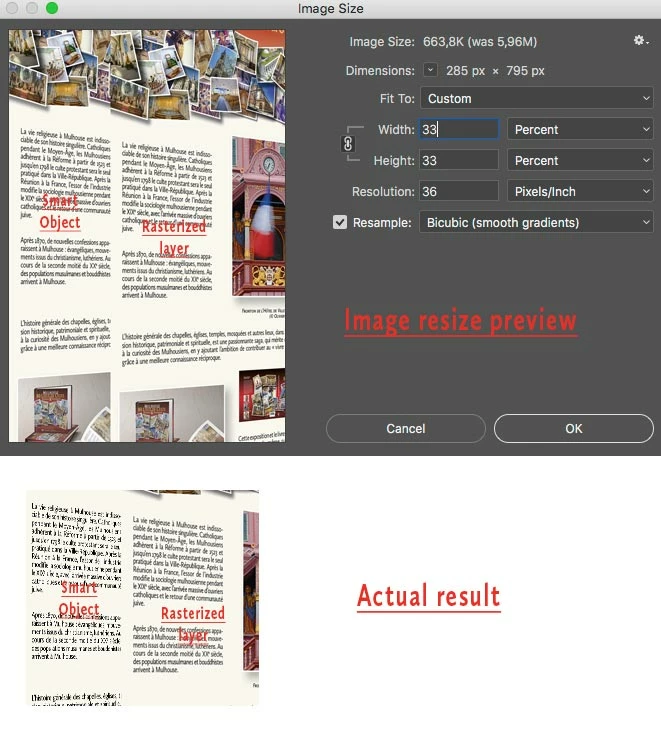
An embeded smart object with a perspective transform get jaggy line after a resize compared to a rasterize layer  but the resize preview is actually OK

(the smart object is from a PNG file)
This topic has been closed for replies.

6 replies

luzp59102677
Participant
February 3, 2018

I work in Photoshop for web production all day long and what you are describing sounds very familiar. It is an issue that manifest when a screen is skewed. Photoshop tries to remember every original detail and what ends up in the end is something with too much information and looks jagged. We apply a technique to solve the resolution issue.

"An embeded smart object with a perspective transform get jaggy line after a resize compared to a rasterize layer"

Try doing the following:

• After you do your smart object resize, make is a smart object again. Essentially you are wrapping it inside another smart object.

• Then go inside the new smart object. Inside is where you will adjust the image resolution.

• Using the "Image Size", increase the current resolution by multiplying it by 2. Example, if your image is 72ppi, increase it to 144ppi. (If you are dealing with something thats extremely angled then do this step twice. Example, 72ppi increases to 288ppi.)

• Then save and close the smart object so you are back to the main level of your Photoshop file.

JJMack
Community Expert
Community Expert
June 24, 2017

A Smart Object layer has some overhead.  They resize like a Raster layer however, if you may be resizing a raster layer more than once you should convert the raster layer to a smart Object before any resizing because they resize better than raster layer. Every time you resize a raster layer the layer looses some image quality the layer's quality degenerates some.  Though smart Object layers resize like raster layer via interpolation the smart object layer overhead preserves the layer quality.  The Layer pixels are not changed at all. just the rendering for the layers composite rendering is.   This transformation is always done from the layers pixels that where rendered by Photoshop for the object and these pixel are set in concrete they can not be changed.  The layers image quality does not degrade the current layer transform for the document composite may be poor if the transform size change is large.  For example if object is text and when Photoshop rendered pixels for the object text  and shapes become pixels its a raster layer.   If the text characters are rendered with a black line width of one or two pixels resizing the layer  to 33% would mean the text line width would be 1/3 or 2/3 of a pixel the transform will be awful you do not the pixels needed to do a good transform.  Do not crate object that you will transform too small or too big.   There is a range of size transformation  that will work work well with an object. resizing outside that range will produce unacceptable results.

The example 2500x2500 document where  I perspective transformed a smart object layer that contained text then resized then 2500x2500px document to 33% of that.  Resized the smart object not to 33% of the object size it resized it to 15% of its size.  For in the 2500x2500PX document the object was transformed to 47% in the document composite view.  

If you have a high quality object it can tolerate quit a large change in size.  If an image has a large about of detail like text does  you need a lot of pixels to record all the fine detail.  If you are constrain to some number of pixels you can record just so much detail.  The image quality is not as good as it could have been had you more pixels the to store more detail.   A digital image is stored in pixels. 

When you change an image size via interpolation you not changing it size by just changing its DPI resolution your doing it for displays they can not change their DIP their Pixel size is fixed. Your changing the number of pixels you render the image with.    Pixel is where the image details is.   If you reduce the number of Pixels you have to discard details you now have.  If you increase the number of pixels you have to create detail you do not have for the image. When you change an image size by changing the number  of pixels you loose some image quality.  

If you loose too much quality the image rendered will be unacceptable.    If you have a high quality Image it will have a lot of pixels finely recording all the image's detail.   A high quality image can withstand a large range of size changes.  UP or down in size the quality lost will not too much.   On the other hand if you have a lower quality image it will not be able to withstand a large change in size you be discarding too much of the little detail you now have.  If you enlarged you will not be able to create good details for you have too little detail to go on.

IMO you problem is you create low quality objects.

JJMack
olh21
olh21Author
Inspiring
June 23, 2017

JJMack
Community Expert
Community Expert
June 23, 2017

If you are being bitten by an Adobe bug there is noting you can do but report it and hope that Adobe will address the bug.

If you know doing something  is going to have problems and produce an unacceptable result.   Why do it?

It is one thing to be bitten by a bug you do did not ask to be bitten. Asking to be bitten is a different story. If you know there is a bug there avoid it work around it. The bug may still be there when your dead.

I have been using Photoshop Many years20+  I have invested a lot in Photoshop.  There is no alternative for me no one product can replace Photoshop and use what I have developed for Photoshop.  Heck I can now really state I use CC 2017 I don't CC 2017 bite what I have developed. I use CC 2014...

JJMack
olh21
olh21Author
Inspiring
June 23, 2017

I will lost hundred of hour of work because i was not aware of the bug.

Had i knew it before i wouldn't of course have made it that way

Now i will have to restart without the smart object

Now that i am aware that it is a bug i will act in consequence

I am just here to help OTHERS not to do the same mistake

For that i had to be sure that it is really a bug so some other people had to be able to reproduce easilly

And confirm the pb.

olh21
olh21Author
Inspiring
June 23, 2017

Same test done with the file TestResize.tif - Google Drive with Photoshop CC 2015,5 on another Mac computer leads to the same result.

Cris Cox admited here Photoshop: EPS or PDF Smart objects render badly (with jags) when being scaled or transformed. | Photoshop Family Custom… that a bug like this occured with PDF and EPS 4 years ago.

They say they corrected this but never investigated the general case. And M Cox is unfortunatly not part of Adobe anymore.

Is there someone from support that can help ?

JJMack
Community Expert
Community Expert
June 23, 2017

The problem I have with all you write. If you know there is a bug and that rasterized text does not interpolate well. Why do you want the Bug to bite and why do you rasterize text and then distort and resize the text through transforms interpolation.  Who knows if Adobe will ever fix the bug you let bit you, Why convert editable vector text to a raster image.  Why not convert it to a shape if you want to make it hard to edit.

Your post show that Image size was cropping your image on three sides. That does not happen on my machine there may be something corrupted on yours.

These do not show cropping just show that the rasterizing text then distorting and resizing  it does not work well and should be avoided. The smart obJect text may also be much larger then there other raster layer depends on the size of the actual object.

JJMack
olh21
olh21Author
Inspiring
June 23, 2017

The first post is a manual screen capture on wich I croped myself not to post the whole screen to show the problem

there is NO crop problem. it's just an extract of the actual picture

Second i do show the problem on text because it's more obvious but it happens on EVERY raster smart object you transform then resize

Typically if you are working with mockup or web interface an "export as" with resize you will have this problem.

Here for exemple i don't have the original image non raster images  and this is all part part of a complex workflow where i NEED smart object to be resized on a large batch of images.

It's basic use of photoshop for web design or mockup design to use smart object - if this does not work the complete workflow is just not usable.

Some people can be just confident in photoshop and get very bad result using this common workflow

Third the purpose of a forum is to post problem so that people facing the same problem can quickly stop loosing time trying to solve something wich is obviously not working. I am not posting that here for me or for you expecting to solve it. I am posting so that ADOBE get aware of the problem, so that other people gets informed of the problem and be carefull in their web design workflow involving smartobject.

I you want to help please run the test from my file on a window computer and tell me if you got the same result.

JJMack
Community Expert
Community Expert
June 23, 2017

Image size is not a cropping tool. It cans distort an image if the width and height are not constrained linked to each other. So it can not change the image's content it can just distort  the image's composition .  The Image Size Preview is just not showing the whole image because of the size of the preview window the zoom level of the preview image does not fit within the preview window.  Here I show an image size dialog with the preview image zoom set to 100% actual pixels. That number of pixels can not even fit on my display  and surely can  not fit in Image Size preview window. No resize has been set here yet. It is not a bug the zoom level.

JJMack
olh21
olh21Author
Inspiring
June 23, 2017

??? have you read my post really ?

JJMack
Community Expert
Community Expert
June 23, 2017

Image size can not crop or add content zoom out in the Preview to see all of the content.

JJMack
c.pfaffenbichler
Community Expert
Community Expert
June 23, 2017

As I understand it Smart Object instances are not calculated based on your Image Size Resample settings but based on the General Preferences Image Interpolation setting.

So you might have resampled the plain Layer with Bicubic but the Smart Object with Bicubic Automatic for example.

olh21
olh21Author
Inspiring
June 23, 2017

Yes I know that. And both are on Bicubique.

Morover it is a bug in itself that the preview not accurate.

Finally just look at the result ?? the resampling of the smart object is totally wrong... whatever bicubic method you use should not produce something like that.

c.pfaffenbichler
Community Expert
Community Expert
June 23, 2017

Finally just look at the result ?? the resampling of the smart object is totally wrong... whatever bicubic method you use should not produce something like that.

You seem to forget that the transformed pixel Layer is resampled twice (the transformation and the Image Size operation) whereas the Smart Object is resampled »once« (because it is resampled from the original data each time) in your scenario.
