Doc_Pit
Inspiring
August 17, 2018
Answered

Some help testing my perception of perspective
  • August 17, 2018
  • 4 replies
  • 1016 views

    This topic has been closed for replies.
    Correct answer Theresa J

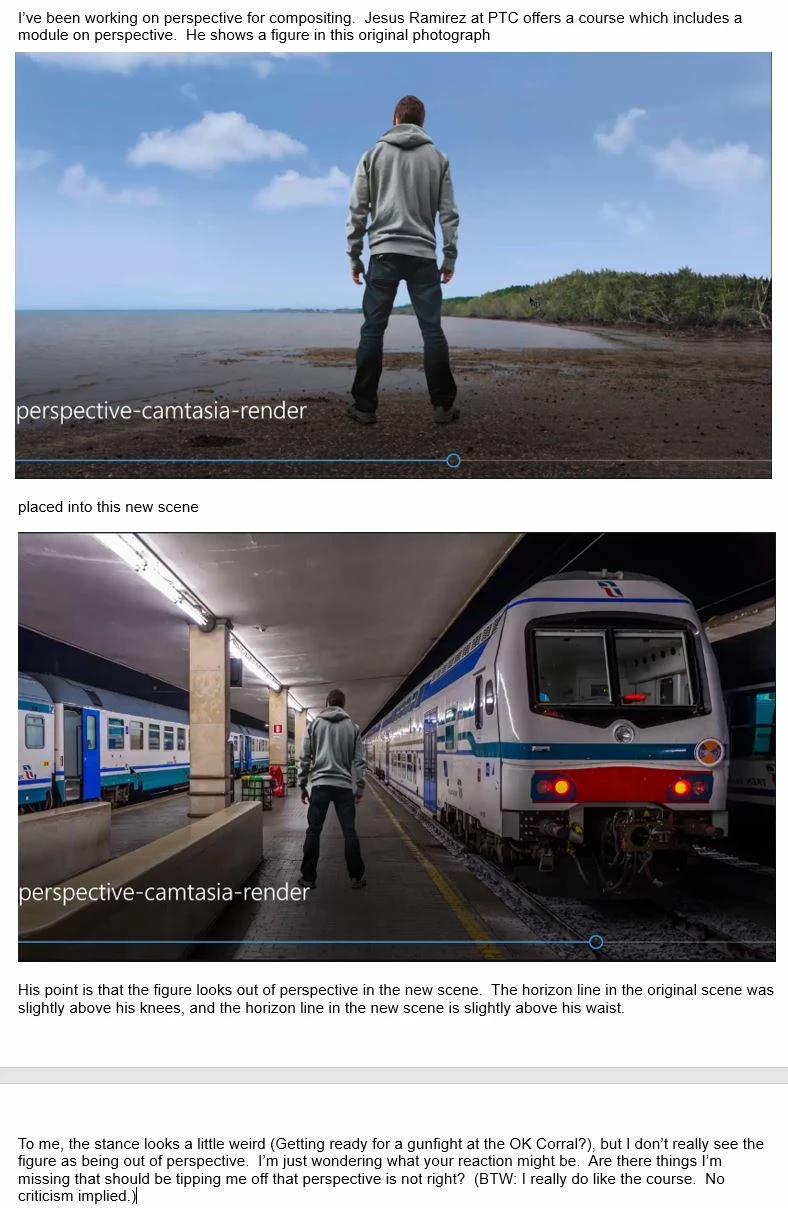
    Look at the shoulders of the figure. You don’t see the top of the shoulders. It looks to me like eye level is around the figure’s waistline or closer to his knees below. If you stand behind someone who is about your same height you will see the top of their shoulders because your eyes are above that.

    When you look at the train scene it’s from an average standing height. You can tell because the perspective lines disappear at about the height your eyes would be when standing by the train. This is why the figure doesn’t work in the second scene. The figure was photographed from a low angle while the train was photographed at a more standard standing height.

    4 replies

    Trevor.Dennis
    Community Expert
    Community Expert
    August 17, 2018

    Doc, this is how Bert Monroy works out perspective, and it  is a  lot easier than some of the aids we've seen.

    He places a two line path (three points) that roughly follow the image perspective, and drags the points to get a good fit

    All he needs do then, is use the Direct Selection tool to hover over the out points to move into a new position, and they will follow the correct perspective. The clever bit is that he copies and pastes the path back over itself, and moves the outer points of the copied path, and keeps doing so  till  he has built the guides for his painting.

    This has a single point perspective, so the horizon will pass directly through the vanishing point. However, we don't know that the camera was at  normal eye height for the shot, and even without the composited figure, it looks like the cameras was below eye height.

    The composited figure has a very strong look of being taken from a low angle, and if the top image is indeed the original for that figure, then the camera was just above his knees.

    Which means he is actually placed a little low in the station image.  So JR is being a bit pedantic, but  I don't think most  people would have an issue with the composite.

    So the issue comes down to can we accept that the camera was at this height when the figure was photographed?

    To me, without the context of the station giving the eye additional clues, it now looks wrong.  It looks like the camera was a lot lower than this, which in fact it was. 

    Doc, do you  use Lazy Nezumi Pro?

    Doc_Pit
    Doc_PitAuthor
    Inspiring
    August 18, 2018

    I've never tried it, Trevor, but I'll check it out.  I'm very partial to any product that has "Lazy" in the name.

    D Fosse
    Community Expert
    Community Expert
    August 17, 2018

    Yep. He's leaning forward, to the point of falling over. That's why it looks wrong.

    Theresa J
    Community Expert
    Theresa JCommunity ExpertCorrect answer
    Community Expert
    August 17, 2018

    Look at the shoulders of the figure. You don’t see the top of the shoulders. It looks to me like eye level is around the figure’s waistline or closer to his knees below. If you stand behind someone who is about your same height you will see the top of their shoulders because your eyes are above that.

    When you look at the train scene it’s from an average standing height. You can tell because the perspective lines disappear at about the height your eyes would be when standing by the train. This is why the figure doesn’t work in the second scene. The figure was photographed from a low angle while the train was photographed at a more standard standing height.

    Doc_Pit
    Doc_PitAuthor
    Inspiring
    August 17, 2018

    Theresa, your analysis is, frankly, keener than mine in terms of how you compare elements of that second picture.  So, you have opened my eyes a bit.  But, when I follow your analysis, I do get a different impression.  To me, the train appears to be photographed at a slightly lower angle; i.e., I'm looking up (slightly) at the train.  So, that comports with not seeing the top of the guys shoulders.  To D Fosse's point, his stance seems to me a bit strange in both photos, which, perhaps, is one difficulty I have in comparing perspective.

    Mylenium
    Legend
    August 17, 2018

    Neither of the answers so far considers horizontal perspective. The guy was clearly shot from the lower left with the focal point not even being on the guy, but glancing past his right shoulder. Hence he can never look 100% correct when forcibly being inserted anywhere else but on the right side of the image or being distorted/ painted on to compensate for this built-in perspective. No, he's not leaning forward, he's just not standing perfectly perpendicular in relation to the camera because of the way he was shot.

    Mylenium

    Semaphoric
    Community Expert
    Community Expert
    August 17, 2018

    Since the figure has shallow depth, and is not boxy,  the error in perspective is not too bad. The only part that, to me, really gives it away are the legs and feet - kinda looks like he's leaning forwards a bit. Both of these are one-point perspective, with the subject centered, which is a very forgiving situation.

    Another thing is the first scene looks to be shot with a rather wide angle lens, and there is a bit of barrel distortion (not a lot), and in the second scene he is moved a bit further back, which adds to the "leaning forwards" effect.

    All this is pretty subtle, and as a  casual viewer, I probably wouldn't have noticed.
