
Participant
December 22, 2023
Question

Assistive technology problem with Khmer font

  • December 22, 2023
  • 4 replies
  • 4739 views

Hi there, 


I create healthcare documents in a variety of languages that must be reviewed for accessibility for screen reader users before publishing. I have run into a problem with a document translated into Khmer (Cambodian) - this was created in Word and then saved as a PDF, but this problem is happening even when I create documents from scratch in Adobe. [I am using Adobe Acrobat Pro - version 2023.006.20380]


The font looks perfect on the PDF page, but in the content tool, the text in the containers is showing up interspersed with diamond question mark characters: �. According to my accessibility team, these characters will not be announced accurately by assistive technology - meaning we're stuck. 


  • I've tried downloading multiple types of Khmer fonts
  • I've tried creating the document from scratch in Adobe rather than saving from Word 
  • I've made sure that the downloaded fonts are saved in C:\Windows\Fonts
  • I saw some potentially relevant advice to embed fonts and I followed the instructions here: https://www.adobe.com/uk/acrobat/resources/embed-fonts-in-pdf.html but although the font is showing up in the main PDF editor, it doesn't show up in the menu for embedded fonts. Could this be the problem? (screenshots below)


Thank you for any advice you can provide, this has been a frustrating roadblock! 
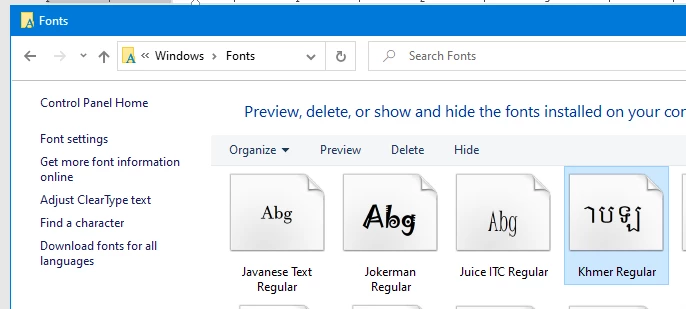


Font is installed... 


...but doesn't show up on this embedding list

4 replies

Participating Frequently
May 16, 2025

Anyone find a solution to this issue? Same exact thing is happening to me and I've installed all the Khmer fonts under the sun. Thank you very much!

AnandSri
Community Manager
Community Manager
May 16, 2025

Hello @karmenc!


I hope you are doing well, and thanks for reaching out.


Acrobat’s built-in accessibility/screen-reader support doesn’t pick up system‐installed Khmer fonts unless the PDF itself carries a proper Unicode “ToUnicode” CMap for every glyph. Simply installing every Khmer font on your PC won’t fix a PDF that was created without embedding those mappings. Have you tried the suggestions and the solution shared in this thread? 


Verify & embed the fonts with ToUnicode maps
Open your PDF in Acrobat Pro.

Go to All Tools → Print Production → Preflight.

Click the Fixups wrench icon, then expand Fonts & Transparency (or search for “embed”).

Choose “Embed missing fonts” and make sure the option “Embed Unicode mapping (ToUnicode)” is checked.

Run the fixup, save the PDF, and test again in your assistive‐tech tool.

That injects the actual font programs and the Unicode mapping that screen readers need to speak or export Khmer text correctly.


Check Acrobat’s Accessibility settings
Even with a correct PDF, make sure Acrobat isn’t blocking assistive tech:

Menu → Preferences → Accessibility

Under “Enable assistive technology support,” tick the box.

Under “Reading Order,” ensure it’s set to “Infer reading order from document structure.”


Test with Adobe’s Accessibility Checker
In Acrobat Pro: All Tools → Accessibility → Full Check

Run the check and expand the “Fonts” and “Tags” results.

It will call out missing or non-Unicode-mapped fonts.


Once the PDF truly carries embedded Khmer fonts and their ToUnicode CMaps, any assistive-tech tool (or the “Read Out Loud” feature in Acrobat) will be able to render and pronounce the text correctly—regardless of what you’ve installed on your desktop.


I hope this helps.

Thanks,

Anand Sri.

Participating Frequently
May 16, 2025

Thank you, Anand. I have tried all the tips on this page and now all the tips you just provided. I have also tried: 

preflight, converting to Word then back to PDF, retagging, and running the doc through postscript. 


None of these things work. Here is my file if you'd like to troubleshoot.

Participant
April 1, 2024

I'm having the same problem, though my original document is in InDesign. Interestingly, the Khmer alt-text comes through just fine, with all characters & modifier characters intact. Following advice from this forum, I tried setting the "subset fonts when % of font used is less than X" to 1%, and rolling back to InD 18.5, but neither made a difference.

(Note, rolling back to 18.5 was helpful for a similar problem with Hindi, so it may work if you encounter this problem with languages that use devengari script). 

Participant
February 6, 2024

Hello Hayley,

We are also encountering the same issue. Any chance you/your team found a way to fix the issue? Please let us know. We are also using MS Word and when we create a PDF using the Acrobat 'Create PDF' option, we see the same output as the screenshot you have provided. But, if we create a PDF using the 'Save As' option, the diamond question marks will disappear but some characters will show up as dotted circles instead, which means the characters are still corrupted.


Also, the fonts are already embedded in the PDF but the characters still show up as corrupted. If you cannot find the font you used from the list, you can add it manually, the same as in the screenshot below. Unfortunately, this still doesn't fix the issue.


Thank you very much and hoping to hear some answers/advice.

An Pennino
Participant
January 2, 2025

Hi!


Were you being able to fix the problem? I am working on a flyer InDesign Khmer document using Noto Sans Khmer font. Based on my poor understanding, the main problem must not be the fonts since the it looks perfect on the PDF page, but in the content tool, the text in the containers is showing up interspersed with diamond question mark characters: �. Therefore, it is an interface problem.

Participating Frequently
May 16, 2025

Hi An, since your comment is from 2025 I'm hoping you were able to find a solution. Did you figure this out? Thank you!

Abambo
Community Expert
Community Expert
December 24, 2023

The Khmer fonts are embedded in the document attached (Ctrl/CMD D ; Fonts)


It just looks like certain “modifiers” are not correctly shown. It's the first time I have seen Khmer text as this, so my observation may be utterly wrong.


ABAMBO | Hard- and Software Engineer | Photographer