Correct answer ls_rbls

++Adding to the discussion,


The "SHIFT+ALT+ CTRL" method does not reset Acrobat like other Creative Cloud applications. That is a guidance that is referenced in the Adobe Acrobat Help Center( Adobe HelpX)  for Adobe In-Copy.


In addition, in more recent updates Adobe has been blocking and reassigning keyboard combination shortcuts that used to be exclusivley dependent on the ESC or CTRL  keys. You'll notice that tgey don't work anymore like they used to.


Your screenshot also shows that you are using Micrososft Windows 11, in which case you must be aware that not all of the features that used to work  well for a 32 bit or 64 bit version of Adobe Acrobat Pro on a Windows 10 computer will work well with a Windows 11 version (the same is true for other Microsoft applications, not just Adobe's).


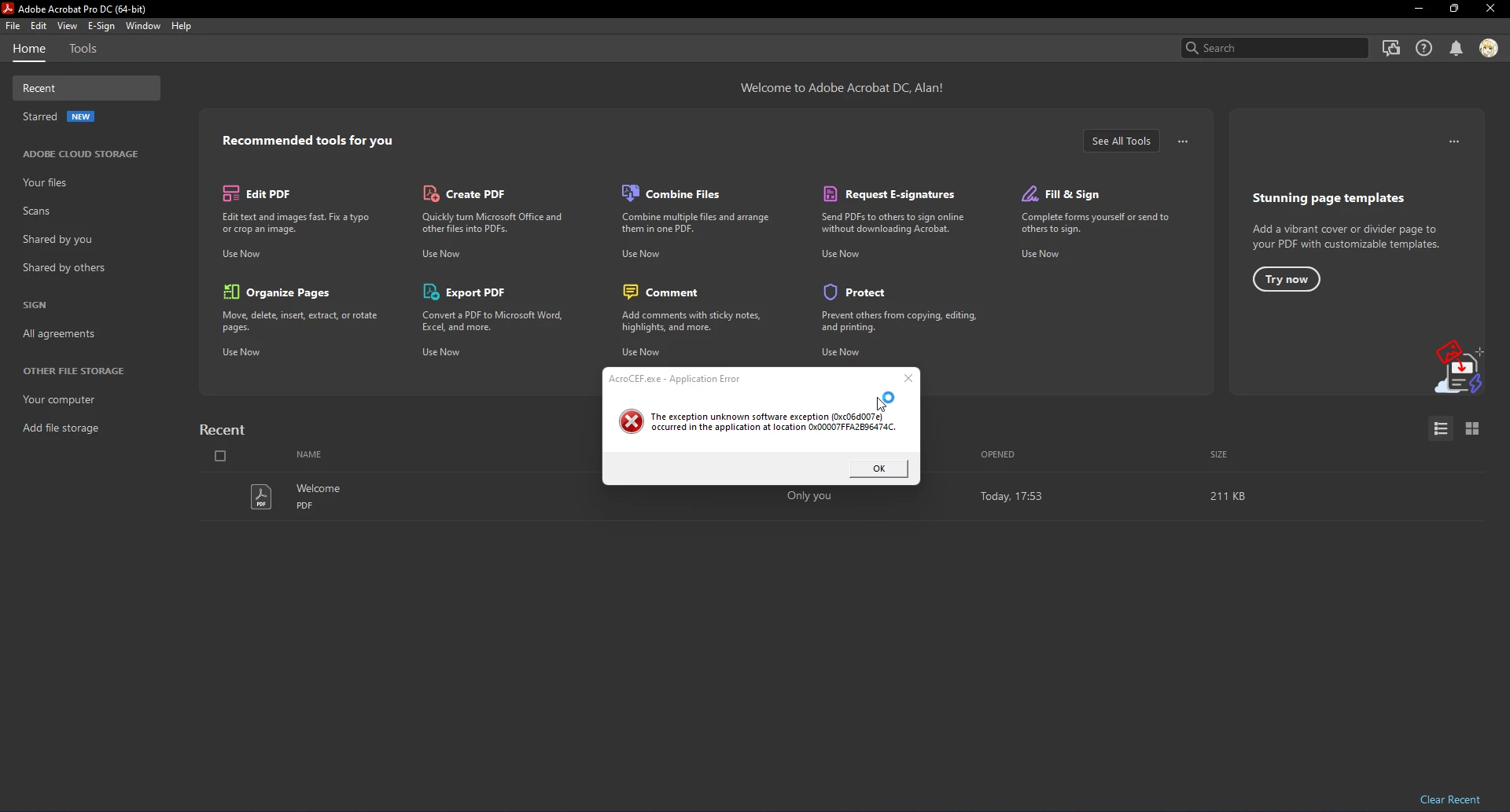
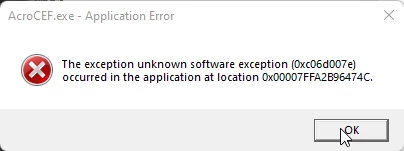
In any case, in order to understand the error that you're getting you must also understand what AcroCEF executable is, what is it used for, and how many other processes depend on it.


Acording to Adobe HelpX you may try to repair the installation, or perform an uninstall / reinstall and the problem should go away.


However, this is not the same as "Resetting the preferences" so the whole concept shouldn't be used interchangeably because the procedures are entirely different, hence resetting Acrobat nor uninstalling and reinstalling may not resolve the issue at all.


For example, wether you choose to repair an installation or uninstall the software completely and reinstall it, there is a bunch or orphan files that stay present in other document cloud cache folders, temporary cache folders and system startup files. This also implies third-party dynamic link libraries (.dll) that remain associated with old traces of your Acrobat after it is uninstalled.


For macOS users, there is no repair insrallation option, so they must manually troubleshoot the cache folders, for example. Nevertheless, if resetting Acrobat preferences to their defaults is your approach, the best way to do it is manually (be advised that these may not be a trivial task).


In Micrososft Windows you can do the same by moving the contents of your Adobe Acrobat cache folders to a different location.


Look in:


  • C:\\Users\"your current user account name"\AppData\Local\Adobe


  • C:\\Users\"your current user account name"\AppData\Local\LocalLow\Adobe   <<<---AcroCEF cache is here


  • C:\\Users\"your current user account name"\AppData\Local\Roaming\Adobe   <<<---Acrobat Preferences and User preferences here


Once you restart your computer, Acrobat will recreate these temporary folders and files again. If this works you can compare the old cached files with the new cached files to spot discrepancies. 


Be aware, that you won't be able to move a cached content out of its cache location n until all processes that are currently associated with Acrobat are terminated.


You may use the Task Manager to end all Creative Cloud and Acrobat's related processes. And for troubleshooting purposes, I would also suggest to go to the "Startup" tab of the task manager and disable all of Adobe's startup programs (you can always enable them again if you need to).


You may also want to get in the habit of clearing the Windows Temp folder periodically:


C:\\Users\"your current user account name"\AppData\Local\Temp


2 replies

ls_rbls
Community Expert
ls_rblsCommunity ExpertCorrect answer
Community Expert
July 24, 2022

++Adding to the discussion,


The "SHIFT+ALT+ CTRL" method does not reset Acrobat like other Creative Cloud applications. That is a guidance that is referenced in the Adobe Acrobat Help Center( Adobe HelpX)  for Adobe In-Copy.


In addition, in more recent updates Adobe has been blocking and reassigning keyboard combination shortcuts that used to be exclusivley dependent on the ESC or CTRL  keys. You'll notice that tgey don't work anymore like they used to.


Your screenshot also shows that you are using Micrososft Windows 11, in which case you must be aware that not all of the features that used to work  well for a 32 bit or 64 bit version of Adobe Acrobat Pro on a Windows 10 computer will work well with a Windows 11 version (the same is true for other Microsoft applications, not just Adobe's).


In any case, in order to understand the error that you're getting you must also understand what AcroCEF executable is, what is it used for, and how many other processes depend on it.


Acording to Adobe HelpX you may try to repair the installation, or perform an uninstall / reinstall and the problem should go away.


However, this is not the same as "Resetting the preferences" so the whole concept shouldn't be used interchangeably because the procedures are entirely different, hence resetting Acrobat nor uninstalling and reinstalling may not resolve the issue at all.


For example, wether you choose to repair an installation or uninstall the software completely and reinstall it, there is a bunch or orphan files that stay present in other document cloud cache folders, temporary cache folders and system startup files. This also implies third-party dynamic link libraries (.dll) that remain associated with old traces of your Acrobat after it is uninstalled.


For macOS users, there is no repair insrallation option, so they must manually troubleshoot the cache folders, for example. Nevertheless, if resetting Acrobat preferences to their defaults is your approach, the best way to do it is manually (be advised that these may not be a trivial task).


In Micrososft Windows you can do the same by moving the contents of your Adobe Acrobat cache folders to a different location.


Look in:


  • C:\\Users\"your current user account name"\AppData\Local\Adobe


  • C:\\Users\"your current user account name"\AppData\Local\LocalLow\Adobe   <<<---AcroCEF cache is here


  • C:\\Users\"your current user account name"\AppData\Local\Roaming\Adobe   <<<---Acrobat Preferences and User preferences here


Once you restart your computer, Acrobat will recreate these temporary folders and files again. If this works you can compare the old cached files with the new cached files to spot discrepancies. 


Be aware, that you won't be able to move a cached content out of its cache location n until all processes that are currently associated with Acrobat are terminated.


You may use the Task Manager to end all Creative Cloud and Acrobat's related processes. And for troubleshooting purposes, I would also suggest to go to the "Startup" tab of the task manager and disable all of Adobe's startup programs (you can always enable them again if you need to).


You may also want to get in the habit of clearing the Windows Temp folder periodically:


C:\\Users\"your current user account name"\AppData\Local\Temp


Alan25363469b0c9
Participant
July 26, 2022

I clear all about acrobat's file and reinstall it, and then acrobat can work properly

ls_rbls
Community Expert
Community Expert
February 8, 2023

it sees that i only have adobe acrobat 64 bit installed and no DC like in the link ( https://helpx.adobe.com/acrobat/kb/problems-uninstalling-reader.html )

So i will try to deinstall it and clean it up. Do you know which files i also have to delete after the cleanup tool to ensure everything is gone?


I see that you have the Adobe Creative Cloud(CC) installed.


You're welcome.


You may want to double-check if you've installed Acrobat Pro through the CC app before and then downloaded the Acrobat Pro at a later time and installed it from a different download source (just huessing in the blind). This is also a common cause of similar issues like yours.


And since you have many Creative Cloud apps you may also want to try this tool:


This tool may be advanced, so some careful reading is advised.


As for the AcroCleaner tool it may run silently and do its cleanup duty automatically; it is very stright forward after you deploy it.


One more thing that I forgot.


Since you are using the Adobe Creative Cloud and Acrobat is using the Adobe Document Cloud, it may also be convenient to reset the Windows Credential Manager cache.


For some reason, when Microsoft Windows makes use of cloud services for long periods, the file synchronization service seems to break.


To rule out if that would be your case, before you uninstall or run the cleanup tools, go to the Control Panel ==>> Credential Manager


There are two credentials caches of interest:


  • Web Credentials
  • Windows Credentials


Click on Windows Credentials; a list of generic credentials will be displayed. You may need to backup  that list and then remove manually all of the listed credentials. Then restore from the backup.


In my case I just delete everything, and the next time a cloud service is invoked it will just ask for username and password as if you were signing in to a service for the first time.


After that you should have a solid workflow. This is true for users that I hava assisted before with OneDrive or Sharepoint cloud services issues.


See if this approach works for you.


Geоrge
Legend
July 23, 2022

The quick way of resetting on a PC which is to hold down Ctrl + Alt + Shift when launching Acrobat and respond affirmatively when asked if you want to reset.

Remember, never say you can't do something in InDesign, it's always just a question of finding the right workaround to get the job done. © David Blatner
Alan25363469b0c9
Participant
July 23, 2022

nothing happens when i hold Ctrl + Alt + Shift

Geоrge
Legend
July 23, 2022

Double click on Acrobat icon and then press and hold fast CTRL+ALT+SHIFT


Remember, never say you can't do something in InDesign, it's always just a question of finding the right workaround to get the job done. © David Blatner