
JohnVo
Inspiring
January 12, 2022
Question

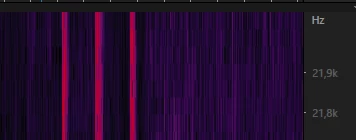
why spectral view is always stuck at 21k ? is there a way to raise up/increase the display Hz?

  • January 12, 2022
  • 1 reply
  • 954 views

Hi

may I know why audition cc spetral view is always stuck at 21K on my recording flac ?

I was thinking that audition cc  does read the audio and does show the spectral view according the audio loaded but i guss i'm wrong

I set spletracal view prerefences to default (resetting the preferences , i have created a backup before)

window function Blackman-Harris

spectral resolution 512

decibel 132

is there a way a way to increase the the display Hz?

you can see in the screenshot there is audio above the 21.9kHz

thanks
 

This topic has been closed for replies.

1 reply

SteveG_AudioMasters_
Community Expert
Community Expert
January 12, 2022

What you see is related entirely to the sample rate of your audio. If it's a 44.1k file, then the top of the scale will be at 22.05kHz, which is almost certainly what yours is. This is determined by the Laws of Physics - you may think that there's audio above that frequency but a) there isn't and b) you couldn't hear it anyway!

JohnVo
JohnVoAuthor
Inspiring
January 12, 2022
quote

What you see is related entirely to the sample rate of your audio. If it's a 44.1k file, then the top of the scale will be at 22.05kHz, which is almost certainly what yours is. This is determined by the Laws of Physics - you may think that there's audio above that frequency but a) there isn't and b) you couldn't hear it anyway!


By @SteveG_AudioMasters_

Hi Steve

yes it's a cd so 44.1k 16bit track

I have 2 questions

1)

"you may think that there's audio above that frequency but a) there isn't and b) you couldn't hear it anyway!"

so in the 2 red lines (in the screeshot) above 21.9k there is no audio in that frequency

2)

just to understand the audition cc spectral view ,if i load an high res audio clip recored at 96k /24bit  audiction will show an higher frequency scale ,maybe not higher like 96k but higher than 21k

in short with an audio 96k/24bit clip ,it will show an higher scale according the audio  in that file ,

a 96k/24 clip with  audio frequency around  48k , the scale will be  higher or around 48k

thanks Steve


JohnVo
JohnVoAuthor
Inspiring
January 13, 2022

Even if there was sound above 22.05kHz present before it was recorded, it wouldn't have been recorded anyway. If you really want to know why, you have to look at sampling theory and Nyquist - but the bottom line is that the highest frequency you can record at any given sample rate is half of that sample rate. And you couldn't hear it, because the human hearing range, even in young adults, doesn't extend beyoind about 20kHz.


Yes, if you record at 96k (the bit depth is irrelevant) you will see a frequency range displayed up to 48kHz. There are a number of issues with this, though; Firstly you couldn't hear any of them, secondly the equipment to capture them is esoteric and expensive, and thirdly there is virtually nothing around that will reproduce anything much above 25kHz into air anyway. If you record at 96k using 'normal' equipment you will end up with files twice the size they need to be, and anything you record in that upper space will be no more than noise.


Back in the days when analog to digital conversion didn't happen the same way it does now, there was a need to use what is called a 'brick wall' filter to remove any content above 21kHz if you recorded at 44.1k, and this was to prevent aliasing from occuring. Unfotunately these had a bit of a 'sound' to them and things generally sounded slightly better if recorded at a higher bit rate - just to get over that particular issue. But modern converters use massive amounts of what's called 'oversampling' (anything up to 64x the sample rate) to get over this problem completely, so there is now absolutely no justification whatsoever for recording at anything higher than a 48k sample rate. That's generally regarded as the standard for video sound, whilst 44.1k is the standard for CDs and broadcasting. Technically it could all be 44.1k, of course.


Hi Steve

First, i get always great information by you

I know about the human ears limit


quote

"Back in the days when analog to digital conversion didn't happen the same way it does now, there was a need to use what is called a 'brick wall' filter to remove any content above 21kHz if you recorded at 44.1k,and this was to prevent aliasing from occuring"

Audition cc has high pass filter , should be the "brick wall" filter ?


quote

"so there is now absolutely no justification whatsoever for recording at anything higher than a 48k sample rate"

So Steve , the hi res music  release are unless outside for a german sheppard ( a dog that loves music)

I have listened some hi-res music on very expansive equipement , and they sound better than the normal cd , I guess they master them in a different way , I mean to justify the purchasing , I guess they use a different EQ, and some other tricks to let some of them play a bit better


thanks Steve