Srishti Bali
Community Manager
Community Manager
August 21, 2020
Answered

How to save high quality images (JPEGs/ PNGs) from Illustrator?

  • August 21, 2020
  • 11 replies
  • 199707 views

Getting blurry or dull images after exporting from Illustrator? Use these simple tricks to save high quality images from Illustrator

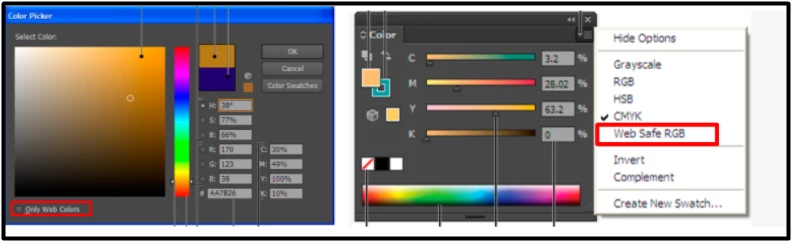
  • Choose colors wisely. If the files are to be displayed on web or other devices, set the Document Color Profile to RGB.
    It is always recommended to choose “Web safe colors”. These are used by all web browsers, regardless of the platform.


  • Export settings for JPEGs and PNGs


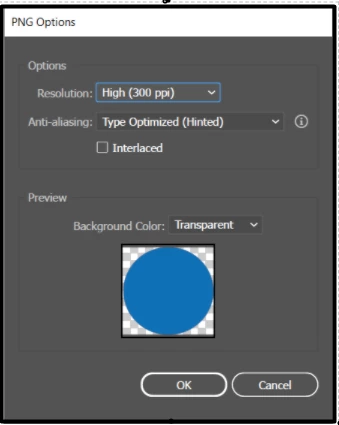
  • Anti-aliasing: This option is used for smoothing of jagged edges in digital images by averaging the colors of the pixels at a boundary. This setting removes jagged edges in the artwork by super-sampling it. You can select one of these 2 options.
    • Art Optimized: Use this option, if you have downscaled the pictures in Illustrator.
    • Type Optimized: Use this option, if your artwork comprises mostly text. When the Type Optimized option is selected, anti-aliasing is applied to the text edges, making them a lot smoother.

  • Resolution: An image with a higher PPI tends to be higher quality because it has a greater pixel density but exporting at 300 PPI is generally considered industry standard quality.


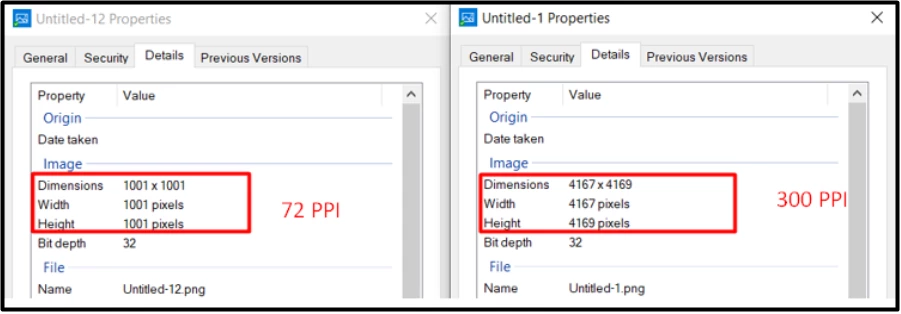
  • For actual size choose 72 PPI: If you are exporting an image 1001x1001 Px at 72 PPI, result will be 1001x1001 Pixels, but if we export the similar image with 300 PPI, dimensions of end result will be 4167x4169 Pixels.
 

For JPEG format, we have these extra options:
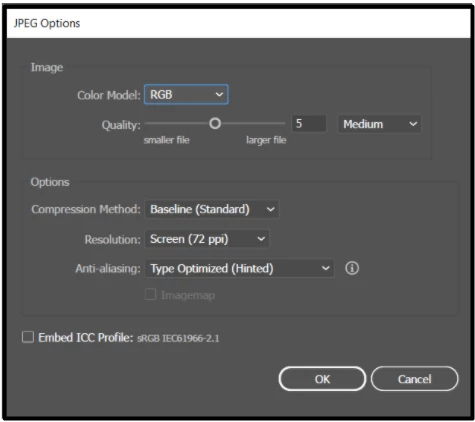


  • Balance image quality with file size (JPEG only). The higher the Quality setting, the more detail is preserved in the optimized image, but the larger the file size. View the optimized image at several quality settings to determine the best balance between quality and file size.


  • Compression Method (JPEG only):
    Baseline Standard is used when you want your JPG to be recognizable to most web browsers. It is basic and, well standard! It makes the least amount of changes to your image. All web browsers support it.
    Baseline Optimized optimizes the color quality of the image and produces a slightly smaller file size (2 to 8% - a little more compression, or slightly faster loading). All modern web browsers support it.


  • Embed ICC profile (JPEG only) If your file needs to be viewed on other applications. Select this option. Saves ICC profiles in the JPEG file An ICC profile allows you to be sure that an application will correctly color match the file.


Please refer to this help article for more details and other file formats.

Correct answer Mohammad.Harb

You can also use Export for screen and set the scale to 2x , 3x, ..

11 replies

Participant
July 30, 2022

Very helpful, thank you. Despite searching online and asking around, I still don't know how to determine (without printing tests) the minimal quality image setting (1-10) that would guarantee a very good quality print. 

I design minimalist and complicated artwork for wall decor with one, couple, or many colors. I use 300ppi and the artboard size as required for the printed outcome.  Then I do Export As in  JPEG (client wish), CMYK, 300ppi.

In order words, I'm looking for answers to questions like. Does the lowest quality setting result in a very good quality very good print of any of my JPEGS designs? If not, then when and how much to increase the quality image number setting in order to obtain just large enough files that give crispy, sharp, and color-true prints? I appreciate any tip, advice, or thought. Thank you.

Participant
June 15, 2021

Why does Adobe make you struggle so much to get a good image? Seems like this should be the default. I can do a poor image in Powerpoint with a lot less headache.

Monika Gause
Community Expert
Community Expert
June 15, 2021

I don't know which struggle you are referring to.


So maybe you tell us about your specific issue?

Participant
August 23, 2021

where is my head-banging emoji when I need it??!!!!!!

Known Participant
May 28, 2021

Hello! Sorry I am so late to the party but I am trying to understand how to get the best quality PNGs of my illustrator files. REgarding this point:


  • Resolution: An image with a higher PPI tends to be higher quality because it has a greater pixel density but exporting at 300 PPI is generally considered industry standard quality.


  • For actual size choose 72 PPI: If you are exporting an image 1001x1001 Px at 72 PPI, result will be 1001x1001 Pixels, but if we export the similar image with 300 PPI, dimensions of end result will be 4167x4169 Pixels.


    So what if the intended size of the image is 1000 x 1000 pixels, but you want really good quality, so you export at 300 PPI. You now have an image triple the size in pixels. In theory,  can it still be used? Say it was for a document or page that specified 1000 x 1000 pixels. When it is used, will the 300 PPI quality be maintained? Is another option resizing it back in Photoshop? What is the best way to do that?

    Thanks! 
Monika Gause
Community Expert
Community Expert
May 28, 2021

When placing something into a print layout, the artwork isn't measured in pixels, but in mm/cm/m (or inches in that one non-metric country).

The optimum resolution (pixel density) depends on the printing process. Can be much lower than 300 ppi (for large format printing) and can be much higher (for highres printing of calendars, museum catalogs or the like). So you always have to discuss the optimum with your printing service.

When you place an Illustrator file into a layout application, then you should question yourself why you convert it to pixels at all.

When producing artworks for the web, only the pixel dimensions matter. Your web developer should be able to tell you which dimensions produce best quality and also cost low bandwidth. This needs to be balanced and you might need to live with lower quality in order to enable folks to see your content at all.

When producing artworks for print on demand services such as redbubble or zazzle, they usually tell you the pixel dimensions of the artwork, because they know that a lot of their clients don't understand resolution anyway. They usually also tell you the resolution of the file, because they don't understand resolution either. But when you have the pixel dimesnions, then you don't need the resolution. It doesn't matter in order to get sufficient quality for printing.


With Illustrator, when you want to export a raster image with the same dimensions as the artboard, then you have to export at 72 ppi. That is how the software works.


Known Participant
May 31, 2021

Thank you, Monika! This is excellent!

dunnamin
Participant
May 8, 2021

This is valuable, so thank you.


Please consider incorporating any suggestions, additions, or corrections in Replies with a shout out to those whose ideas/suggestions you use. Most of us won't read the replies and would like the info, the commentors are made famous by the mentions so won't mind.

Known Participant
March 16, 2021

I now have spent more time trying to export sharp JPG's (it's what the client insists on having) than on doing the actual design work. I see all kinds of people trying to solve this for what looks like a huge number of people having the same issues. I'm completely exasperated as to why in these days where pretty much all design has to be screen compatible, Adobe is apparently oblivious to what is a huge FAIL. I've been doing this for over 20 years so I'd like to think I know what I'm doing and I don't recall this being an issue in older versions of the software, so I don't accept that this is anything else than Adobe's incompetence. This SHOULD BE EASY. To make matters worse, less experienced designers I know, are able to generate crisp images using new apps I in the past have discounted as silly, which, as you might imagine is just a wee bit embarrassing! I think perhaps I've given too much of my love to Adobe over the years and it's time to dedicate a few days to evaluating alternatives. 

Monika Gause
Community Expert
Community Expert
March 16, 2021

Could you perhaps tell us some details of what is working and what is not?


Screenshots help explain the issue.

Known Participant
March 16, 2021

Hi Monika, Thanks but I've seen you on here in numerous posts trying to solve the problem, unsuccesfuly I'm sorry to say. I'm outta time so going with the "open in Photoshop" workaround, which is beyond ridiculous when you consider how long Adobe's been around and had time to make this obvious requirement easy. I seriously am going to see what else is out there. I'm tired of stupid bells and whistles being added, but basic functions being completely ignored year after year. If there was a simple solution all one would need to say is what everyone is saying, vector art in illustrator is exporting as useless and fuzzy. 

Brian Gibbs
Participating Frequently
August 27, 2020

Why not just drop the illustrator file onto Photoshop? set size etc... easy

Participating Frequently
March 22, 2022

It doesn't work if you have multiple artboards, and want to export them all separately. Or am I wrong?

Participant
August 26, 2020

Thank you so much for the info!!


Kind Regards

Srishti Bali
Community Manager
Community Manager
August 24, 2020

Thank you so much Monika, Ton and Mohammad for adding these wonderful suggestions. This will surely help our users.


Regards!

Mohammad.Harb
Community Expert
Mohammad.HarbCommunity ExpertCorrect answer
Community Expert
August 23, 2020

You can also use Export for screen and set the scale to 2x , 3x, ..

Participant
October 9, 2020

Wow, that was so helpful. What did it do differently (as opposed to export for web)?

Ton Frederiks
Community Expert
Community Expert
August 21, 2020

Let me add another thing:

"For actual size choose 72 PPI: If you are exporting an image 1001x1001 Px at 72 PPI, result will be 1001x1001 Pixels, but if we export the similar image with 300 PPI, dimensions of end result will be 4167x4169 Pixels."

That change of dimensions will only happen if the upper left corner X Y values of your object/selection do contain fractions. In your example it would be 4171 X 4171

And it is better to export at multiples of 72 ppi (144, 288) to avoid pixels being added due to anti-aliasing.