Known Participant
July 14, 2017
Answered

PATTERN MODULE - From Illustrator to Photoshop

  • July 14, 2017
  • 3 replies
  • 14928 views

Hello everyone.

The question is:

Is possible cut the module of a pattern created in illustrator and take it to photoshop so that is repeated seamlessly ?

This topic has been closed for replies.
Correct answer Ton Frederiks

A slightly shorter way:

1 Drag the Pattern swatch from the Swatches Panel to the Artboard.

2 In the Layers Panel you see the Pattern as a group, select only the path at the bottom of the group.
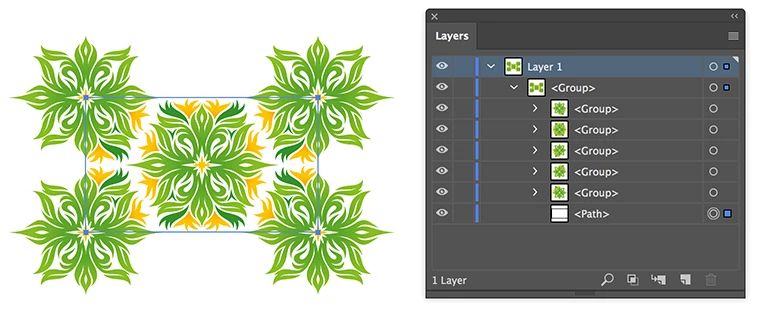
3 Select: Object > Artboards > Fit to Selected Art.

4 Save the ai document and choose Open… (or Open As Smart Object…) in Photoshop.

5 Select All and choose Edit > Define Pattern

3 replies

Ton Frederiks
Community Expert
Ton FrederiksCommunity ExpertCorrect answer
Community Expert
July 14, 2017

A slightly shorter way:

1 Drag the Pattern swatch from the Swatches Panel to the Artboard.

2 In the Layers Panel you see the Pattern as a group, select only the path at the bottom of the group.

3 Select: Object > Artboards > Fit to Selected Art.

4 Save the ai document and choose Open… (or Open As Smart Object…) in Photoshop.

5 Select All and choose Edit > Define Pattern

Known Participant
July 15, 2017

This is the best solution. TKU!

Ton Frederiks
Community Expert
Community Expert
July 15, 2017

Glad I could help.

barbara_a7746676
Community Expert
Community Expert
July 14, 2017

This is a way to do that:

  1. In Illustrator, drag the pattern from the Swatches panel onto the pasteboard.
  2. Each pattern has a rectangle behind it with no fill and no stroke, which defines the pattern tile. You can see it more easily if you View > Outline.
  3. Select the rectangle with the Group Selection tool. Copy it.
  4. Select the whole pattern and Edit > Paste in Front.
  5. Fill the top rectangle with white.
  6. Select the white rectangle and the whole pattern.
  7. In the Transparency panel, click Make Mask.
  8. Now you will see just the area of the pattern tile. These steps are so that you can identify the area of the tile when you get it into Photoshop.
  9. Select the all and copy it.
  10. Switch to Photoshop, create a new document, and paste the pattern into the new document.
  11. It will be easier if you add ruler guides at the edges of the pattern tile. (View > Show Rulers). Use the Move tool to drag guides out of the rulers to the edges of the tile. It will help with accuracy to zoom in.
  12. Turn on View > Snap To > Snap to Guides.
  13. Use the Rectangular Marquee tool to draw a rectangle around the tile.
  14. Then choose Edit > Define Pattern. Name it and click OK>
  15. You can now use the pattern to Edit > Fill any area.
Known Participant
July 15, 2017

It works all properly, until i paste the pattern tile in photoshop.

It gives me delicate edges.

And this hampers seamlessly !

where did i go wrong ?

Ton Frederiks
Community Expert
Community Expert
July 15, 2017

That is the result of anti-aliasing.

Make sure that the dimensions of the pattern tile don't contain fractional pixels.

If the pixel dimensions contain fractions, the rasterized result will be rounded up or down to a pixel and may cause the effect you see.

twaritar3263062
Community Manager
Community Manager
July 14, 2017

Hi Mattia,

I would suggest you to refer Can I transfer a custom made pattern from Illustrator to Photoshop?

Hope that helps!

Regards,

Twarita