I believe this can be accomplished using graphic styles, specifically the Transform effects. You would have to take your sample character and use the transform effects on each of its shapes to move them according to the current dance position. Then you would capture them as graphic styles and name them to ensure a unique identifier that can help with knowing what's what. Additionally you may need to assign the proper notes to each shape of every character, because, the way this would work is by using Illustrator's Actions feature and being able to select items via note.
Be aware that in fact not all graphic styles have to be completely unique to their purpose: they can also be used generically when the case is right for generic transformation usage. For example, say you want to rotate the (screen) right arm of a character by 45 degrees, from the left-center anchor point of its bounding box. Maybe in the same configuration another shape needs to have the same exact rotation and you can use the same style to accomplish the same thing on different shapes. While it may be rare that some shapes would have the exact same transformation style in one dance configuration, surely there would be many repetitions across every move. Since all of these graphic styles are required to be present in the document when the action is played, it pays to have as few as possible.
You will need to construct as many actions as there are dance move configurations and they will each have to be composed of many duplicate events concerning selection of every uniquely-noted item (not names in the Layers panel, but notes in Attributes panel) and applying the appropriate graphic style. Then once you are done constructing one such action that selects all shapes and applies the graphic style that's needed, you will need to create a way for there to be a new editable character in the document when you run the action. Either you have a folder of individual files which each contain a character and you can run a batch of actions through it, or just a single one on an active document, or you may have some way to isolate characters within a single file if you are using one file with multiple characters in it.
Already though, this solution may seem like it would be really tedious and painfully slow. For one, you have to not only make a new graphic style for every shape's every different configuration, you'd have to make an action for every configuration and that action would have to be made of individual actions that apply one style to one shape (or group, rather). But fear not, because there's a secret weapon that you can use, see next paragraph!
For ultimate control, you can also add the use of this script-based technique which also uses variable data. This would be an unorthodox and exciting use for variable data which would truly differentiate Illustrator's variable data abilities from that of InDesign. With it you could accomplish things such as randomized sets of characters with synchronized or randomized dance moves - you'd have to shuffle the data to suit yourself inside of a spreadsheet program, but that's how you can turn a standard piece of art into an extrapolated & uniquely styled variations.
With this technique called "The Recolor workflow", you can completely avoid the bulk of the action step altogether and take care of that logic within a spreadsheet - much faster and much more editable. There are a couple auxiliary articles, one of which goes over an automatic helper script for this workflow that makes it even faster by providing a spreadsheet format to help with the setup.
The subset of the Recolor script's features you will want to use is the ability to apply a graphic style to a group. With this capability you can now avoid creating an Action for this purpose but rather specify intuitively in a grid format the style you want to be applied to which group.
See the 10 minutes after this link marker in this YouTube video which will help demonstrate this method.
In addition to being able to apply a new style to art which overrides any previous appearance, you can also use a style cumulatively, meaning you can add the same style, or different styles to art as an addition which does not nullify any pre-existing appearance on the art. To inspire any ideas, for example you can add a rotate effect by 10 degrees multiple times via the course of a batch action so that the first item is rotated 10 degrees and the last item out of 10 items is rotated by 100 degrees.
When using variable data, you are able to use placed files as a variable, so you may even have one file which contains one 'generic' character composed of placed & transform-styled rectangles containing individual body parts and you can swap out both the body parts as well as their styled transformations to export a multitude of your posed characters from one single mega-template (& many accompanying body-part files).
To add to that, when using variable data, the workflow uses batch processing using datasets as the source instead of a folder of files. This means that you can use a single template with the swappable body-part placed items, or different layers with characters or different artboards with characters and use various Illustrator Action techniques to create all your varying results from the one file.
If you want to make use of the Recolor workflow, I would be interested in seeing if you'd like to share some details about it and allow me to feature it in a LinkedIn article about variable data usage.
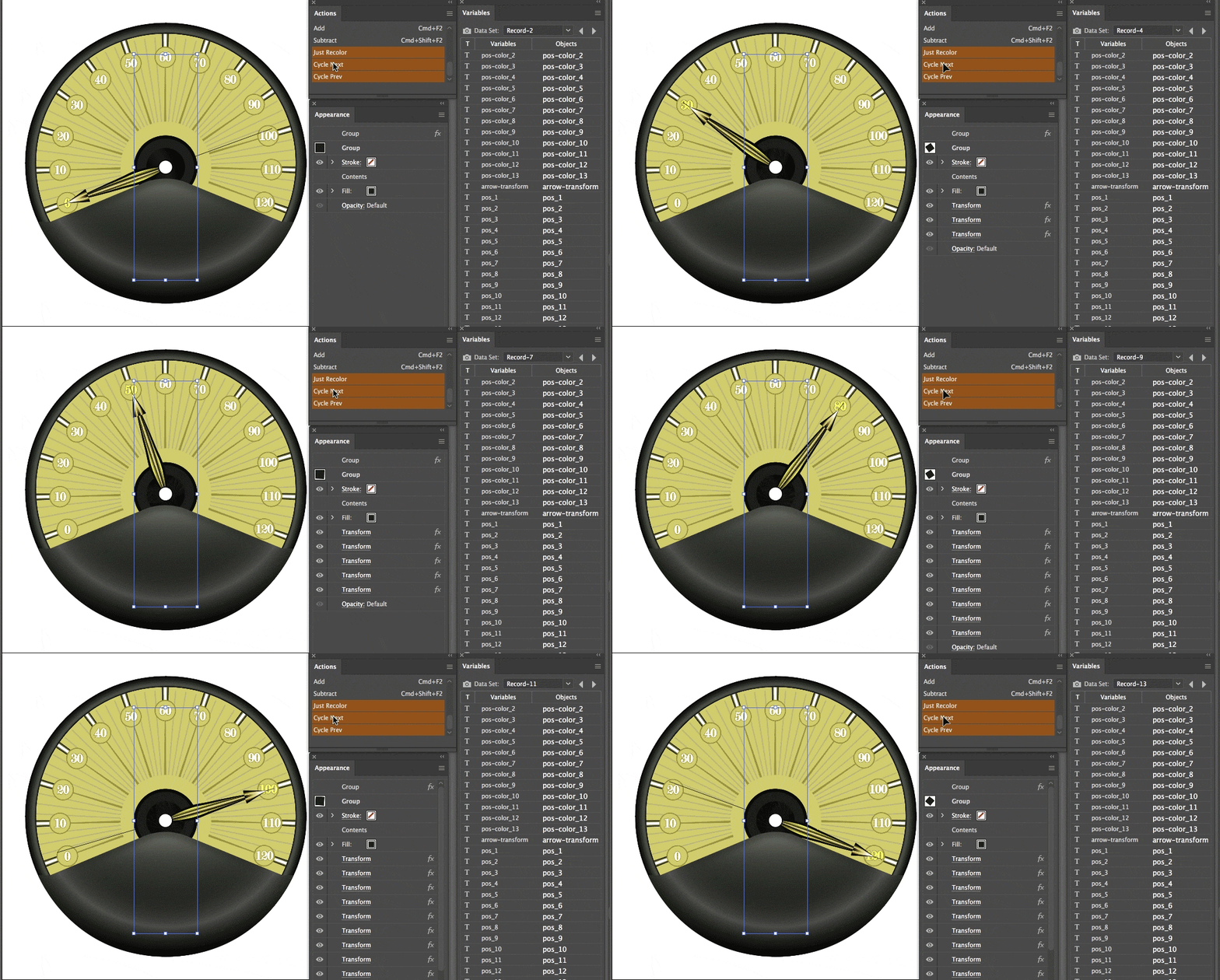
Here's an example of a cumulative transform effect used with the Recolor script workflow, but in your case I think they will be all overriding transforms for this project.

 AdChoices