Inspiring
January 5, 2023
Answered

Acrobat tags not matching InDesign tags

  • January 5, 2023
  • 4 replies
  • 18369 views

Hi,


Using InDesign 18.0 to create accessible pdfs. Issues as follows:


1. Sometimes a pdf generated from InDesign will show the name of the style sheet along with the tag, ie. instead of <H1> it will show as <Title_H1>. This happens with numerous tags. If I clean up all of the paragraph styles in InDesign as neatly as possible and check each one carefully - in some cases this solves the issue, in other cases it does not.


2. A very big problem is that Acrobat will change the tag altogether, so an InDesign tag of <H3> becomes <H4> in Acrobat.


I have very carefully checked all aspects of the tags, the paragraph styles, etc. Of course I'm working on a deadline and spending hours trying to find a solution is not feasible, have wasted a few hours so far. Any help would be greatly appreciated!

This topic has been closed for replies.
Correct answer Oriana808
quote
quote

Because they would be in the middle of the table, I can't make them Table Headers.

If the client wants "Headings" to have a hierarchy within a table, I'm assuming this can't/shouldn't be done at all?

By @Oriana808


Not in InDesign, that has te be done in Acrobat, but make sure that in that case you set all Header ID's and associate the data with the correct Header ID's, set scope etc. That is what we call a (very) 'complicated' table. Tools like AxesPDF are the best tool to remidiate such tables in Acrobat.

But in most cases simplifying table or break them up in different simpeler tables is a better solution...

By @Frans v.d. Geest


Frans has given good advice. He teaches graphic design and accessibility with InDesign.


Although it's not illegal (per the current PDF/UA-1 standard) to have <Hx> tags within a table, it's also not a standardized format, either. That means most assistive technologies won't know what to do with them, and end users are not expecting <Hx>, which then causes confusion. And a lot more verbosity, too.


So no, we do not recommend using <Hx> tags within a table.


One problem with using headings (H1-H6) in tables is that all headings in a file must be in a sequential hierarchical order. If H1 is used to designate the file's title and H2 identifies the first level of subhead, then what is the first heading level to use inside the table itself?

  • H3 if the table is inside an H2 subhead section?
  • H4 if the table is inside an H3 sub-subhead?

This drives us InDesigners nuts, especially when we have many tables in a document: nothing is consistent and the heading levels change from table to table.

And you should hear what it does to those using screen readers. Gah! <grin> Total confusion. They're lost.


So all of your headings/headers must be tagged with a <TH> header tag because they are used by screen readers to identify the column or row the user is in. And they are read in sequence. Example: US Census table, total population of females.
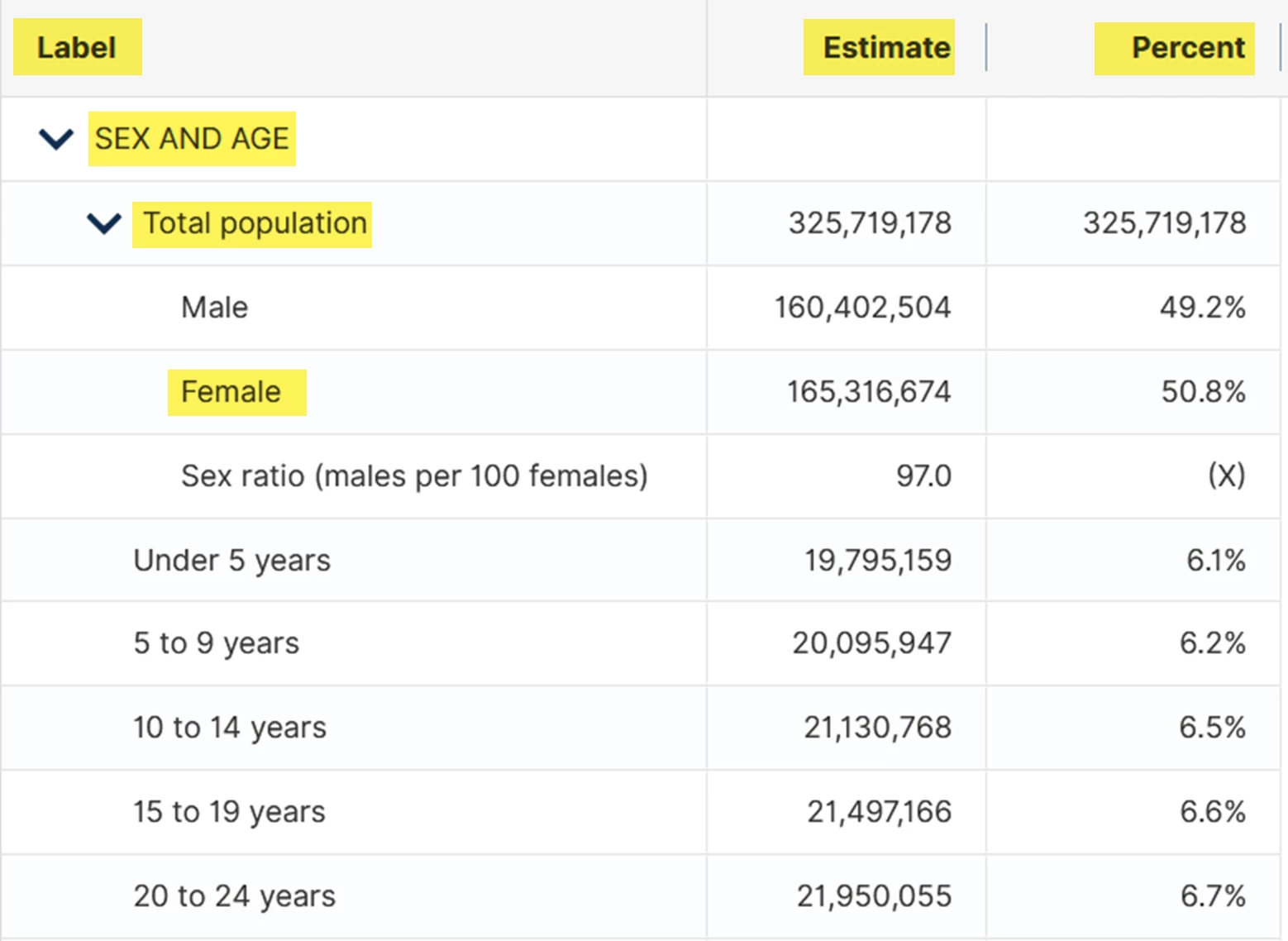
<TH> Headers are highlighted in yellow that affect "female" data.


The voicing, when set to "default" settings by the user:

Label

Sex and Age

Total Population

Female

Estimate

165,316,674


But as Frans said, you'll need to set Scope, Span, and Cell IDs on the headers, and InDesign doesn't do a complete enough job on this. Note, the header "Sex and Age" must be merged across all 3 columns: Label, Estimate, and Percent.


AxesPDF is a good tool for correcting tables in PDFs. But we recommend an even better tool, Made To Tag by axaio software https://www.axaio.com/doku.php/en:products:madetotag  and see their table tutorial at https://help.axaio.com/m/madetotag-manual/l/1614261-tagging-indesign-tables-with-madetotag. It gives you tagging control of the table right inside InDesign so you don't have to waste time fixing tables afterwards in Acrobat.


Personally, I use Made To Tag whenever I have one or more substantial tables. It makes it so easy. Worth the price, especially when doing complex financial or data tables.


Another benefit is that Made To Tag exports a very clean tag tree for the entire PDF (not just the tables) that I like better than what Adobe produces. We purchase our licenses directly from axaio so that we get updates and tech support very quickly. I highly respect the company.


Disclaimer:

Although I know the people behind the companies mentioned, neither me nor my firm get any compensation. No sales commissions, kickbacks, or freebies.


In this forum, those of us listed as "Community Experts" are volunteers who've been invited by Adobe to help other designers (or PDFers, Photoshop gurus, etc.). We don't get paid for answering questions. Just a nice warm feeling when someone says "thanks, that worked."


Personally, I've been in the accessibility world my entire life. Many family members have been or are blind, and others have physical and cognitive disabilities. Professionally, I began working on accessibility standards 25+ years ago when the digital industry was just starting. Today, I'm a US delegate to the ISO committees that create the PDF and PDF/UA standards, so I read that technobable every week for my volunteer work on the committees, as well as to advise our large corporate and government clients.


I, too, want to put <Hx> in tables, so I'm working with others on the committee to pitch the idea of TableSubHeads (not to be confused with <Hx> headings). But if the idea flies, it will be many years before some concept like that is developed, tested, and written into the standards so that you and I can then use them. Who-ie! Hopefully, we'll still be in the industry by then <grin>.


Now you know more than you ever expected to get! <grin>


This is fantastic. I've been wondering about the table "headings" tagging treatment by the client for a while - this clears that up!


I've passed along all of the pertinent information regarding proper accessiblity tagging to the client and they're actually very happy to receive it, and are quite interested in the Made To Tag software.


Thank you and everyone else so much for all of the much needed help in this matter. Very much appreciated!!

4 replies

Bevi Chagnon - PubCom.com
Legend
January 10, 2023
quote
That also doesn't address Acrobat changing the tag structure.
By @Oriana808


Acrobat isn't changing the tag structure. You're seeing the tag structure created by InDesign's export utility, which by Adobe's insane logic, are custom tags named after InDesign's paragraph styles that are then camoflagued via Role Mapping to the accessibility tags.  It's a strange system, that's for sure!  Pure voodoo.


But something in your InDesign layout is throwing off this conversion and I'd like to take a couple of routes to see if we can discover what it is. It could be:

  1. One or more of the style names is too long or conflicts with another.
  2. A bug in the export utility's conversion algorithims.
  3. Mis-mapping in Acrobat's Role Mapping utility.


Let's start with the easiest:

Can you shorten the names of your paragraph styles? For example, Black sub subhead H4 can become just H4.

And then resave the layout as File / Save As and give it a new file name. Don't overwrite the existing file: we want a new file so that the InDesign code is rewritten as a "clean" new file from start to finish.


Export a new PDF: File / Export / PDF Interactive, and see if anything improved in the new PDF. Let us know what you get.


|&nbsp;&nbsp;&nbsp;&nbsp;Bevi Chagnon &nbsp;&nbsp;|&nbsp;&nbsp;Designer, Trainer, &amp; Technologist for Accessible Documents ||&nbsp;&nbsp;&nbsp;&nbsp;PubCom |&nbsp;&nbsp;&nbsp;&nbsp;Classes &amp; Books for Accessible InDesign, PDFs &amp; MS Office |
Oriana808Author
Inspiring
January 10, 2023

I can tell you like InDesign for ACC lol.


I had changed most of the paragraph style names (Black sub subhead H4 was from an older pdf) - should show in the "Edit all export tags" screenshot I sent earlier.


Just went through and shortened even more, eliminated a couple of styles and it's getting better. However I just found:


1. Tag H6 in InDesign, showing up as H4 in Acrobat.

2. Tag H5 in InDesign, showing up as H4 in Acrobat.


I am limited as far as screenshots are concerned, as this is a document from a financial institution.

Frans v.d. Geest
Community Expert
Community Expert
January 10, 2023
quote:


1. Tag H6 in InDesign, showing up as H4 in Acrobat.

2. Tag H5 in InDesign, showing up as H4 in Acrobat.


By @Oriana808


 Then that H-level tag is set in the Paragraph style itself in InDesign or incorrectly mapped in the Edit all Export tag dialog... 

Bevi Chagnon - PubCom.com
Legend
January 6, 2023

@Oriana808, you're seeing InDesign's "custom tags" in your PDF.

To change what you see and get the correct accessibility tags (H1, H2, etc.), turn on Apply Role Mapping in Acrobat. Here's how:


  1. In Acrobat Pro, switch to the Tags Tree panel.
  2. From the panel's options drop-down menu, select Apply Role Mapping to Tags.
  3. You should now see the correct tag names in the Tag Tree.


Before Role Mapping ...


After Role Mapping


|&nbsp;&nbsp;&nbsp;&nbsp;Bevi Chagnon &nbsp;&nbsp;|&nbsp;&nbsp;Designer, Trainer, &amp; Technologist for Accessible Documents ||&nbsp;&nbsp;&nbsp;&nbsp;PubCom |&nbsp;&nbsp;&nbsp;&nbsp;Classes &amp; Books for Accessible InDesign, PDFs &amp; MS Office |
Oriana808Author
Inspiring
January 6, 2023

Hi Bevi,


Yes I do have Role Mapping turned on. The issue doesn't effect all of the tags, just some of the tags. Also this doesn't solve the problem of incorrect tag structure - which is pretty serious as one wouldn't know if a tag was changed in hierarchy in a large document. Notice in one screenshot how it skips from H3 to H5. The other screenshot shows how the tags don't match between InDesign and Acrobat.

Bevi Chagnon - PubCom.com
Legend
January 6, 2023

@Oriana808 , thanks for the screen shots of your tag tree.

Question: are the problems only appearing in tags inside tables? Or do the problems appear in other non-tabular portions of the PDF, such as within the narrative text?


|&nbsp;&nbsp;&nbsp;&nbsp;Bevi Chagnon &nbsp;&nbsp;|&nbsp;&nbsp;Designer, Trainer, &amp; Technologist for Accessible Documents ||&nbsp;&nbsp;&nbsp;&nbsp;PubCom |&nbsp;&nbsp;&nbsp;&nbsp;Classes &amp; Books for Accessible InDesign, PDFs &amp; MS Office |
James Gifford—NitroPress
Legend
January 5, 2023

Are you familiar with the Edit All Export Tags menu? It's a bit hidden — click on the 'hamburger' icon in the Paragraph Styles menu — but it will let you review and edit all export tags at once (for both EPUB/HMTL and PDF).


This may not be a solution, but perhaps having all the tags in one place, rather than laboriously working through each style's menu, might help assure consistent and correct assignments.


Bevi Chagnon - PubCom.com
Legend
January 6, 2023

James gives excellent advice.

First, make sure you've designated which tag to apply to the paragraph's text as he said.


But I think the real culprint is InDesign's stupid custom tags (that mimic our paragraph style names) that then must be Role Mapped to the correct accessibility tag.

Once you check it "on" as detailed below, it should stay on permanently...or until your version of Acrobat is updated.


|&nbsp;&nbsp;&nbsp;&nbsp;Bevi Chagnon &nbsp;&nbsp;|&nbsp;&nbsp;Designer, Trainer, &amp; Technologist for Accessible Documents ||&nbsp;&nbsp;&nbsp;&nbsp;PubCom |&nbsp;&nbsp;&nbsp;&nbsp;Classes &amp; Books for Accessible InDesign, PDFs &amp; MS Office |
kglad
Community Expert
Community Expert
January 5, 2023

in the future, to find the best place to post your message, use the list here, https://community.adobe.com/


p.s. i don't think the adobe website, and forums in particular, are easy to navigate, so don't spend a lot of time searching that forum list. do your best and we'll move the post if it helps you get responses.


<moved from using the community>

Oriana808Author
Inspiring
January 6, 2023

Hi kglad,


Ok thanks so much, yes please move the message, that would be very helpful!