
Inspiring
March 22, 2022
Answered

Export to PDF issue (black box on characters) - macOS/Preview

  • March 22, 2022
  • 4 replies
  • 3741 views

Dear all,

I'm reporting a most strange issue with the Export PDF output. I will provide all files for you to reproduce.

Context: I'm reviewing a musical score I created in 2019, score PDF exported from Sibelius, cover and intro created on Pages for Mac, exported to PDF from within, everything assembled with the Organise Pages feature of Acrobat DC. To future-proof and make updating files easier to me I decided to assemble these PDFs as graphical frames of page size into InDesign (reason: updating a PDF would simply require me to double click the yellow sign in the Links panel, much quicker than the Replace Pages function in Acrobat). 

The issue: upon assembling the InDesign document, I exported it to PDF using the Press Quality preset. I checked every file in Acrobat and it looked fine, yet the composer reported that, upon opening the PDFs in Preview on macOS 12.3 (same as I have been using), he would see black boxes over a couple of glyphs: 
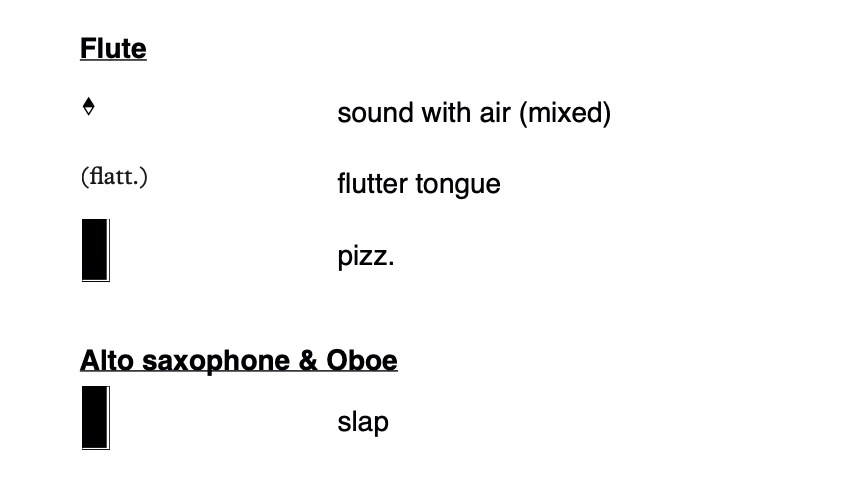
Originally these glyphs were created in Sibelius, and exported as selected graphic in SVG format (I didn't know how to use Illustrator in 2019 to do this more efficiently). The attached PDF is the resulting PDF exported from Pages, and it opens well in Preview. Placing it with the File > Place command in InDesign results in correct drawing onscreen, but with these black boxes on Export. 

I have no idea what is happening here and I would really appreciate if someone could help me investigate what is happening: to reproduce the issue, create a new InDesign document, create a parent page with a graphical frame occupying all of it, create a total of 2 pages in the document, place the attached PDF in those two pages and export it as PDF using the Press Quality preset. Open it in Preview and tell me if you also see the black boxes. 

Since I needed to deliver the job as quickly as possible I used Acrobat DC to open the PDF exported from InDesign and replaced the two offending pages with the attached ones, which instead just work perfectly. 

The issue reproduces also in InDesign 2020 and 2021, and my educated guess is that something may be wrong with Apple Preview under macOS Monterey, yet I am in no way sure of it.

Thank you for your time and help!
This topic has been closed for replies.
Correct answer Brad @ Roaring Mouse

I'm surprised your file worked as well as it did in anything!

I opened it in Illustrator to get a sense of the structure of it (actual procedure: PLACED the file, then Flattened it (Object > Flatten Transparency, selecting High and convert fonts to outline), and it's such a complicated file that I'm not surprised it failed.

Each of your note graphics is a cropped image from a full sheet of score.. many many many times. and each crop has a few clipping paths/and or masks

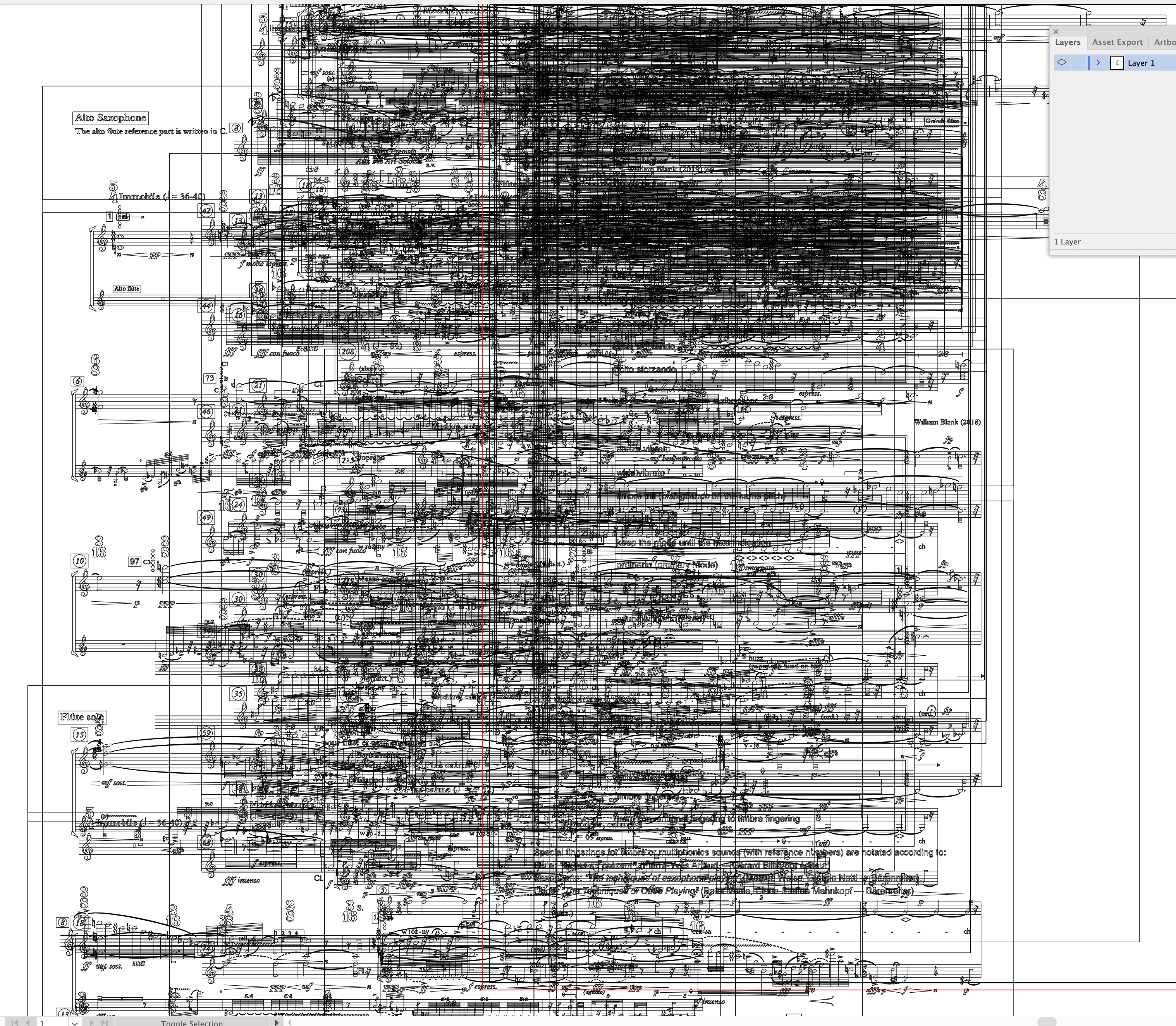
This is what it looks like in outline:


 If you want a quick fix this to this file right now, Open your PDF and Export To > EPS (Encapsulated Postscript), selecting Level 3 and embedded and referenced fonts. Place the resulting files in ID and PDF the file. Not only will it work, it will be a fraction of the size.

This is one of those rare moments when EPS comes to the rescue.

Otherwise, when you have more time, rebuild your files so you are placing your notes as isolated graphics onto themsleves as opposed to a crop/clipped section of the full score.


4 replies

Brad @ Roaring Mouse
Brad @ Roaring MouseCorrect answer
Adobe Expert
March 22, 2022

I'm surprised your file worked as well as it did in anything!

I opened it in Illustrator to get a sense of the structure of it (actual procedure: PLACED the file, then Flattened it (Object > Flatten Transparency, selecting High and convert fonts to outline), and it's such a complicated file that I'm not surprised it failed.

Each of your note graphics is a cropped image from a full sheet of score.. many many many times. and each crop has a few clipping paths/and or masks

This is what it looks like in outline:


 If you want a quick fix this to this file right now, Open your PDF and Export To > EPS (Encapsulated Postscript), selecting Level 3 and embedded and referenced fonts. Place the resulting files in ID and PDF the file. Not only will it work, it will be a fraction of the size.

This is one of those rare moments when EPS comes to the rescue.

Otherwise, when you have more time, rebuild your files so you are placing your notes as isolated graphics onto themsleves as opposed to a crop/clipped section of the full score.


BobLevine
Adobe Expert
March 22, 2022

Nice sleuthing! 

Adobe Expert
March 22, 2022

"I ran the Preflight you suggested."


If you were successful with that Acrobat's Document Properties > Fonts should not list any entry at all.

However the "wide vibrato" wave will render very, very thin. And the file size of the converted PDF becomes very large.


Download my result from the font conversion process from my Dropbox account:

https://www.dropbox.com/s/cmd5bk4tsjtxoc0/p%27x%27_0016_A3_Signes%20speciaux-FONTS-OUTLINED.pdf?dl=1


Regards,
Uwe Laubender

( ACP )

Inspiring
March 22, 2022

Your file and my "fixed" file are both the same size, 16.4MB, and both show nothing in the Fonts page of the Document Properties (on Mac: File > Properties > Fonts).

Using your file produces the same result, unfortunately. 

I would appreciate if someone with a Mac could confirm if this is happening for them as well. I assume you have tried on your Windows machine and that it doesn't reproduce, not even using the original PDF.

Adobe Expert
March 22, 2022

You assume right. Tried some of my browsers to show the PDF.

No issue found. Of course also with Acrobat Pro and Adobe Reader.


Regards,
Uwe Laubender

( ACP )


Adobe Expert
March 22, 2022

Hi Inélsòre,

to work around the issue you could convert all fonts in the exported PDF to outlines using Acrobat Pro:


FWIW: I cannot see an issue in your provided PDF. Even the PDF reader of my Firefox browser is able to render the pages without flaws. Or the preview of my Windows 10 machine in the file explorer.


Regards,
Uwe Laubender

( ACP )

Inspiring
March 22, 2022

Thanks Uwe.

The PDF in itself seems to be fine.

Have you tried to reproduce the issue from InDesign? Just because that's what all's about. 

Those two glyphs seem to become corrupted when exported from InDesign.

BobLevine
Adobe Expert
March 22, 2022
Something MAY be wrong with Preview? In short, it's garbage and always has been for anything other than very plain vanilla PDFs.

If they work in Acrobat and Reader you're wasting your time reporting it to Adobe. Instead, report it to Apple.
Inspiring
March 22, 2022

Thank you for your very direct answer, Bob.

There are things such as PDFs exported from Sibelius that show perfectly on both system but if printed to a physical printer from Acrobat (DC & Reader) they have almost no glyph showing, while they print perfectly from Preview. That's to say I would not judge Preview so harshly so fast but, in this case, you may be right. 

The problem with reporting this to Apple is that the issue arises when I export the PDF from an Adobe product, InDesign, so I would like to avoid being bounced back and forth. 

BobLevine
Adobe Expert
March 22, 2022

If you spend a little time researching this you'll see that issues with Preview (as well as other third party readers) have been reported for many years. I stand by my statement. Another thing you'll note is that when you export, you export specifically to Adobe PDF.


If you're having issues with your PDFs in Acrobat or Reader, report it to Adobe but otherwise, it's pretty much a waste of time.