
Participant
November 20, 2021
Answered

Any way to reset text box scale after transform or image resize?

  • November 20, 2021
  • 2 replies
  • 4405 views

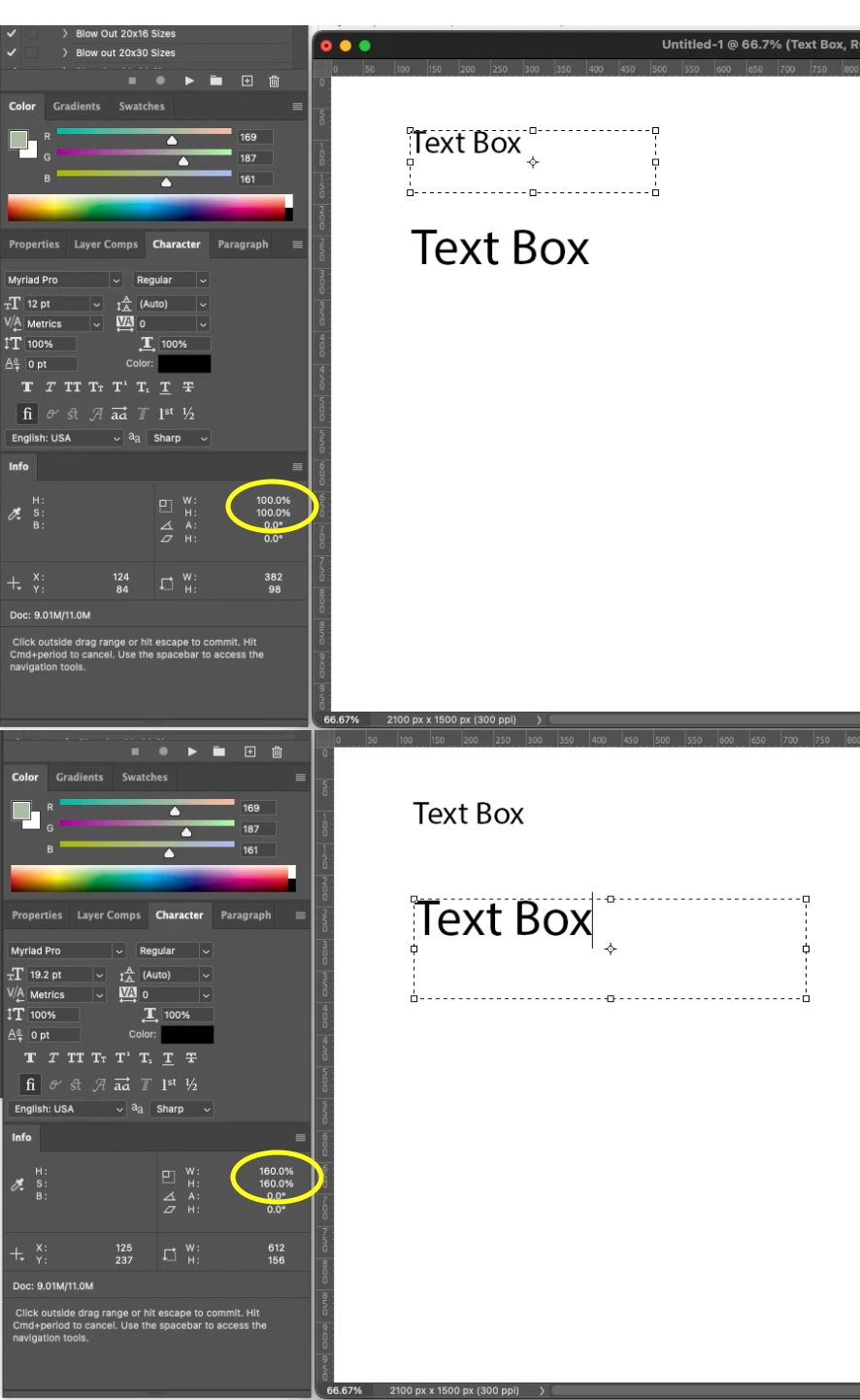
I am trying to find a solution that will reset the scale percentage of a text box after a transformation or image resize. I have a layout that needs to be rolled out to many different sizes and after I take it through all of the image size commands, the scale of the text boxes in all of the files shows the reduction or enlargement value in the info palette.


I have to upload these to an ecom platform (the layouts are ingested into a custom online builder where the customer can personalize the product by adding their own text/typography and images.


Unfortunately, the system will not properly ingest any text box that doesn't have a scale value of 100%. If it sees a scale value, it will reduce or enlarge the type according to that value.


I'm curious if there is a simple solution (scripting or otherwise) to quickly reset the scale value of the text box back to 100%, without affecting the point size. Right now, I have to manually reset the copy in each of the scaled layouts... sometimes hundreds of files.


Here is a snapshot illustrating what scale value i'm referring to.
 

This topic has been closed for replies.
Correct answer r-bin

@r-bin @Kukurykus After you transform the text box and commit, activate the cursor in the text box and then hover away from the box. In the info palette, you should see the scale numbers that I'm referring too.


try undeform script

https://www.mightyplugins.cc/magic-scripts


2 replies

Legend
November 21, 2021

Maybe I didn't understand something, but I don't see this either on CC2020 or on CS6. After any transformations, resizing, the info-panel is always 100%.

Legend
November 21, 2021

not after, but during 🙂 
(as I understand)

Participant
November 21, 2021

во время трансформации, видимо


Так понял, что автору нужно увеличить размеры textBox, но так чтобы размер шрифта остался таким же как и до трансформации.


@michaelb89663848  I've never worked with a textBox, but just noticed - why TRANSFORM it if you can just stretch the borders? 


For some reason, text objects (and paths) seem to remember what scale they were created at... similar to how a smart object always remembers what it's original size is. I don't understand why this is necessary. Why does PS need to remember the size of the original text shape??


r-bin Stretching the borders and setting new point sizes is what I have to do now as a work around. That means manually resetting copy on hundreds of files.


I know this isn't of any concern to most... Almost all just spit out rasters at the end and it's all good


Quick question @jazz-y I have not done any java scripting in PS before. For your code above, do I just save out as a .jsx and then run by going to File>Scripts>Browse?

Legend
November 20, 2021

The problem is that the increase in the textBox is related to the textShape parameters. We can find out how much the size of the textShape has changed, but when we try to change it, we will automatically receive the change in the textBox.

However, we can find out the transformation ratio and proportionally reduce the current font size. The script does this with the active layer:


#target photoshop
var s2t = stringIDToTypeID;

(r = new ActionReference()).putProperty(s2t('property'), p = s2t('textKey'));
r.putEnumerated(s2t('layer'), s2t('ordinal'), s2t('targetEnum'));

if (executeActionGet(r).hasKey(p)) {
    var textKey = executeActionGet(r).getObjectValue(p),
        shape = textKey.getList(s2t('textShape')).getObjectValue(0),
        styles = textKey.getList(s2t('textStyleRange'));

    scale = 1 / textKey.getObjectValue(s2t('transform')).getDouble(s2t('xx'))

    var l = new ActionList();
    for (var i = 0; i < styles.count; i++) {
        var cur = styles.getObjectValue(i),
            textStyle = cur.getObjectValue(s2t('textStyle'));

        try {
            textStyle.putUnitDouble(s2t('impliedFontSize'), s2t('pointsUnit'), textStyle.getUnitDoubleValue(s2t('impliedFontSize')) * scale);
            textStyle.putUnitDouble(s2t('impliedLeading'), s2t('pointsUnit'), textStyle.getUnitDoubleValue(s2t('impliedLeading')) * scale);
        } catch (e) { }

        cur.putObject(s2t('textStyle'), s2t('textStyle'), textStyle);
        l.putObject(s2t('textStyleRange'), cur)
        $.writeln(l.getObjectValue(i).getObjectValue(s2t('textStyle')).getUnitDoubleValue(s2t('impliedFontSize')))
    }

    textKey.putList(s2t('textStyleRange'), l);
    (r = new ActionReference()).putEnumerated(s2t('layer'), s2t('ordinal'), s2t('targetEnum'));
    (d = new ActionDescriptor()).putReference(s2t('null'), r);
    d.putObject(s2t('to'), s2t('textLayer'), textKey);
    executeAction(s2t('set'), d, DialogModes.NO);
}

function objToDesc(o) {
    var d = new ActionDescriptor();
    for (var k in o) {
        var v = o[k];
        switch (typeof (v)) {
            case "number": d.putDouble(s2t(k), v); break;
        }
    }
    return d;
}


(run it only once on one layer, as it will resize each time).


This is a fairly simplified example (I do not work much with text and have not tested it on many layers, only checked basic things), however, it may be able to help solve your problem.