MahaB82A
Braniac
March 17, 2023
Answered

JPEG Options

  • March 17, 2023
  • 5 replies
  • 4013 views

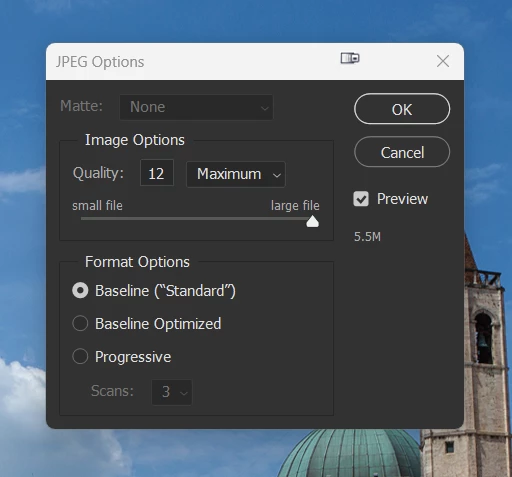
I use latest version of Ps. When I tried to save JPEG file, I usually get this window. Do you have any idea of pros and cons of the selection combination? I am following a tutorial which does not get a message like this. I assumed it may be made in previous version. 


This topic has been closed for replies.
Correct answer NB, colourmanagement

As others have pointed out, Jpeg is pretty risky - you should always archive a copy of your original, with adjustment layers if that’s how you work. Jpeg really is "lossy" and should ONLY be used for final delivery AFTER resizing & cropping to the FINAL size and crop.

Why? Any edits to size or crop mean the next save with compress again, potentially that’s very damaging 


Jpeg is not OK for archiving or for any file that may need to be resized or cropped down the line. 


I hope this helps
neil barstow, colourmanagement net - adobe forum volunteer - co-author: 'getting colour right'
google me "neil barstow colourmanagement" for lots of free articles on colour management

5 replies

MahaB82A
MahaB82AAuthor
Braniac
March 17, 2023

Thanks for the explanation of all contributers.

NB, colourmanagement
NB, colourmanagementCorrect answer
Braniac
March 17, 2023

As others have pointed out, Jpeg is pretty risky - you should always archive a copy of your original, with adjustment layers if that’s how you work. Jpeg really is "lossy" and should ONLY be used for final delivery AFTER resizing & cropping to the FINAL size and crop.

Why? Any edits to size or crop mean the next save with compress again, potentially that’s very damaging 


Jpeg is not OK for archiving or for any file that may need to be resized or cropped down the line. 


I hope this helps
neil barstow, colourmanagement net - adobe forum volunteer - co-author: 'getting colour right'
google me "neil barstow colourmanagement" for lots of free articles on colour management
MahaB82A
MahaB82AAuthor
Braniac
March 17, 2023

Do data in this window belong to original JPG? 


NB, colourmanagement
Braniac
March 17, 2023

@MahaB82A for clarity, please explain what you mean by

"Do data in this window belong to original JPG?"

are you asking whether the "save" settings there are showing you what settings were used when that Jpeg was saved? 


I hope this helps
neil barstow, colourmanagement net - adobe forum volunteer - co-author: 'getting colour right'
google me "neil barstow colourmanagement" for lots of free articles on colour management

jane-e
Braniac
March 17, 2023


@MahaB82A 


For the first part, the quality is how much compression will be applied to the jpeg. The higher numbers are less compression; the lower numbers are more. When I was at a roundtable with Staff at Adobe MAX a couple of years ago, they said there was no difference between 10 and 12 except file size, so that's what I use.


JPEGs are lossy, meaning they lose information every single time you save them, so you should work in a non-lossy format such as tiff or psd, then save to jpeg once. Edit in the tiff or psd and save out a new jpeg. JPEGS also cannot contain transparency or layers.


Can you share a screenshot of what you are seeing in the tutorial?


I remember learning about the three format options 20 or 30 years ago, but I forget what they are. I just use the default. Maybe another volunteer will chime in.


Jane


EDIT: I am the slowest typist ever!

D Fosse
Braniac
March 17, 2023

The turnover is pretty fast here, Jane. Sometimes I feel you have to sit at the keyboard with your hands in the air, ready to punch the second an interesting post comes in. Ding...


Progressive is what people used 25 years ago, when dial-up internet bandwith was so poor that images had to be loaded incrementally in stages. First you would sit looking at a blurry something for a minute, then in the next pass you'd be able to see what it was, enough to determine if it was worth another minute's wait.

jane-e
Braniac
March 17, 2023


I remember that about progressive now. I wonder why it doesn't say (legacy) after it! 🤣


Jane


D Fosse
Braniac
March 17, 2023

The thing about jpeg is that the only reason to ever use it, is to reduce file size as much as possible. The jpeg compression will always, no exception, degrade the image a little. And every time you resave, it degrades further.


So given that, you might as well get some real file size payoff while you're at it. Quality 8 to 10 is the sweet spot in most practical scenarios. Quality 12 makes very little sense. You're still slowly destroying the image, so the extra file size has no real purpose.


If you want to keep the image at full quality, don't use jpeg. Use PSD or TIFF (or in some circumstances PNG).

Braniac
March 17, 2023

Always choose BASELINE, the others are not important.

The other options control quality. You need to know that JPEG files are made small by damaging the file. You can have a very small file which is very damaged and poor, and a large file which is excellent quality. NEVER edit a JPEG over and over because the quality gets worse. For the final version save at the quality/size that you need. Experiment and check carefully. Or just use Maximum and use more disk space.

c.pfaffenbichler
Braniac
March 17, 2023

… and make sure to keep the layered files as psd, psb or tif. 

jpg should ideally just be used for the very final output.