


Community Manager
September 8, 2026

Layers as Materials - Now Available in After Effects Beta

  • September 8, 2026
  • 1 reply
  • 333 views

Version 27.0x41 of After Effects Beta introduces support for Layers as Material Sources. 
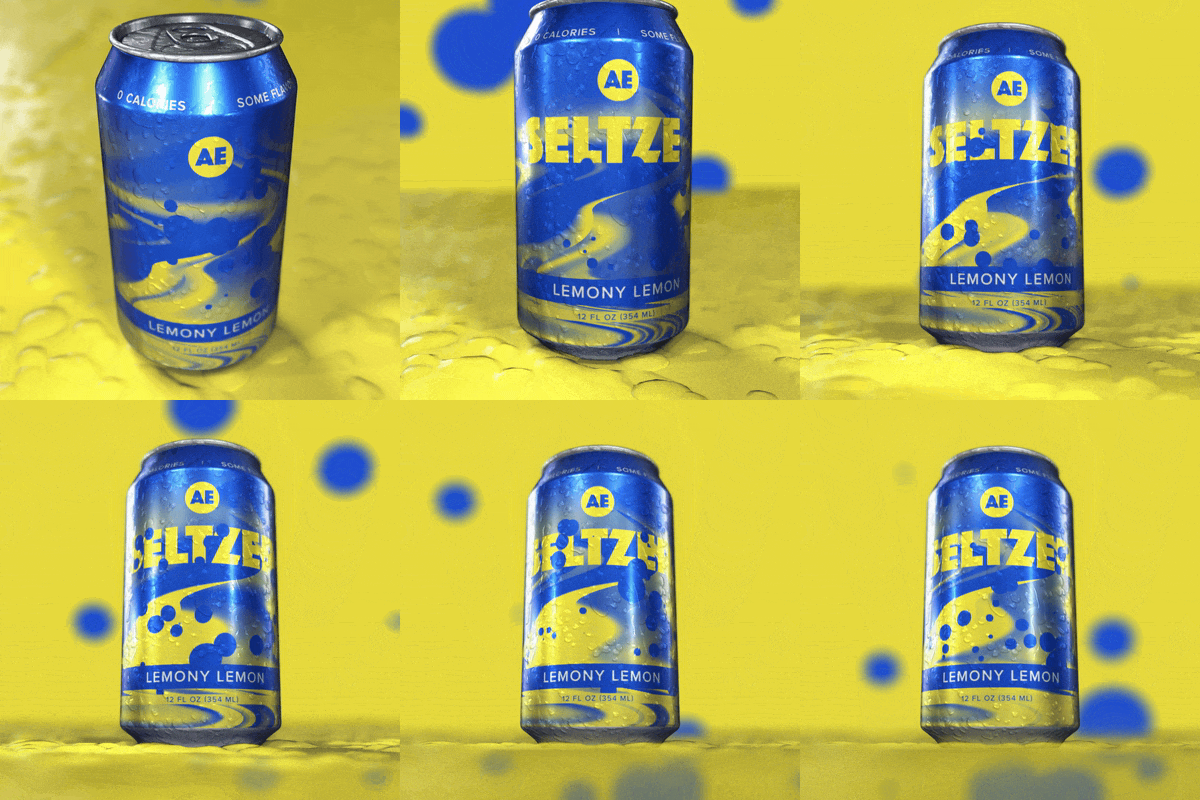
You can now apply layers — animated pre-comps, solids, images, and videos — directly as 3D materials on parametric meshes, 3D models and 3D text and shapes when using the Advanced 3D renderer. No more round-tripping through other apps or baking out intermediate textures: animate your 2D content and your 3D scene together, in the same project. We’re also changing how materials are applied so that you don’t have to scroll through big lists of material assignment slots when you only want to tweak part of a model. 


Getting Started 


Select a parametric mesh, 3D model, 3D text, or 3D shape, then open the Material dropdown in the Timeline or Properties panel and choose any eligible layer to use it as the base color source. Once assigned, you can fine-tune the look using new intrinsic material streams — Opacity, Roughness, Metallic, Emission Color, Emission Intensity, and Ambient Response — all keyframeable and expression-friendly just like other default material properties. You can even mix layer-based and Substance 3D materials on objects with multiple material assignments.
 

We'd love your feedback on: 

  • How intuitive the material source dropdown is to find and use (including the new search/filter options for Comps, Footage, and SBSARs) 

  • Whether the exposed scalar properties (Roughness, Metallic, etc.) give you enough control 

  • Performance with animated compositions as sources, especially in interactive preview 

  • Any crashes or unexpected behavior when copying, pasting, or duplicating layers/comps with material assignments 
     

Known Issues and Feature Limitations 

  • Decals (applying a layer to only part of a model rather than the full surface) are not supported in this first version — full-model/assignment texture wraps only for now.You can work around this somewhat by precomposing a material and adding the “decal” to the precomp.

  • Some edge cases (e.g., circular references between layers used as materials) can cause a crash. Avoid assigning a layer as a material source to itself via another layer 
     

Please give this new functionality a try and let us know how it's working for you! 

    1 reply

    Shebbe
    Community Expert
    Community Expert
    September 10, 2026

    ​I was hoping for this to come soon, thanks! While the first step is interesting, the current implementation is too basic to be usable. There is no point in assigning a custom texture map if the only available slot is diffuse/albedo. We need individual slots for all possible material channels if we want to utilize custom maps properly.


    As a fix this could be implemented by providing dropdown menus for each. But this isn't the only design problem. Custom maps seem to require you to have the layers available in the comp. For a single mesh in a single comp this isn’t that bad, but imagine 20 meshes with custom maps used in multiple comps. That will be quite the mess. It would be better if some additional mechanism could be designed that allows isolated set up for materials that meshes can reference from other than the comp itself. Just like it does with .sbsar. A dedicated material library panel where both .sbsar and custom maps could be created/reviewed could be much more useful. Additionally a manager that could assign materials to the meshes in a way that it makes the source media always reference that data so it isn’t instanced per comp, but could be overwritten if the users wants to could be welcome.


    In above’s context, assigning materials could be upgraded to allow drag-drop from material library to the viewer, highlighting which model/part of model the material will be assigned to. And also from the Properties Panel the dropdown menu could be a thumbnail based grid rather than a flat list.


    All in all I think there's a lot of work still to be done to make this a proper 3D working environment, and I would ask you to be cautious with these 1% quick fixes that stack up to a potentially clunky and incoherent design that puts you into a position where if you really want to make it work, the previous work needs to be redesigned along with it.


    I was recently testing out possible workflows for product label replacements inside AE using real 3d+shading. I got a really reasonable result with using:

    • KeenTools GeoTracker for motion tracking the bottle and exporting a null and camera.
    • RedGiant Geo for shading, lighting and rendering the 3D model/texture.
    • RE:VisionEffects ReelSmartMotionBlur to render motion blur.

    None of the above can be achieved yet natively and this update isn't getting it closer. Some key features are still missing other than the obvious geo tracker.

    • No native 3d motion blur in Advanced Renderer
    • No access to the linear light data from the Advanced Renderer
    • No individual texture slots for all possible material inputs.

    The reason I mention the linear light problem is because the renderer is internally clamped to 0-1 which causes motion blur and DoF to render inaccurately. It also makes it impossible to properly merge 3D workflows with other scene referred data like log video. The Advanced Renderer now lives sort of in it's own limited world but even internally doesn't render nicely because it's only a linear to 2.2 gamma conversion rather than some form of tone mapping.


    I hope we can see some more thought through feature updates around the new 3D system in the near future. With some solid decisions on what it should do in it’s basis, the possible use cases will become much larger than only solving smaller problems here and there.


    Below you can see my efforts. Don’t mind the UV mapping being funky in one of them. It's the quality of the material, lighting and render that really matters here.


    Native AE


    RG Geo + RSMB


    ​