


Inspiring
May 11, 2012

P: PDF import show edge artifacts on tiled PDF images (bug in PDF creation)

  • May 11, 2012
  • 262 replies
  • 4156 views

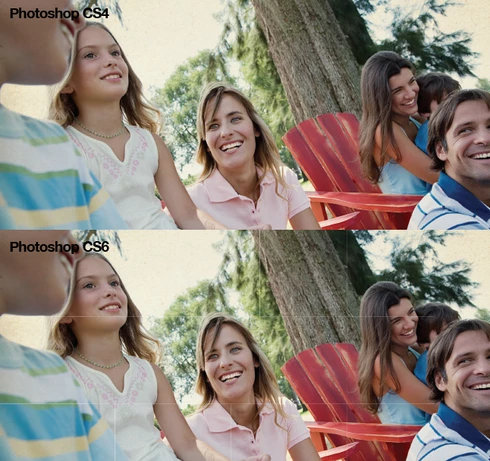
When importing a PDF with images, Photoshop CS6 adds faint outlines to the PDF image segments in the file. Prior versions of Photoshop render the PDF correctly. See the attached image for an example.
This topic has been closed for replies.

262 replies

Inspiring
February 19, 2013
Hello Chris, after few testings – here are my latest thoughts about the issue:

1)
I cannot understand why PDF production with CS5 should differ from the way CS6 produces PDF files. For my understanding PDF creation is done by the Acrobat/Distiller unit wich (I think) is a stand alone production tool and independent from the CS evolution steps.

2)
Several testings revealed for me that the PS CS6 render issue only appears on PDFs produced with image files that don ́t have a fixed background layer. From those image files Acrobat XI Pro engine produces tiled images within the PDF. Unfortunately I ́m not able to reconstruct if previous versions of Acrobat showed same behaviour.

3)
Photoshop CS5.1 (64 Bit) is capable of rendering those tiled image files without problems. Photoshop CS6 (64 Bit) is not (transparent lines).

4)
PS CS5.1 rendering quality is very superior to PS CS6. See images attached. Both images are rendered from same PDF file. The 'CS5.1.png' was rendered via PS CS5.1 from a PDF with a tiled image within -> no issue - goog quality. The 'CS6.png' was rendered via PS CS6 from a PDF with the same image including a fixed background layer resulting in a no-tiled image PDF -> of course no transparent lines but poor quality.

I hope my reflections are constructive because this is what they are ment to be.

Best regards,

Jan

Inspiring
February 18, 2013
It seems to me...

Chris is the only person in the Kingdom of Adobe taking any notice of any of you.

What they really need is some real advertising talking about the pitfalls of investing in CS6 before it is purchased. I tell people all the time... looking to upgrade... I tell them to wait until the bugs are fixed... cos Adobe really dont care...

It currently has an unacceptable ftp engine also in the new CS6 Dreamweaver which is causing all sorts of major problems with hosting companies which is making people transfer using different means than Dreamweaver.

ADOBE YOU ARE LAUGHABLE

Im afraid Adobe has become a joke... and its sad that the joke isnt just on them... but all of you guys too.

Fortunately I am still on CS5... so I can safely say im safe for now.
Participant
February 18, 2013
Ok i'm not into software development, i wish it was as easy as just putting the CS5 code back into CS6. I understand your point, allthough i still hope Adobe will consider to re-invest in the old rasterizer, as i don't see the bad PDF files being exterminated very soon.
Inspiring
February 18, 2013
Because we moved to the new one to avoid bugs in the old one?
Because we can't test and support 2 completely different rasterization paths?
And because it doesn't fix the problem with incorrectly written PDF files that still show artifacts (which users were complaining about).

It's not as simple as you make it out to be -- and to solve this, we really need to fix the files.
Participant
February 18, 2013
Chris, what's the reason that the old rasterizer can't be added as an option to PS CS6?

So what the old rasterizer is worse than the new one, we like the old one.
The PDF file may be fundamentally bad, the old rasterizer gave us acceptable results with these files, the new one doesn't.

Adobe has the technology for 2 rasterizers, old and new one, which both have their uses. I really don't see the problem in adding them both in CS6, like a simple "legacy mode" checkbox in the rasterizer dialog box.

It almost seems like you persistently refuse to give an acceptable "solution" as a way to be proven right against the other Adobe team. As a way to use our complaints to put pressure on the correct team for solving the fundamental problem.

(btw, no mean to offend Chris, i respect you keep answering)
Community Expert
February 18, 2013
I encountered this problem several times today myself and worked around it by simply duplicating the rasterized layer in Photoshop (ctrl/cmd-j) a bunch of times. It can easily be automated. (Protip: if you duplicate+merge 11 times you will make a 1% opaque pixel 100% opaque).
It won't work for all of you (it depends heavily on the content of the pdf), but in many cases this can serve as a work-around.

This is an interesting thread to follow indeed... A lot of people not listening to the good feedback from the Photoshop team on this issue. A shame the rasterizing-people are not listening yet (could it be escalated above their heads?).

Since the problem is so fundamental to PDF flattening/image tiling, can adjustments be made to the newly improved Photoshop rasterizer to work around this in some way (as it doesn't show up at larger resolutions)?
Inspiring
February 18, 2013
Read what I wrote: you are not being ignored, we (the Photoshop team) are being ignored by another team inside Adobe.
Participating Frequently
February 18, 2013
THIS is the problem. I'm not able to rasterize a PDF 1.3 at ANY resolution at all, neither the original, nor greater
Participating Frequently
February 18, 2013
And what you mentioned above that the artifacts shouldn't appear when the redering is done with equal or greater resolution is not correct. The theme of the whole thread here is that the artifacts appear particularly in this cases. The PDF was exported for printing process, with 300 dpi pictures inside and with high-quality flattening settings (also 300 dpi). When I then render it in Photoshop with also 300dpi evereything should be fine, but it isn't. When the artifacts only appeared in lower resolutions, we had no problem at all, because it was easy to render it with 300dpi and reduce the picture size in a second step.
Inspiring
February 18, 2013
Yes, I thought it should be well planned as well - but apparently it was planned for print and nobody thought about the implications for rasterization at lower resolutions.
Photoshop is rasterizing the tiled images correctly - but they cannot be rasterized without artifacts except at resolutions equal or greater than the resolution of the original image data.

Again, we have researched this: it is not a flaw in Photoshop, it is a flaw in the PDF image data and the way they are created.