OsakaWebbie
Inspiring
February 17, 2022
Answered

Character style that picks alternate glyph?

  • February 17, 2022
  • 1 reply
  • 641 views

My goal is pretty much exactly like this thread - in my magazine design work I often use a font that has one or two characters that are weird but the first alternate glyph offered looks much better. Currently the font I'm dealing with is Dolce - I want to use the alternate for lowercase "p". But my challenge is not the GREP styles, which is most of what was explained in that other thread. My challenge is figuring out what setting(s) in the Character Style Options will replace the glyph. When I select the desired glyph manually and then hover over the paragraph style to see what overrides it has, it says, "ligatures; OT contextual alternates". So I searched Character Style Options and found what sound like those settings: Basic Character Formats -> Ligatures and OpenType Features -> Contextual Alternates. But applying such a character style does nothing. I also tried just ignoring character styles and just using Find/Change, but the Change Format Settings has the same set of choices as Character Style Options - I assume the magic is somewhere in the OpenType Features tab, but I can't find anything that will have any effect. The only way I can get the glyph to change is to manually select it.


One interesting thing that might be related is that when I select a "p" that has not been changed and hover to see the glyphs (or view them in the Glyphs panel), I see two other glyphs to choose from, but after I select the first of those two, if I look again, only one is there (I would have expected the original one to appear as a choice, but it doesn't). I clearly don't understand how glyphs work.
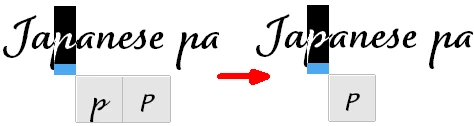
 

So, is there a setting in OpenType Features (or elsewhere in the settings) that will do what I want, selecting the first alternate glyph?
This topic has been closed for replies.
Correct answer Laubender

Hi OsakaWebbie,

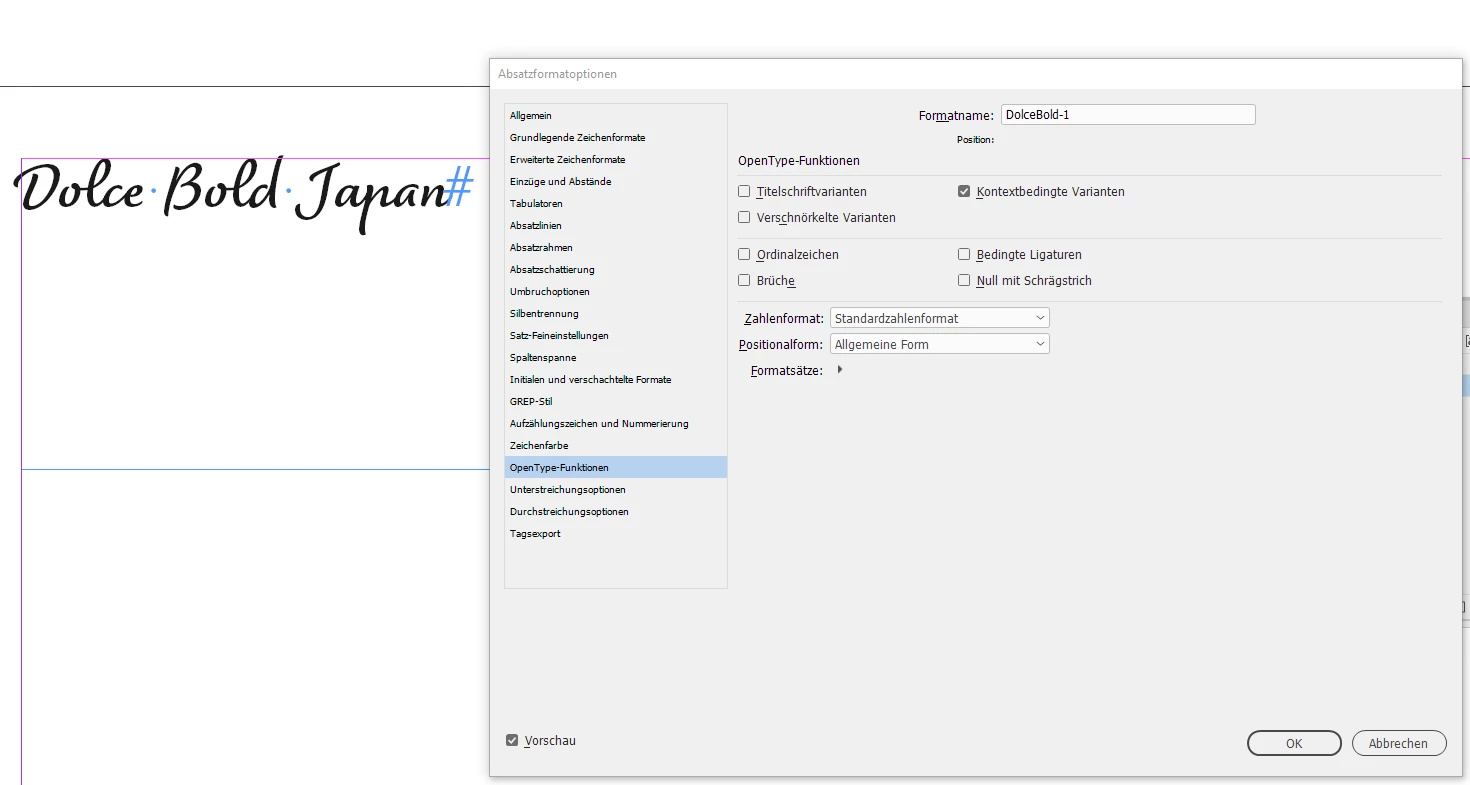
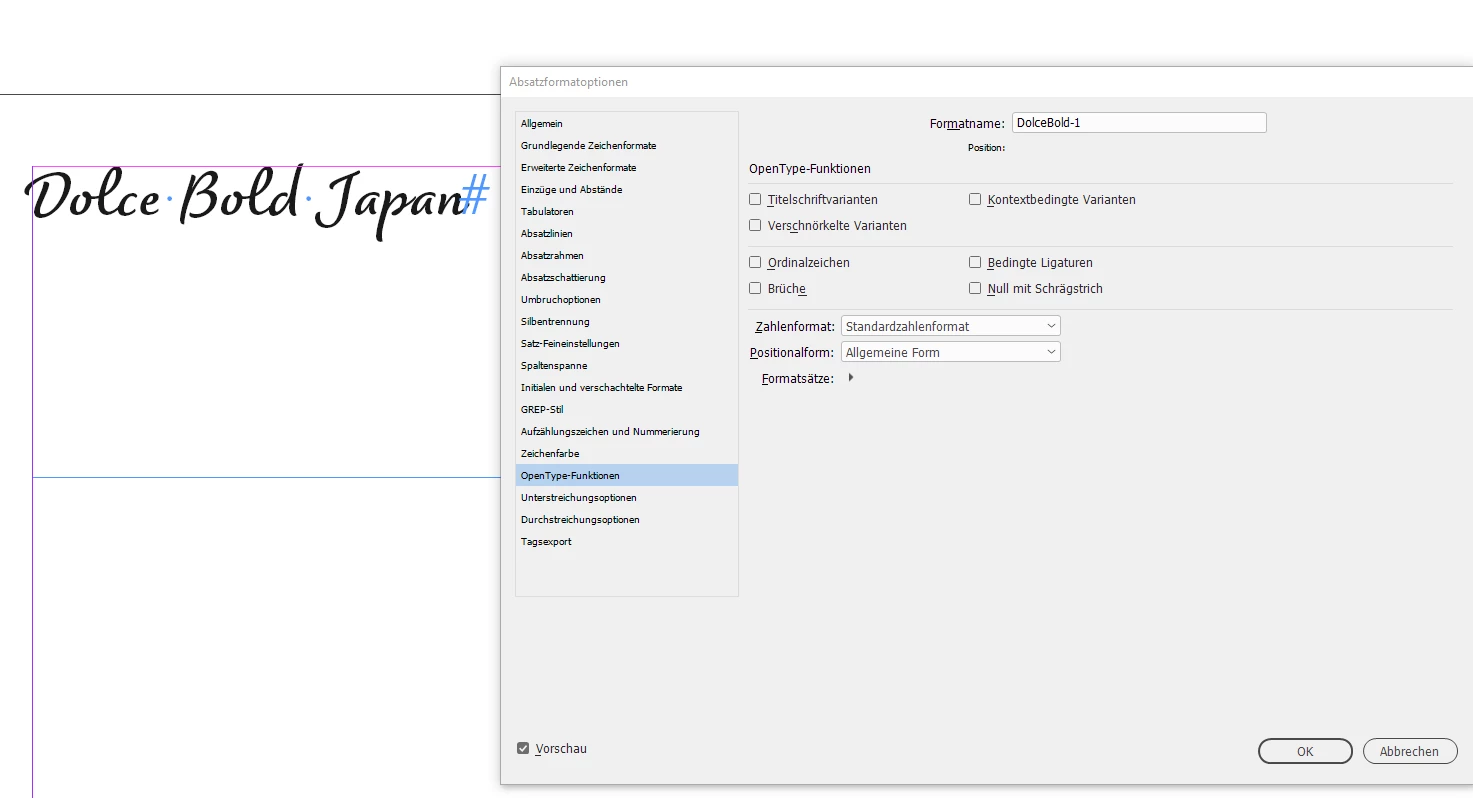
don't know how the exact English term for that Open Type feature is, but you should disable "Kontextbedingte Varianten" ( Contextual Alternatives ) that is enabled by default.


From my German InDesign 2022 with Dolce Bold activated through Adobe Fonts.

"Kontextbedingte Varianten" enabled.


"Kontextbedingte Varianten" disabled:


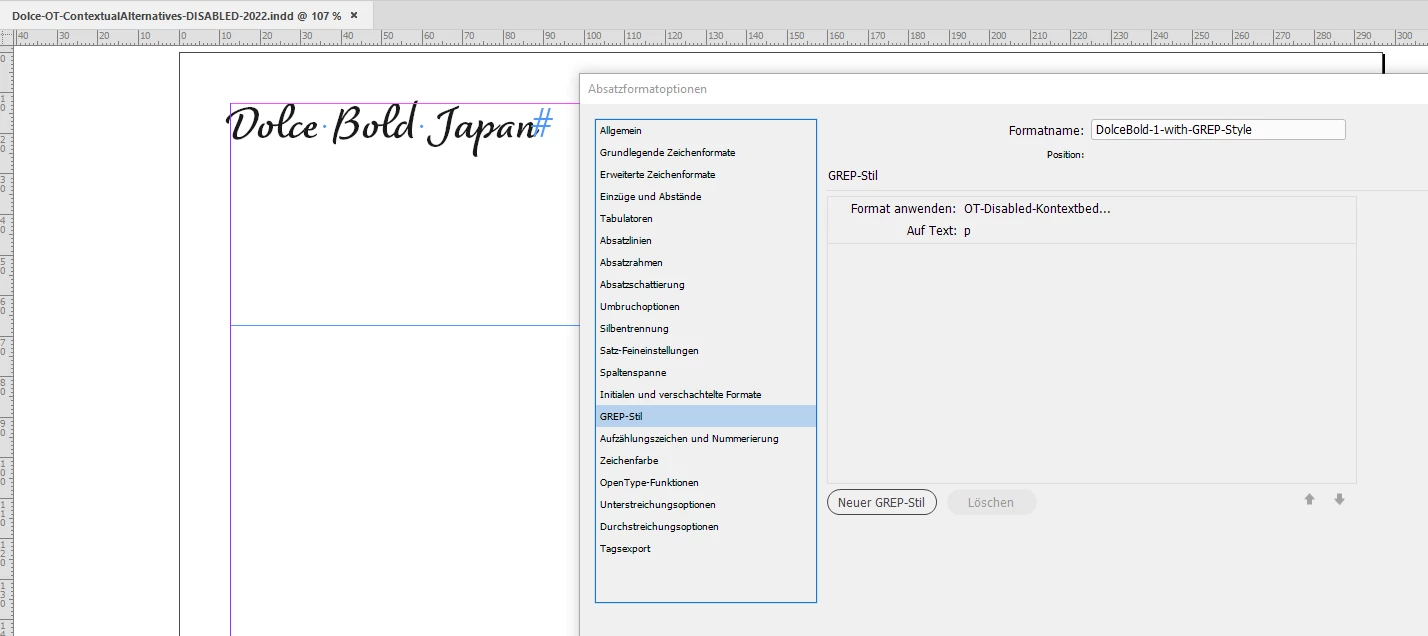
The paragraph style where I only disabled "Kontextbedingte Varianten" for character "p" only:


Download a document from my Dropbox where I did this with a character style that is used by a GREP Style for every character "p" in a paragraph:

https://www.dropbox.com/s/wlcgrzluz3ylf95/Dolce-OT-ContextualAlternatives-DISABLED-2022.indd?dl=1


Regards,
Uwe Laubender

( ACP )


1 reply

LaubenderCommunity ExpertCorrect answer
Community Expert
February 17, 2022

Hi OsakaWebbie,

don't know how the exact English term for that Open Type feature is, but you should disable "Kontextbedingte Varianten" ( Contextual Alternatives ) that is enabled by default.


From my German InDesign 2022 with Dolce Bold activated through Adobe Fonts.

"Kontextbedingte Varianten" enabled.


"Kontextbedingte Varianten" disabled:


The paragraph style where I only disabled "Kontextbedingte Varianten" for character "p" only:


Download a document from my Dropbox where I did this with a character style that is used by a GREP Style for every character "p" in a paragraph:

https://www.dropbox.com/s/wlcgrzluz3ylf95/Dolce-OT-ContextualAlternatives-DISABLED-2022.indd?dl=1


Regards,
Uwe Laubender

( ACP )


OsakaWebbie
Inspiring
February 17, 2022

That was perfect - thank you! I guess the override called "OT contextual alternates" was actually saying that it was disabled, not enabled - that hadn't occurred to me.