Hi @Serssmart,
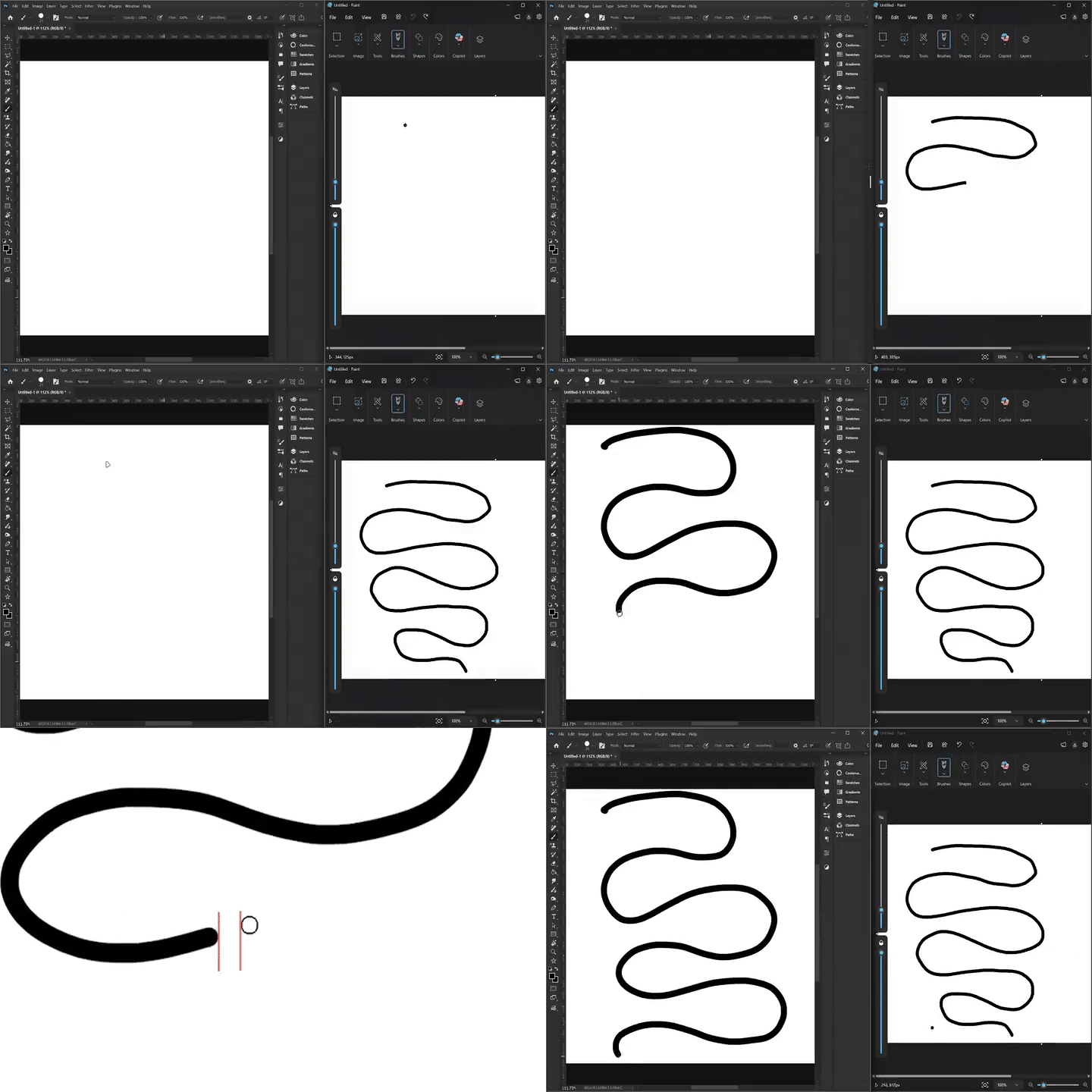
First, I want to apologize for the delayed response. You're raising a valid observation, and you're not the only one who has noticed it. The difference you're seeing is real and comes down to a fundamental architectural difference in how Photoshop renders brush strokes versus lighter paint applications.
When you draw a stroke in Photoshop, the engine isn't simply writing pixels to a flat bitmap. Every single brush stamp is composited in real time against your entire layer stack, honoring blending modes, masks, adjustment layers, smart filters, color management profiles, and bit-depth precision. This is what allows Photoshop to support non-destructive workflows, CMYK/LAB color spaces, 16/32-bit depth, and the full range of brush dynamics (pressure, tilt, rotation, scatter, texture, dual-brush) simultaneously.
Applications like MS Paint or even Clip Studio Paint operate on a fundamentally simpler rendering model, either writing directly to a flat raster buffer or compositing against a much lighter layer model with fewer simultaneous dependencies. That simpler path naturally results in lower per-stroke latency because there's dramatically less computation happening between your pen input and the pixels appearing on screen.
So what you're experiencing isn't a bug or a misconfiguration on your end; it's the inherent cost of the compositing depth that powers everything else Photoshop does. Your observation that older versions like ME7 felt snappier is consistent with this as well; those versions had a simpler compositing pipeline with fewer capabilities to account for.
That said, this is absolutely something our engineering team is aware of and takes seriously. Thank you for taking the time to document this so thoroughly, and again, my apologies for the late reply.
Best,
Anshul Saini




 AdChoices