
Doc_Pit
Inspiring
January 19, 2026
Question

Problems with aliasing around selections

  • January 19, 2026
  • 2 replies
  • 83 views

My question addresses artifacts resulting from selections.

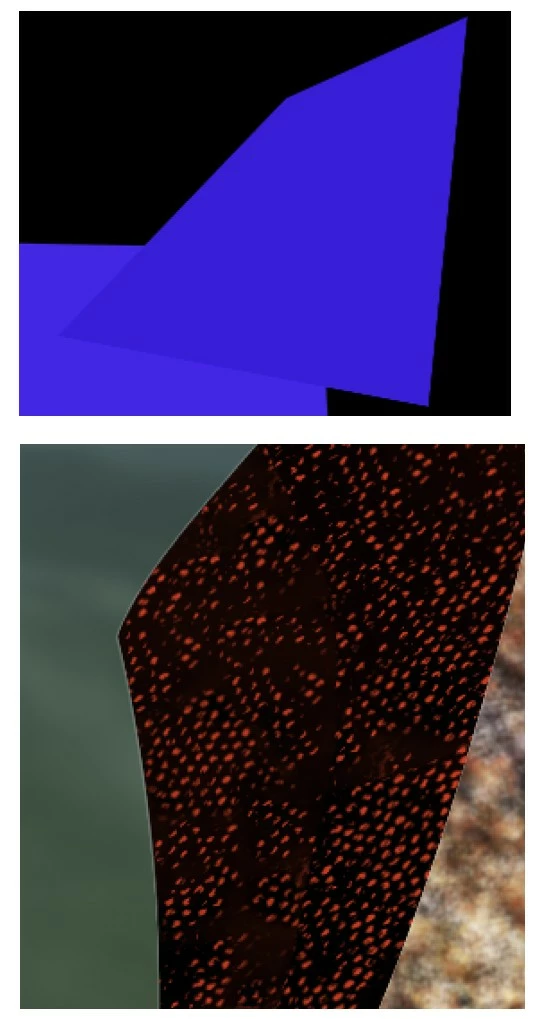
In the first image, I simply drew a selection rectangle with zero feather.  (Anti-alias was grayed-out.)  I then used alt-backspace to fill the selection with the foreground color.  The edges of the filled selection are perfectly smooth.


Then, I used the pen tool to draw a path, converted the path to a selection (feather radius = 0, anti-aliased checked), then used content aware fill to fill-in the area.  The edges of the filled area are (1) not smooth like the original rectangle and (2) are substantially different from one another.  The edge furthest to the right shows the most obvious jagged edge.


The second image shows a path, converted to a selection, then filled with the content-aware fill command.  Notice the slight jagged edge and white line.


These images are shown at high magnification.  However, the artifacts are visible at Print View.  More to the point, I would just like to know what causes this aliasing (if that’s what it is) and how to avoid it.  Any explanation would be much appreciated.alias.jpg
2 replies

Hannah Nicollet
Community Manager
Community Manager
January 26, 2026

Hi @Doc_Pit @Sameer K 

This is a workflow issue. I'll explain below.

Thanks!
Hannah Nicollet
QE, Photoshop

What's
 Causing the Artifacts

  1. Anti-aliasing Creates Partial Transparency:
  • When you convert a path to selection with anti-aliasing enabled, Photoshop creates partially selected pixels along the edge (typically 50% or varying opacity)
  • These edge pixels are designed to create smooth curves on solid backgrounds
  1. Content-Aware Fill + Partial Selection = Artifacts:
  • Content-Aware Fill synthesizes new pixels based on surrounding content
  • When operating on partially selected edge pixels, it tries to fill them proportionally
  • The algorithm may not produce consistent results for these semi-transparent edge pixels
  • This can lead to:
  • Jagged appearance
  • White/light halos (unfilled partial pixels)
  • Inconsistent edges around the same selection
  1. Why Edges Vary:
  • Content-Aware Fill is analyzing different surrounding content at each edge
  • The algorithm's synthesis differs based on local context
  • Partial selection opacity interacts unpredictably with the content generation

How to Avoid These Artifacts

Option 1: Use feathering instead of anti-aliasing
  • Set anti-alias to OFF, use feather radius of 0.5-1px instead
  • This may provide better blending for content-aware operations
Option 2: Expand/contract selection
  • After converting path to selection, use Select → Modify → Expand by 1px before filling
  • Or use Contract to ensure clean boundaries
Option 3: Use different fill methods for anti-aliased selections
  • Content-Aware Fill works better with hard-edged selections
  • For anti-aliased selections, consider using a cloning or healing brush manually along edges after fill
Option 4: Post-process the edges
  • Fill with Content-Aware first (anti-alias off)
  • Then manually blend edges with blur or smudge tools if needed

Doc_Pit
Doc_PitAuthor
Inspiring
January 30, 2026
Thank you. Much appreciated.
Sameer K
Community Manager
Community Manager
January 19, 2026

Hey, @Doc_Pit. Thanks for the detailed post. Although I think this might be the expected outcome for the workflow you've shared, I've still shared it with the team to review and confirm. 


Thanks!
Sameer K
(Type '@' and type my name to mention me when you reply)