
Participant
September 17, 2022
Answered

Import psb to ID on Mac (using command + D)

  • September 17, 2022
  • 3 replies
  • 2397 views

Hi, 
I have a new Mac Book Air and want now to import a psb file into InDesign by using command+D function.

When doing so I can´t choose the psb files but only jpeg and others.
On Windows it is possible, does anybody know how to solve this?

Thanks!
This topic has been closed for replies.
Correct answer rob day

Hi @Anne26161258femd , Try dragging and dropping the .PSB from either the Finder or Bridge:


3 replies

Participant
September 18, 2022

Thank you @Willi Adelberger and @rob day for the fast and god help. I will try it. 

rob day
Community Expert
rob dayCommunity ExpertCorrect answer
Community Expert
September 17, 2022

Hi @Anne26161258femd , Try dragging and dropping the .PSB from either the Finder or Bridge:


Willi Adelberger
Community Expert
Community Expert
September 17, 2022

Save as TIFF and import that. PSB is not supported under every condition in InDesign.

Community Expert
September 18, 2022

Hi Willi,

I disagree. PSB is supported. Nothing bad will happen if you find a way to place or import a PSB file.

On Windows, one could use the Place dialog and reset the filter for files to *.* so PSB files are visible while placing, on Mac and Windows one could drag a PSB file to the layout from Finder or file Explorer.


Regards,
Uwe Laubender
( Adobe Community Professional )

James Gifford—NitroPress
Legend
September 18, 2022

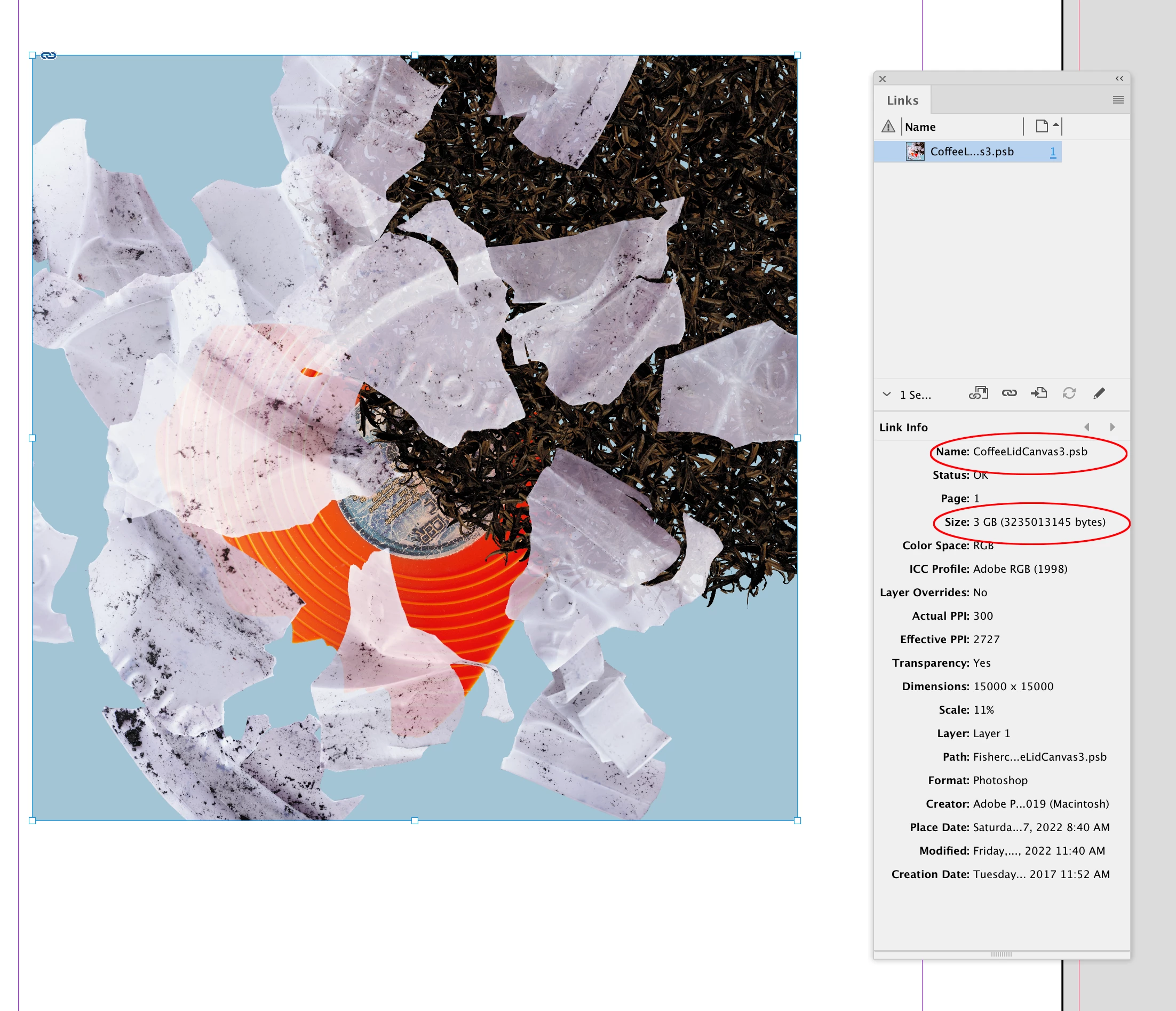
Hi James, I place .psb’s for large format art prints when I don’t want to place and manage an extra flattened copy.


This 3GB example has 23 layers, 10,000 x10,000 pixels with an Effective output res of 263ppi. InDesign has no problems displaying it—the ID file size is only 2.7mb.


It exports with no problem to a PDF/X-4 keeping the same dimensions—with Maximum Quality Compression the PDF is 19.8MB(!)


As long as you're using the immense resolution. I see way too many designers using huge-rez images directly for fairly small print use, and maxing out all those resources when it can be avoided is what leads to all kinds of trouble.


That is, they don't realize that while having a max-res master is a good thing, a reduction to more reasonable proportions, matched to the need, is often a better thing for day to day work.