Robert at ID-Tasker
Legend
March 30, 2025
Answered

(Most common) signature folding patterns

  • March 30, 2025
  • 5 replies
  • 645 views

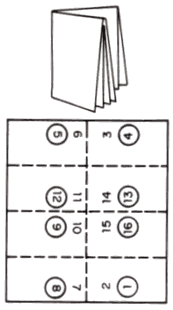
Unfortunately, I don't have access to a big printing facilities - so, can anyone suggest (most common) folding patterns? 


Something linke this: 
 

TIA 

 

Correct answer Colin Flashman

Consult the CIP4 guide - https://www.cip4.org/files/cip4-2022/Documents/Specifications/XJDF%20Specification%202.1.pdf

Starts at page 425. Programs like Fuji XMF and Agfa APOGEE imposing software do reference the fold patterns referenced such as F16-6.

5 replies

Dave Creamer of IDEAS
Community Expert
Community Expert
March 30, 2025

Here is another simplier breakdown of a 16-page sig:

Source: https://www.chinabestprinting.com/blog/post/print-signatures


Take total page count of document, divide by 16. If you end up with fractional sigs, you will need to run an 8 and/or 4 page sig. For example, if a 64 page document, that would be four 16-page sigs; if a 68 page document, that would be four 16-page sigs and one 4 page sig. (Covers are usually printed separately as 4-page sigs.) Larger sigs are generally less expensive that smaller sigs, depending on the press of course.

Here is how the page numbering is affected...

Perfect Bound: the signatures are just run sequentially, with the page numbers increasing incrementing. For example: 1-16, 17-32, etc.

Saddle-Stitch: Page number is broken down as follows: each spread should add up to the total page count plus 1, but the last 8 pages from each sig starts from the back. For example, the first sig would be 1-8, 64-57; the second sig would be 9-16, 56-49, and so on. Note that in a 64-page document, pages 64 and 1 are together (=65), 2 and 63 (=65), etc. 


David Creamer: Community Expert (ACI and ACE 1995-2023)
Colin Flashman
Community Expert
Colin FlashmanCommunity ExpertCorrect answer
Community Expert
March 30, 2025

Consult the CIP4 guide - https://www.cip4.org/files/cip4-2022/Documents/Specifications/XJDF%20Specification%202.1.pdf

Starts at page 425. Programs like Fuji XMF and Agfa APOGEE imposing software do reference the fold patterns referenced such as F16-6.

If the answer wasn't in my post, perhaps it might be on my blog at colecandoo!
Robert at ID-Tasker
Legend
March 30, 2025
quote

Consult the CIP4 guide - https://www.cip4.org/files/cip4-2022/Documents/Specifications/XJDF%20Specification%202.1.pdf

Starts at page 425. Programs like Fuji XMF and Agfa APOGEE imposing software do reference the fold patterns referenced such as F16-6.


By @Colin Flashman


THAT'S GOLD 😄 😄 THANKS 😄


I hope I can use this info - it's not copyrighted or something? There is a Copyright Notice at the beginning.


Robert at ID-Tasker
Legend
March 31, 2025

Pretty much, all those combinations can be already done in the free version of IDT - not as effective as in the paid version - but 100% doable - INCLUDING all the creeps, etc. 


Robert at ID-Tasker
Legend
March 30, 2025

@James Gifford—NitroPress, @Dave Creamer of IDEAS


Pretty much - anything you have / know / can share. 


Just to know more. 


James Gifford—NitroPress
Legend
March 30, 2025

Not sure what you're asking. Is this for booklet? brochure? cut-down? What's your end goal, that is?

Dave Creamer of IDEAS
Community Expert
Community Expert
March 30, 2025

What bindery method? 

If saddle-stitch, the signature page count would matter (4, 8, 16, 32) and over all project page count would matter.

If perfect bound, the signature page count would matter.


David Creamer: Community Expert (ACI and ACE 1995-2023)