Participating Frequently
February 14, 2018
Answered

PDF Accessibility: Master page items artifact by default-how to change?

  • February 14, 2018
  • 5 replies
  • 7934 views

Hi,  I'm working in CC 2018, InDesign 13.0.1 on a Mac running OS Sierra. The recent updates have played havoc with the accessibility of master pages in my templates for technical documents and newsletters. We keep disclaimers (including links to URLs and email addresses), mastheads, banners, etc on the master pages so we can better control design and reading order by using a combination of articles and layers. The new CC InDesign versions automatically artifact all items on master pages and I can't figure out a way to make them active again. Also, the URLs on the master pages are now dead, even though they work if I move them off the master pages onto a "live" page. Does anyone know a way to make the master page items active again? We must make the changes in InDesign, not wait and do it in the exported PDF because we are frequently making changes to these documents and don't have the time to constantly remediate newly exported PDFs. This impacts many, many of our documents and publications, which all have to be accessible.

Thank you!

sunnibeemt
This topic has been closed for replies.
Correct answer Dave Creamer of IDEAS

No offense taken Sunnibeemt. Email and forum posts don't come across with the right inflections sometimes ;-)

I can tell you that the users involved, work in a variety of sectors including government but I can't say that STEM was in that mix. I'm happy to hear about the things that you'd like added. Maybe you could direct message me and we could exchange information.

What I was referring to regarding master pages is that in InDesign, typically master pages contain header and footer information that we want to be artifacted on every page. The latest version does a pretty good job of accomplishing that and for most projects that is what my expected behavior would be. That being said, some projects (one recently) made me realize that although this is the case most of the time, there are valid cases where I would not want that to happen. It's definitely something that I plan on bringing up to the InDesign development team. As Steve Werner pointed out, anyone can submit feature requests to Adobe and the more requests they get, the greater the chances that we'll see this change implemented.


Here is what I would do...

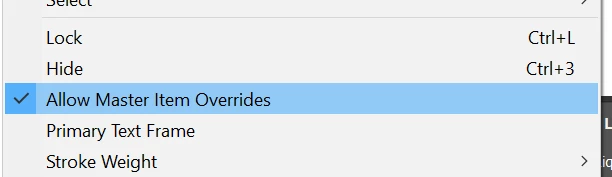
On the master pages, mark all the items that you WANT to artifact by turning OFF Allow Master Item Overrides

Leave the other items you want "live" as is.

In your Pages panel, select ALL the pages (click on first page, shift-click on last).

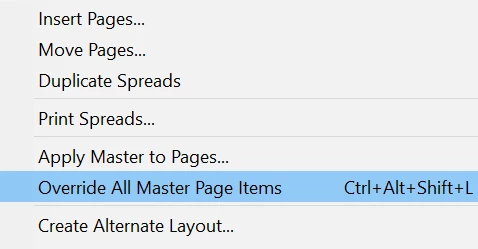
Right click and select Override All Master Page Items.

5 replies

Jaz Harlow
Participating Frequently
February 29, 2024

Setting accessible headers and footers

I commented a year ago and now I better understand the problem regarding accessibility and have a potential solution that might help some people. I now understand that content information should NOT be contained in the Parent pages, which for me, presented a problem with footer text that I want to be the same on each page.

Note: I will address hyperlinks at the end.

To overcome the problem, I created a new layer on top of all others that the header and/or footer would sit on. I created the footer in a text box on one page, applied the appropriate paragraph style, and created an object style for it. In the object style, I controlled the positioning, so it would default to the correct position on the page whenever that object style was applied. I made four versions of this object style for when the text was to be on the right hand side or left hand side or if I wanted the text light or dark. (There might be a more efficient way to do this, feel free to suggest).

As an example, here are the settings of one of my object styles, which I named "Footer LHS dark". I unchecked all of the Basic Attributes, except for:

  • 'Size and Position Options' - no need to set the Size, it can be left on 'Adjust: None'. As this is a footer for the left hand side, my Position options are:
    • 'Adjust: X & Y';
    • 'Reference Point:' set to the lower left square - this is the reference point of the object, not the page;
    • 'X Offset: 9mm';
    • 'From: Page Edge' – it uses the left side of the page as its 0 reference;
    • 'y Offset: 291mm' – it uses the top of the page as its 0 reference;
    • 'From: Page Edge';
  • 'Paragraph Styles' – set it to use the appropriate paragraph style, the one I used sets the text styles and sets: Align 'Away from Spine'. I have another paragraph style for light text:
  • In the 'Export Options' make sure "Tagged PDF" is selected;
  • In Tagged PDF set:
    • 'Apply Tag: Artifact';
  • NOTE: I am not an accessibility expert, I would love to know if there are any other settings I should be building in to this process for accessibility best practice. Please let me know!
  • Press 'OK'

If necessarly, you can make other versions for the right hand side of the page and to apply light or dark schemes as I have. I found it helpful to set them in "General" to be "Based on…" the first/main object style.

The header and footer can be placed on the top layer each page, and the object style will ensure the positioning is correct. If you are retrofitting this solution, you could:

  1. Make a new Parent page;
  2. Put the header and footer details on it in the correct position;
  3. Apply it to all pages and then right click the Pages menu and select Override All Parent Page Options;
  4. Return each page to whatever the original Parent Page(s) were.

Or, copy > paste in place is your friend. 

On hyperlinks

It is my understanding that hyperlinks can not be set to Artifact, nor should they be able to be, as this would provide information to some people but not others.

If hyperlinks are repeated on every page, the document would not be accessible due to redundancy. More info on reduntant links is here https://app.pope.tech/result-documentation/articles/redundant-link

I have begun to discourage clients from adding hyperlinks that do not add value, but this might not always be an option. It might be up to the client to choose to have redundant links and forfeit the accessibility of the document, or give up the repetitive hyperlinks for the greater good.

Feel free to correct me on anything or offer alternative solutions! Hope this helps someone. Much thanks to @Bevi Chagnon - PubCom.com and @Willi Adelberger for helping me understand the issues at play.

Jaz Harlow
Participating Frequently
February 29, 2024

I also meant to add that if the header/footer needs a content change, it would be easiest to do this in the Find/Change window. You can specify that it Finds whatever text with the paragraph style applied to it and change it throughout the document.


My main reason for wanting the repeating content in a Parent page was to enable me to make changes throughout the document from one place, but this can be achieved using Find/Change for content changes, and adjusting the object style for position changes.

Jaz Harlow
Participating Frequently
February 7, 2023

This is not solved. I'm still having the issue with hyperlinks in the Parent page in 2023. Doesn't matter if I have them checked as "Allow Parent Override Items" or not. It still throws a tagging error in Acrobat. @hammer0909 Do you know if there has been any further update on this? I've done your accessibility courses on Linkedin Learning, super helpful. Any help is appreciated!

Inspiring
August 12, 2023

The solution from Creamer Training does not work and it is 2023

Willi Adelberger
Community Expert
Community Expert
August 12, 2023

Master/Parent Pages cannot and must not have any content items. They have to have the global orientation, margins, running headers via variables, page numbers markers, background color or images, nothing else. If you want to make any item to content and move it into the structure you have to everride them on the pages. 
I think, that often used items can be placed on the master/parent. That is ok, but they have to be overriden. Otherwise they are not part of the content, they remain artifacts and are even ignored in several EPUB exports.  

hammer0909
Community Expert
Community Expert
February 25, 2018

Just to be clear, the items you don’t want Artifacted, you have the allow checkbox enabled. The things you do want artifacted have allow disabled. Did you then select all of the pages in your document and choose override all master page items before exporting to PDF?

Participating Frequently
February 25, 2018

Yes, applicable master page items are overridable. I also made all pages overridable per your instructions. My disclaimers and banner/flag/masthead-type info come across into the pdf as artifacts that would have to be remediated. The live text and URLs are dead. I tried it several times, using different master page configurations and then moving the info onto actual pages instead of master pages (which, of course, works for accessibility, but not for workflow). 

I can't share the sample because it is not for release. I can try and make up a blank sample at a later date and see if you can troubleshoot it, but this week I will be in travel status and won't be available.

Note: My previous default procedure was to leave all master page items overridable and to manually mark the ones I want artifacted. To do so, I chose applicable items, right-clicked, and used the object export options menu to select "artifact." Because many of my master ages are based on others, the artifacts followed through and the live stuff stayed live. I didn't have to override all pages at that point unless there was a different design reason.

hammer0909
Community Expert
Community Expert
February 25, 2018

This absolutely works like a charm for me. I've attached a sample file for you to see. If you select all of the document pages and choose "Override All Master Page Items" from the Pages panel menu and then export the PDF. The items that say "don't artifact me" are tagged and the items that say "artifact me" are not tagged.

https://adobe.ly/2CjjtHr

hammer0909
Community Expert
Community Expert
February 15, 2018

Hi Sunnibeemt,

Steve Werner is correct in his assumption about your situation. I recently ran into a situation with a project that had a notes field on each page of the document. I put the notes field on the master page to ensure that it appears on each page in the same location but upon export, realized that those items don't get tagged.

I attempted a scripting approach to the solution but an InDesign scripting but reared its ugly head and prevented me from being able to override the object on all pages.

The reality is that more often than not, having master items artifacted is the desired result. But in certain cases like the one that you're describing, it would be nice to have an option to NOT have the item artifacted but instead have it appear tagged on each page. I'm afraid the only option I can suggest is to manually override those items from the master prior to export. In my case i was able to create a pseudo solution by putting the object on a document page and then using a script to copy the object onto each page. This still isn't an ideal solution because the tag doesn't appear at the proper location in the Tags pane without further refinement.

I wish I had a better answer for you but I'm afraid this is the current behavior. Let me know if you have any other questions!

Community Expert
February 15, 2018

https://forums.adobe.com/people/Chad+Chelius  wrote

… I attempted a scripting approach to the solution but an InDesign scripting but reared its ugly head and prevented me from being able to override the object on all pages. …

Hi Chad,

did you discuss that scripting problem in the Adobe InDesign Scripting forum?

InDesign Scripting

If not, I would suggest to do so and share your code. I guess, there is a solution for this. Whatever the exact cause of the issue is…

Regards,
Uwe

hammer0909
Community Expert
Community Expert
February 15, 2018

Hi Uwe,

I should have been clear that my good friend Keith Gilbert wrote the script, not me personally. Apparently it's a known issue and I'm sure has been reported on the Scripting forums. It was an issue where when you overrode an object on a master page via scripting, the position of the object randomly changes.

Steve Werner
Community Expert
Community Expert
February 14, 2018

I'm not an expert on accessibility. I have viewed discussions with those who use these features, and those active in the field of accessiblity have said that artifacting master page items was the correct way for accessiblity to work. As a result of discussions as the feature was being developed, it was described like this (which I included in my article about CC 2018 features in InDesign Magazine #103:

"Master Page Tagging is now handled properly: page objects on a master page now correctly show an artifact tag in Acrobat. When a master page object is overridden, it will now show the tags of such an object."

As far as I know, there is no option for turning this off, and items which you don't want to be artifacted will have to be overridden on document pages.

I'm hoping that Chad Chelius, an Adobe Certified Professional, and expert on accessibility (he's the author of several excellent Lynda.com video courses on accessibility) will see this discussion and respond. There aren't a lot of people who specialize in this field and participate in this forum.

I'm modifying the topic title to make it clearer that this is a PDF Accessibility issue.

Participating Frequently
February 18, 2018

Dear Steve, et al:

Sorry for the delay in answering. I was traveling and I hadn't saved my login info for this forum and couldn't respond from my phone.

Background: I am an advanced accessibility designer, considered a subject matter expert in my technology program.

FYI: There is a work-around. Use the TURO (touch up reading order) tool in Acrobat accessibility tools. But that is an "after-the-fact" added burden, especially given that these pubs are drafts that are changed frequently or finals that are updated frequently and now it has to be done on each one, each time.

Personal comment: I was told that the folks at Adobe didn't get feedback from (very many) actual (read: advanced) users when they made the decision to artifact all master page items. Section 508 (accessibility) requires that all essential information must be available to all users whether or not they use assistive devices. Although running headers/footers, page numbers, background designs, etc., are not essential information, there is MUCH essential information that designers want on master pages so they don't have to manually place them on each page and work them into the correct reading order. I dread having to thread or anchor, in a consistent manner, the word "DRAFT" into every page of a 300+-page book or even on a few pages but in multiple publications. This is one area where all Adobe has to do is make this a "toggle" situation in InDesign, selectable in the preferences or under Master Page options.

As for scripting, it's a nice idea, but, in addition to the problems you mention above, my IT department would need to vet any scripting before I could bring it onto my machine (not a likely scenario). As I said above, Adobe could simple toggle it, or allow us to select and convert. Right now, all master page items are treated as objects in InDesign, even if they are text boxes, and there is no way to convert them to anything else in the native program (at least no way that I could figure out).

Thank you for your input.

Sunnibeemt

hammer0909
Community Expert
Community Expert
February 19, 2018

Hi Sunnibeemt,

The workaround that you provide is pretty obvious. I was assuming that you were looking for a solution in InDesign. Using the TURO tool (old name), now the RO tool certainly works but is completely manual. Not ideal.

I can assure you that Adobe had the feedback of at least 3 advanced users who were to some level responsible for the features that we did get in InDesign CC 2018. It's easy to look back in hindsight to say "we should have done it this way", but the reality is that the bigger problem of master page items not getting artifacted was mostly resolved. I'd have to say that the larger majority of users want this behavior. Would it be nice to have a toggle switch to turn it on and off? Certainly, but to say that it would be easy for the developers at Adobe to do this is likely not the case. What I've learned is that things can sound really easy from a user perspective but are quite difficult from a development perspective. I certainly would like to have that option as well. There is still work to do with InDesign accessibility but we've taken a large step forward.

I'm sorry that my scripting suggestion won't work in your environment but it sounds like that's an internal issue beyond my (and your) control. It is however a solution that can work quite well.