

YvonS
Known Participant
September 12, 2022
Answered

Tab order in pdf doesn't work (no fields or forms, just text blocks)

  • September 12, 2022
  • 3 replies
  • 6935 views

I've seen more threads about this subject, but haven't found a satisfying answer yet...
I'm trying to create an accessible pdf-file from an InDesign file (a flyer with a lot of small text blocks; no threading). I followed all the steps in this (excellent!) description: https://helpx.adobe.com/indesign/using/creating-accessible-pdfs.html, (among other things) setting the (desired) order in the Articles panel. I thought that would determine the reading order in my pdf. After exporting, the reading order as shown in Acrobat's accessibility tool is just totally random (and not at all the order I put in the Articles panel). (I can't post any screenshots cause my client's information is confidential)
I read some posts where people said 'Acrobat doesn't show the right order, but in practice it does have the right order' but how can I check this? I tried the VoiceOver function on my Mac, but I guess I need more training to be able to use that properly (besides: it shouldn't be necessary - though it is a great user's test).
Can somebody please enlighten me and help me solve my problem? 
This topic has been closed for replies.
Correct answer Frans v.d. Geest

Thanks so much @Dave Creamer of IDEAS and @Bevi Chagnon - PubCom.com for your help so far! The blog is very useful, as is your plan of action [recommende reading!].

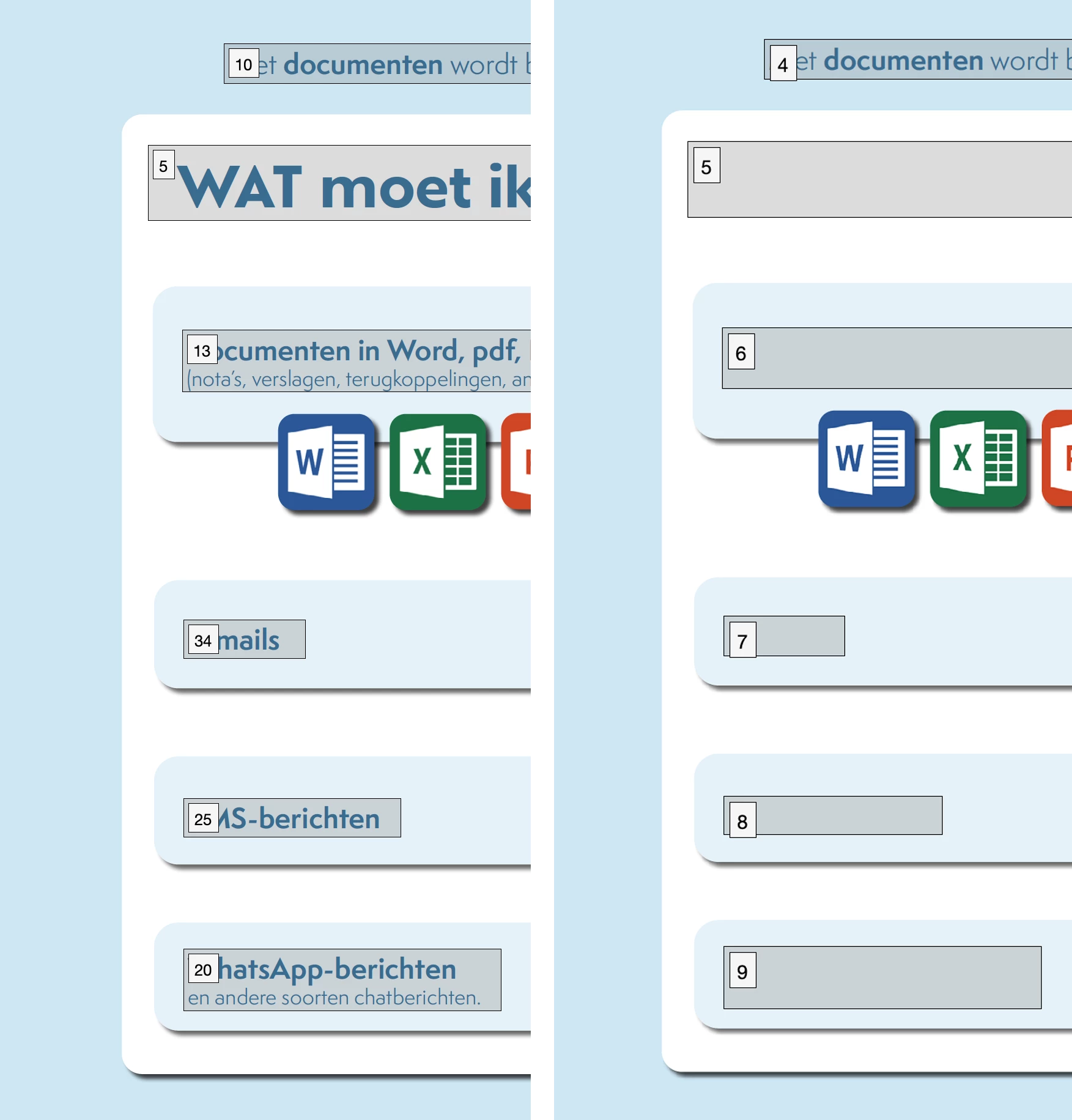
Tag RO and Tab RO are all set in my document, but it gets messy when I try to fix the architectural RO… This order is totally messed up in the first place; probably follows too much of the order in the Layers panel? And that just doesn't make sense to me at all - why would they use the stacking order of my visual elements to dictate a reading order…? I tried to fix this, but here arises the next problem: when I do, my tekst disappears - looks like it ends up behind one of the white/blue blocks (as shown in screenshot: left: original order in the order panel; left: what happens when I try to correct it…)


Don't drag that order in Acrobat, it is like dragging text below frames in InDesign (top/bottom)!

The Article panel ONLY sets the Tag order; the Layer panel sets the Reading/Z/Logical (whatever you want to name it) order, and that one is from bottom to top! So go back, open the Layers panel and there place them in the order you want: bottom ('1') and then stack up. So a bit 'reversed' in what you see in the tags-tree (Article panel).

3 replies

Dave Creamer of IDEAS
Community Expert
Community Expert
September 12, 2022

Are you referring to "tab" order or "reading" order? Your title and text refer to different things.


David Creamer: Community Expert (ACI and ACE 1995-2023)
YvonS
YvonSAuthor
Known Participant
September 12, 2022

In human terms, it's the reading order: how the information should be read.
In Adobe terms I guess it's the tab order: the order in which a screen reader should be guided through the document in a logical way (either by tab or buttons/inputs). 

Bevi Chagnon - PubCom.com
Legend
September 15, 2022

Thanks for the detailed screen shot, @YvonS. It explains what you're trying to create.


Examining this from an accessibility viewpoint, you have a table of information that should be arranged in a spreadsheet matrix of columns and rows — there's the WAT column, and the HOE column that is further broken down into 2 sub-columns.


It really shouldn't be individual text blocks that you then have to wrangle into a correct Tag reading order and Architectural reading order.


A table structure is required because the user must be able to read down the first column and choose either Documents, E-mails, SMS, or WhatsApp, and then read across the row to find the screenshots or video instructions. This is exactly the correct functionality that a table structure gives end users. Plus, your reading orders are set perfectly!


I quickly created this sample that mimics your design (both the InDesign and PDF files are attached).


The key is that I created a table that sets the correct accessible structure for the content. And then I created Paragraph Styles to format the heck out of it. I heavily used the new Paragraph Shading and Borders settings in paragraph styles to create your design of the blue "hotdog" boxes.


By using Paragraph Styles to do the visual formatting, most of the text boxes are eliminated and your reading orders are left in tact. I did nothing to the PDF, other than to do the usual minor corrections to table span settings, which took all of 1 minute.


quote

... Do you see a way to make this simpler? 

By @YvonS


Yes.

  1. Minimize the number of frames in the design. Use background shading on paragraph styles where you can to create faux boxes that look like frames but aren't. Example, eliminating the 2 white "column" boxes and use cell formatting instead to make the 2 sides clearly visible. The blue hotdogs could also be replaced by simple cell formatting, too.
  2. Simplify the design. The design instrustry has been moving to a cleaner "flat" design aesthetic that uses flat color blocks, fewer rules/borders, and simplier designs. As a creative director of a small cadre of designers, I like this movement!


As Mies van der Rohe said, "Less is more."


And as Bevi Chagnon says, "Not only is 'less' more, 'less' is more accessible." <grin> (I have a degree in architecture and studied the philosophy of Mies and the Bauhaus movemement. Their theories have greatly affected my graphic design career ever since.)


Ooops!

Here are the sample files.


|&nbsp;&nbsp;&nbsp;&nbsp;Bevi Chagnon &nbsp;&nbsp;|&nbsp;&nbsp;Designer, Trainer, &amp; Technologist for Accessible Documents ||&nbsp;&nbsp;&nbsp;&nbsp;PubCom |&nbsp;&nbsp;&nbsp;&nbsp;Classes &amp; Books for Accessible InDesign, PDFs &amp; MS Office |
YvonS
YvonSAuthor
Known Participant
September 12, 2022

I did manage to change the order in Acrobat (see screenshot), but this also seems to change the stacking order (?) so the text in my blocks disappears...

Willi Adelberger
Community Expert
Community Expert
September 12, 2022

You should thread the text bloxks in the right order. If not, InDesign follows the order when these text rame were created.

I wonder why you use different text frames? In my experience most, near to all, layouts can be done in a single text frame. This will guarantee the right reading order.

YvonS
YvonSAuthor
Known Participant
September 12, 2022

Thank you, @Willi Adelberger for your reply.
I didn't use threads because there's no need for it; text blocks are standing on their own and I don't want text to flow into another block. It's more of an infographic/schematic visualisation, so I need to be able to position all the blocks very precisely. 
But I guess threading might be a workaround... 
Still hoping somebody can help me find a better method (like the one Adobe provides - but then with a better result)...