

Doc_Pit
Inspiring
October 31, 2017
Answered

Image Size vs. Canvas Size Question
  • October 31, 2017
  • 3 replies
  • 4000 views

    This topic has been closed for replies.
    Correct answer Cari Jansen

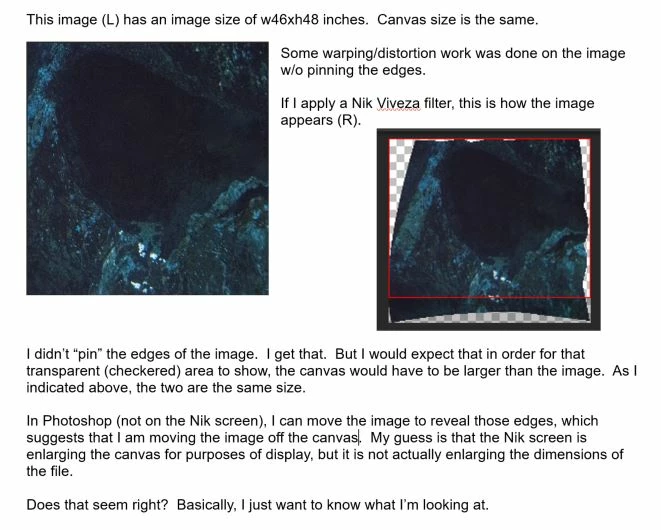
    You are right!  I never looked at it that way thanks for correcting me. You can have stuff from layers sticking outside the canvas size naturally and that makes the layer size (the bounding box around all image information in the layer) different from the canvas size.

    You don't see that however unless you move content around within the layer and make it visible again, or press Cmd/Ctrl-T for transform ;-). When you save the Photoshop file, and use it in other applications the visible area of the image will match the Canvas Size.

    3 replies

    Cari JansenCorrect answer
    Legend
    October 31, 2017

    You are right!  I never looked at it that way thanks for correcting me. You can have stuff from layers sticking outside the canvas size naturally and that makes the layer size (the bounding box around all image information in the layer) different from the canvas size.

    You don't see that however unless you move content around within the layer and make it visible again, or press Cmd/Ctrl-T for transform ;-). When you save the Photoshop file, and use it in other applications the visible area of the image will match the Canvas Size.

    Doc_Pit
    Doc_PitAuthor
    Inspiring
    November 2, 2017

    So, actually, there are three concepts, not two: canvas size, image size, but also layer size.  Thanks for the response.

    Conrad_C
    Community Expert
    Community Expert
    November 2, 2017

    Right. And if you ever want to see the true size of the largest layer in a document with no Background layer, choose Image > Reveal All. It will expand the Canvas Size to show all of the largest layer.

    Image > Trim is the opposite; it clips any overhanging layers to the Canvas Size. So will using the Crop tool at the current Canvas Size with Delete Cropped Pixels on.

    JJMack
    Community Expert
    Community Expert
    October 31, 2017

    Actually only the Background layer need to be canvas size and it does not support transparency.   Normal layers can be any size up to Photoshop max size.   Any part of any layer not over the  document canvas will be clipped  by the document canvas size. The pixels will be in the layer file unless the document is cropped and the cropped off pixels are deleted that a crop option.

    Some Photoshop features may change canvas size.  I think  remember seeing this when I rotated an image like 30 degrees  Photoshop added some canvas so none of the images pixels would be outside of the documents canvas.  But that may have been done by some script used or Adobe provided as part of Photoshop..Like Load files into a stack and align the stack.

    JJMack
    Legend
    October 31, 2017

    The canvas size is related to the image size (that is the w x h) of the image.  You can increase / decrease the canvas size by using the Crop Tool, or by using Image > Canvas Size. Consequently the physical dimensions (wxh) of the 'image' as you see it will also be adjusted.

    Photoshop's Warp will always initially retain the exact canvas size, which means you end up seeing transparent areas, but you can drag the corners outwards out of the canvas area, and thus transform the warped areas so you fill the entire canvas again, that's totally possible, so you can file the complete canvas area and not see the transparent areas.  Only thing to consider is that if your artwork is rasterised and you're not working with a Smart Object layer, you'll get some image resampling occurring as you transform things a second time, for background patterns etc. that's generally not an issue though.
