heshuimu
Participant
May 14, 2021
Answered

Understanding the purpose of "CAI Helper" installed by Photoshop 22.4

  • May 14, 2021
  • 5 replies
  • 107063 views

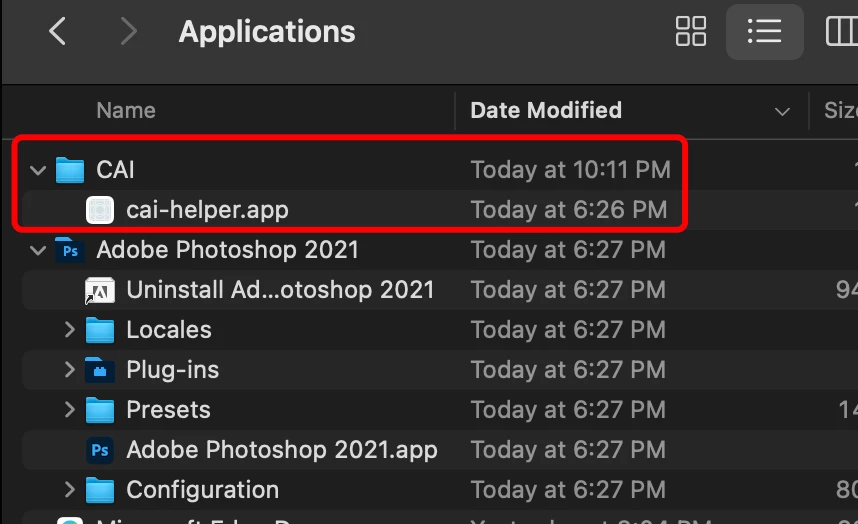
My Photoshop auto-updated to 22.4 earlier today, and I noticed an application called "cai-helper"appeared in my /Application directory. I thought it was malware, then I noticed that Photoshop mentioned it in "What's new" (but only there), and it was installed around the same time as Photoshop itself.


The app bundle did not give enough info to deduce what this is for. So the question is what does this thing do, and why is it not mentioned anywhere else? And why is it not inside the Photoshop directory?


Correct answer Conrad_C

@epic_daisy8731 wrote:

 If adobe really cared about artists they would do something about marketing firms and other massive companies that rob artists of their work. . 


The Content Authenticity Initiative largely exists because artists got sick of people ripping off their work, or altering their work without permission to create inflammatory images. Content Authenticity is a way to help prove who truly created and has the rights to an image, by using a voluntary provenance trail to distinguish an original work from unauthorized copies.


From the CAI home page:

“We are a community of media and tech companies, NGOs, academics, and others working to promote adoption of an open industry standard for content authenticity and provenance.”


It is not tied to one corporation. It is an open standard technology arrived at after discussions that included nonprofits and news organizations.


And no, a corporation probably wouldn’t do this out of the “goodness of their hearts” but if you follow the money, the motivation for Adobe would be better PR for Photoshop. For example, for many years the term “Photoshopped” has been used to mean “faked image,” so the company might have decided it was it in their best interests, commercially, to add technology that helps record and show how images have been modified or not modified, and also prove which creator really owns it. In other words, Photoshop is currently seen as part of the problem of image copying and theft, so adding Content Authenticity can now help Photoshop become part of the solution.

5 replies

PECourtejoie
Community Expert
Community Expert
September 14, 2022

Hello, a google search also gave me this helpx page: https://helpx.adobe.com/uk/photoshop/using/content-credentials.html

TheDigitalDog
Inspiring
August 25, 2022
Author “Color Management for Photographers" & "Photoshop CC Color Management/pluralsight"
Participant
August 24, 2022

I just had the pop-up from cai-helper asking for access to all my files, I paniced, shut down my PC and turned off my router to reset my IP address 😝
They really should have come up with a better name for this app that gave a clear link to it being part of Photoshop.

Participant
August 24, 2022

Same thing just happened to me

Participant
August 11, 2022

This is a huge over reach and a massive trojan horse for something insidious...Seems like i can see which way photosop is leaning politically because no corporation does anything like this out of the goodness and kindess of their heart....for the "artist" much less. No one give a crap about artists. They are free marketing and image generators. If adobe really cared about artists they would do something about marketing firms and other massive companies that rob artists of their work. 

Conrad_C
Community Expert
Conrad_CCommunity ExpertCorrect answer
Community Expert
August 25, 2022

@epic_daisy8731 wrote:

 If adobe really cared about artists they would do something about marketing firms and other massive companies that rob artists of their work. . 


The Content Authenticity Initiative largely exists because artists got sick of people ripping off their work, or altering their work without permission to create inflammatory images. Content Authenticity is a way to help prove who truly created and has the rights to an image, by using a voluntary provenance trail to distinguish an original work from unauthorized copies.


From the CAI home page:

“We are a community of media and tech companies, NGOs, academics, and others working to promote adoption of an open industry standard for content authenticity and provenance.”


It is not tied to one corporation. It is an open standard technology arrived at after discussions that included nonprofits and news organizations.


And no, a corporation probably wouldn’t do this out of the “goodness of their hearts” but if you follow the money, the motivation for Adobe would be better PR for Photoshop. For example, for many years the term “Photoshopped” has been used to mean “faked image,” so the company might have decided it was it in their best interests, commercially, to add technology that helps record and show how images have been modified or not modified, and also prove which creator really owns it. In other words, Photoshop is currently seen as part of the problem of image copying and theft, so adding Content Authenticity can now help Photoshop become part of the solution.
Participating Frequently
May 23, 2021