Andres007
New Participant
January 21, 2018
Answered

Washed out colors on After Effects when rendering - Using macOS High Sierra

  • January 21, 2018
  • 25 replies
  • 366064 views

I have found an issue that is driving me crazy when rendering any video in After Effects.

I am not sure if it is related to the last version of After Effects (I am using CC 2018), the last version of my Mac Book Pro, which is High Sierra, or both together. The truth is that is has never happened to me before.

When I render a video, no matter which format I choose it renders the video with washed out colours, or as if something had happened with the saturation of the picture.

This is the original illustration inside After Effects :

This is the results when I open the video on QuickTime (or importing the video to Photoshop in order to get the frames apart):

Note: thumbnails of Illustrator look the same on my desktop (washed out) + If I open the video in VLC colours are displayed correctly.

There must be something wrong with either CC or Mac.

If someone knows how to solve it, please let me know, I need to deliver a few projects and I haven't managed to find a solution,

Thanks,
Correct answer Andres007

After checking the issue I found out something that may be basic knowledge for experienced animators and designers in After Effects. For me is wasn't. And I also didn't find any forum where this issue was approached and explained using simple terms.

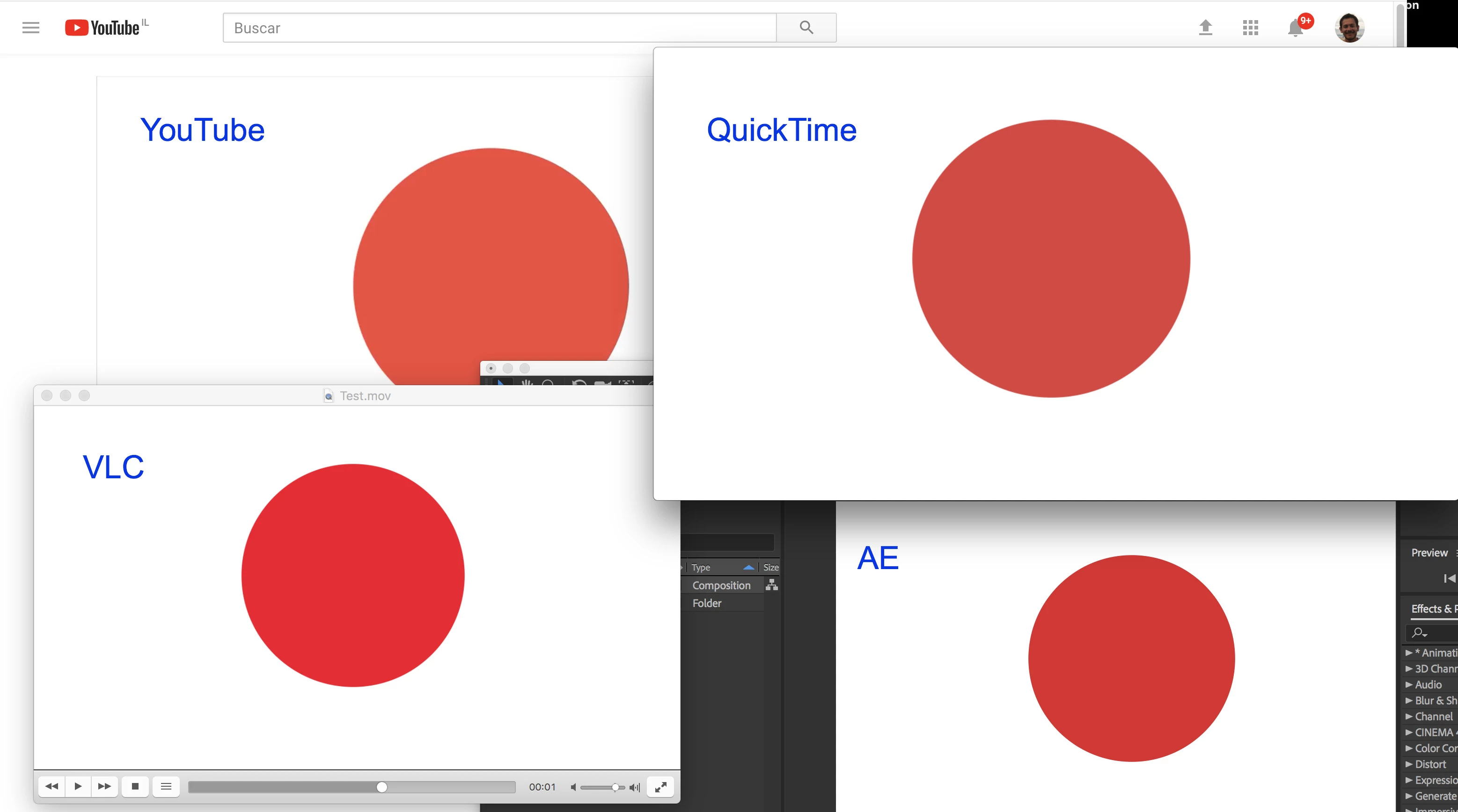
What I found is that colors may vary according to the video player as it is shown below (YouTube, QuickTime, VLC):

It is something I didn't notice when working on Windows, but now that I am working on Mac it is more noticeable to me as the screen is better.

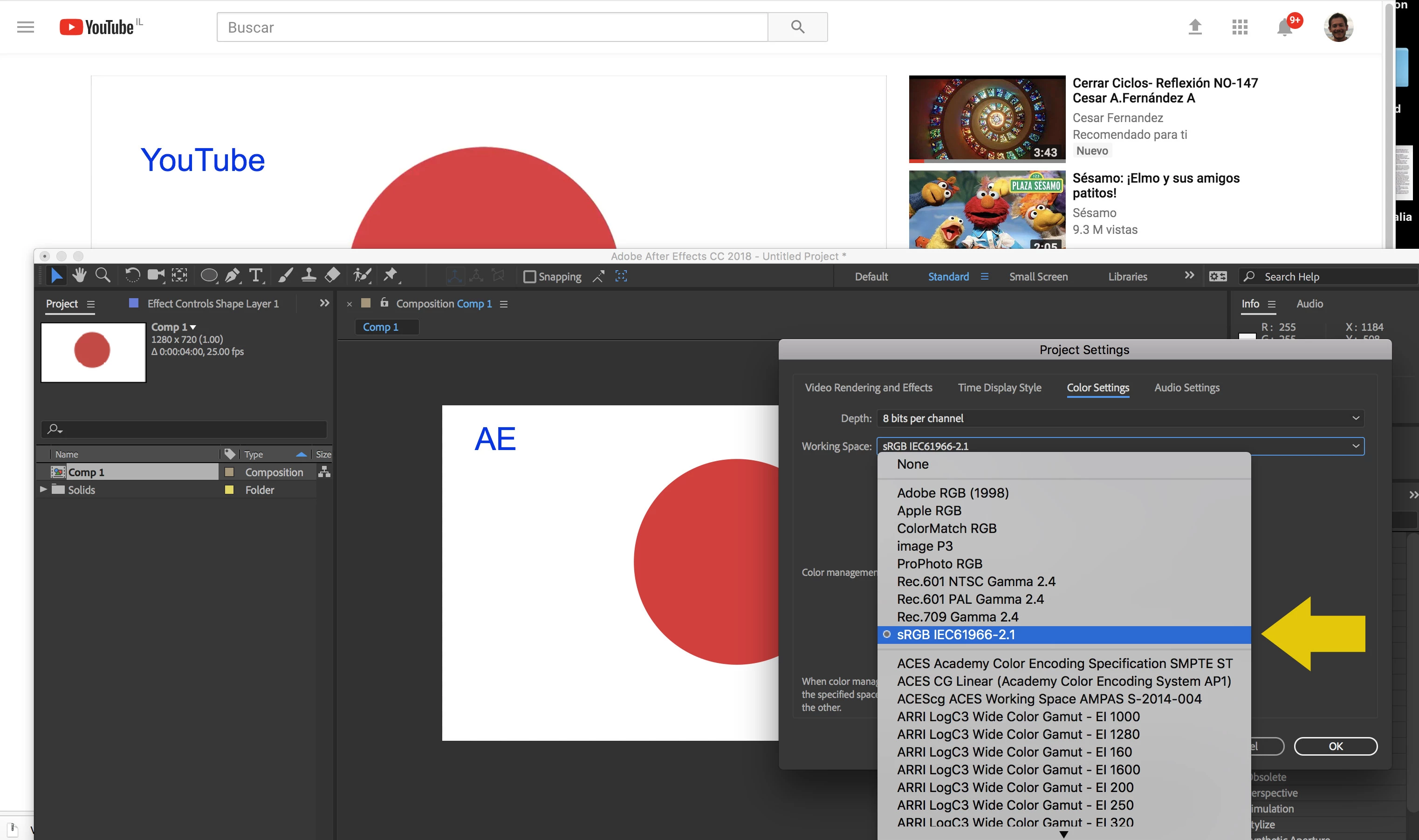
The solution is to change the color configuration of the projects in AE, in a way you choose an option as similar as possible to the final device in which the video will be played. In my case, I make animated videos to be published in YouTube so the choice that seemed to be closer to the color I see in YouTube was this one:

It is important to notice that the colors vary when you render the video inside AE or when you use the Adobe Media Encoder with the YouTube default compression.

So my recommendation is to do your tests before you start a big project, this way you won't be disappointed later on when you render your video to discover colors are not what you expected.

25 replies

New Participant
May 21, 2019

I am having this problem at the moment with bright green coming out like a mint green every time I render. I have tried after effects, media encoder and premier pro renders and still unsuccessful.

Here is my machine:

Any ideas of a work around would be highly appreciate.

New Participant
April 30, 2019

I'm having the same issue man... It's frustrating as hell. If I play my video file in Mac Media Player it displays correctly but if I hit spacebar and play through apple's finder player it's all pale coloring. Vimeo also shows the pale coloring. This isn't a display issue as the player on the same display shows different color information. I'm going to do some test exports and see if there's any fixes for this. Adobe should really address this problem.

Participating Frequently
January 24, 2018

I've been over multiple forums by now, and most say the problems that form within AE of Premiere should be solved by using Encoder and the right colour settings. however in my experience every step Dynamic link step seems to be part if the problem. as if  colour information is lost in the dynamic link, see my reference image below.

I get these washed out steps with every app - premiere, AE and Encoder.   I believe MacOS is to blame.  But who knows maybe Adobe should update their Dynamic Link algorithm to the new OS.  because it wasn't a problem in 2017.  or before high Sierra..

Changing the project colour management settings to sRGB didn't help. for me.  As you can see there's colour loss along the way of each step.

Hope this could be looked at by someone from Adobe..

New Participant
January 28, 2019

I have the same issue with a embedded vimeo video. The hex value from the website does not match a background color with the same hex value.

Andres007
Andres007AuthorCorrect answer
New Participant
January 22, 2018

After checking the issue I found out something that may be basic knowledge for experienced animators and designers in After Effects. For me is wasn't. And I also didn't find any forum where this issue was approached and explained using simple terms.

What I found is that colors may vary according to the video player as it is shown below (YouTube, QuickTime, VLC):

It is something I didn't notice when working on Windows, but now that I am working on Mac it is more noticeable to me as the screen is better.

The solution is to change the color configuration of the projects in AE, in a way you choose an option as similar as possible to the final device in which the video will be played. In my case, I make animated videos to be published in YouTube so the choice that seemed to be closer to the color I see in YouTube was this one:

It is important to notice that the colors vary when you render the video inside AE or when you use the Adobe Media Encoder with the YouTube default compression.

So my recommendation is to do your tests before you start a big project, this way you won't be disappointed later on when you render your video to discover colors are not what you expected.

New Participant
August 10, 2019

Same issue. Really frustrated loosing so much colors and contrast when i export. By Default, my Project Setting Color Working Space was set to none. Colors were completely washed out after exporting. 1. Changing to sRGB 16 bits added a bit more saturation and contrast but still way not enough compared to my colors in After Effect.

I found this workaround that seems to works but would be nice having a better solution/answer from Adobe. It's not normal having such a color/contrast shift after exporting.

Top : After Effect/Project Setting/Colors set to sRGB 16 bits. (colors good)

Left : Exported .mp4 opened with Quicktime with After Effect/Project Setting/Colors set to none 8 bits. (colors not good)

Right : Exported .mp4 opened with Quicktime : After Effect/Project Setting/Colors set to sRGB 16 bits + an adjustment layer WITH Image Contrast - Saturation Effect applied. 40/50% on your Adjustment Layer. I toggled my Adjustment Layer before rendering only. In After Effect, my colors looks over saturated and contrasted when the adjustment layer is on but after rendering this adjustment layer did a really good job to compensate the color loss. (colors good)

Brainiac
August 10, 2019

Intentionally over-correcting your exported footage so it looks "right" in an external video player is completely the wrong approach.

Assuming you have followed the rules for setting up a calibrated display and enabling color management for the composition window, then what you see in After Effects is "correct", in the sense it is a true representation of the appearance of each pixel (because color management takes account of your display calibration profile to "adjust" the image, it may not be sending the exact RGB value to the screen that is stored in the frame - but if you set up two different color-managed computers side by side, each with a calibrated display, the composition previews should look exactly the same).

If a third party playback app shows something different, then there are three possible causes:

  1. That app is not using color management, so it is ignoring the "adjustments" needed for your calibrated monitor.
  2. That app is reading the file incorrectly, for example ignoring or mistaking which color profile has been set in the file header.
  3. Your video file has been incorrectly saved from AE or AME (for example by mangling the header).

(1) is extremely common. Very few players - either on desktops or within web browsers, are properly color-managed. On mobile devices just forget it. It's possible to calibrate a phone screen using a spectrometer, but nobody ever does it. There is an option in AE to disable display correction, which will send the pixel RGB values direct to screen without adjustment. That makes the preview window look wrong, but it will probably match what you see in third party apps. It's still wrong though.

(2) is also common, and QuickTime player is notorious for it. Washed-out or over-contrasty playback is almost always the result of QT getting confused by data or video levels (whether the brightness range for R/G/B is 0-255 or only 16-235). It also has big issues understanding gamma. Unless you have a specific project goal to target QT Player, you should avoid using it for any color-critical testing. It's just... bad. Since you have After Effects all set up and working, the best way to test your exported video is to import it back into AE, and play it in the Footage window. If it looks the same as the comp window, you're all good.

For common formats we can generally discount (3), as it would affect everyone and be reported and fixed very quickly. While it is possible to trick AE/AME into saving a file with invalid headers, it requires effort.

Mylenium
Brainiac
January 21, 2018

Same old, same old: Color management - lack thereof or crooked settings. You need to read up on that. A good place to start might be your system's color and monitor settings panel. Perhaps it's enough to set the Gamma to a different value to make it work again. in the long run, though, only consistent calibration al lacross the baord can save your bacon, including that color issue with teh native AI files.

Mylenium

Andres007
Andres007Author
New Participant
January 21, 2018

Hi, but how can you explain that it suddenly started happening? I have worked on AE for a few years, and on this machine for a few months. Can it be that the OS update messed the monitor settings?

Mylenium
Brainiac
January 21, 2018

Totally possible, so start by checking your system panel whether or not something has changed there. Perhaps the update simply reset something or introduced a new color profile that you don't want. Could be as easy as that.

Mylenium