


Participating Frequently
May 29, 2017
Answered

FFT Y-Axis scale and effect on loudness of harmonic in output

  • May 29, 2017
  • 1 reply
  • 679 views

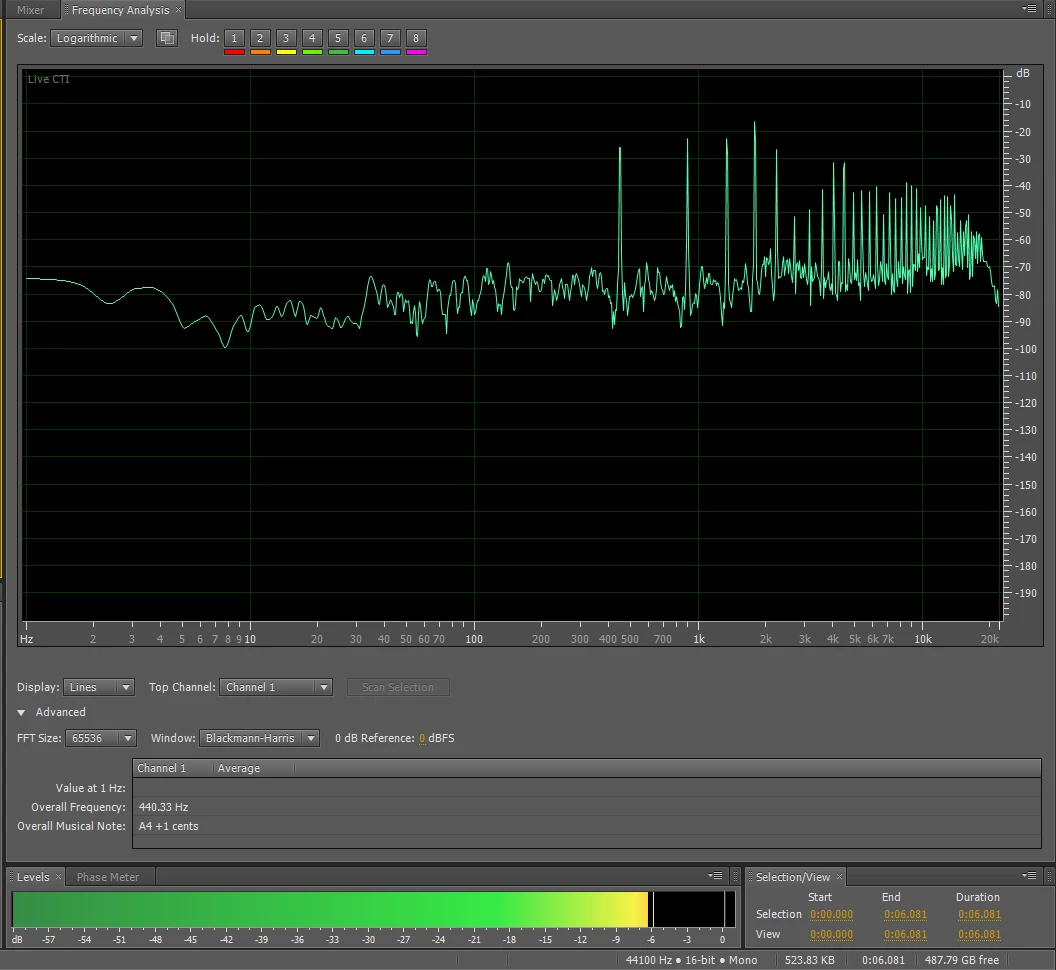
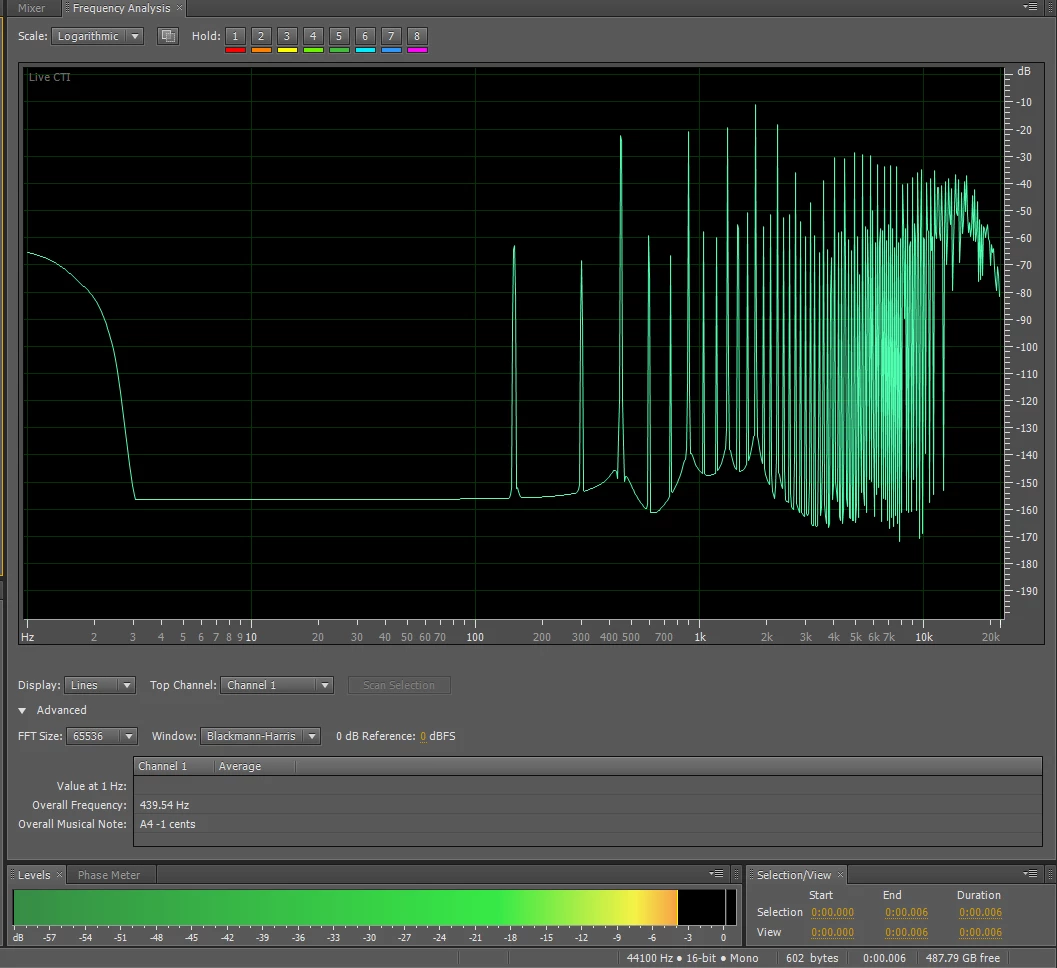
I'm working on project where I take a sample of a musical instrument tone, adjust for pitch and amplitude, then clip a representative sample that can be played seamlessly at the correct pitch.  When I look at the FFT graph of the original and the FFT of the looped replay of the sample I see that  the single cycle looped has extra peaks not in the original sample. The original sample has peaks at the proper frequencies for the sample. It goes down to -80db.  The first peak should be about 440hz but I'm seeing additional peaks at 146hz and 292hz.  146hz is 1/3 of the fundamental and 292hz is 2x 146.  Since both show up before the desired fundamental of 440hz they may be a problem.  I only want the 440hz and its harmonics. The single cycle graph goes down to -160db. .

I did a quick test to see if I can figure out the extra peaks.  The graph shown below actually has 3 cycles of the wave so that the pitch came in correctly when played at 44100.  I did a quick edit and changed it to 2 cycles and only saw one peak about 1/2 the fundamental.  When I went back to a single cycle I had no extra peaks but the pitch was up to 441 hz.  My goal is to get the pitch as close as I can  to 440.  If the additional peaks won't be significant in the final wave then I can get within 0.5hz if they will affect the sound then I may need to go single cycle and live with the higher pitch error.

My question is related to how far down the Y-Axis scale will the peeks be so that they still add to the output sound

Are the top of the two stray peaks (up to -60db) still low enough to not show up on the output for that harmonic?

Original sample pitch corrected.
Single cycle sample played in loop mode
    This topic has been closed for replies.
    Correct answer SteveG_AudioMasters_

    What you've got there are the harmonics of the step-function changes of the repeat process (the loop point). Chances are that if you do this with a single cycle, you'll hear nothing but possibly the incorrect frequency (rather depends on your original). But the moment you put a few more cycles in, you also end up analysing the harmonics generated by the step-function discontinuity at the stop/start point.

    You can demonstrate this quite easily to yourself using Audition's tone generator and a triangular wave. Generate a few seconds of a 440Hz wave with the triangle tipped over a bit to get plenty of harmonics, and then select different bits of it whilst it's looping and both watch the analysis and listen to the result - you might be surprised at what happens, especially when you're down at the really small sample size. Just keep it looping and vary the selection length by dragging the CTI and letting go, and you should hear exactly what I mean.

    1 reply

    ryclark
    Participating Frequently
    May 29, 2017

    But what about all the other extra peaks that you are seeing in your second image apart from the two sub harmonics? I don't know how accurate it can be to just take one cycle of a complex audio signal to analyse. It may very much depend on where and how each edited cycle starts and ends. However you really need to wait to see what SteveG has to say about your findings since he is our audio file analysis expert.

    Participating Frequently
    May 29, 2017

    By  eye the wave seems to repeat.  Given that one cycle works out to within 1hz of the correct pitch and the peaks are correct I think I'm ok. I tried creating a 6 cycle sample and it just made things worse. I had even more peaks down from the fundamental. This may end up being a problem with audition running FFT on a looped wave.  I'll need to do some more work to generate the sound using he sample to see how it looks coming back into my line-in.

    SteveG_AudioMasters_
    Community Expert
    SteveG_AudioMasters_Community ExpertCorrect answer
    Community Expert
    May 30, 2017

    What you've got there are the harmonics of the step-function changes of the repeat process (the loop point). Chances are that if you do this with a single cycle, you'll hear nothing but possibly the incorrect frequency (rather depends on your original). But the moment you put a few more cycles in, you also end up analysing the harmonics generated by the step-function discontinuity at the stop/start point.

    You can demonstrate this quite easily to yourself using Audition's tone generator and a triangular wave. Generate a few seconds of a 440Hz wave with the triangle tipped over a bit to get plenty of harmonics, and then select different bits of it whilst it's looping and both watch the analysis and listen to the result - you might be surprised at what happens, especially when you're down at the really small sample size. Just keep it looping and vary the selection length by dragging the CTI and letting go, and you should hear exactly what I mean.