


Eric Holtz
Known Participant
January 9, 2017
Question

Frequency Analysis: Sub 20Hz Frequencies Shown Across All Files

  • January 9, 2017
  • 2 replies
  • 4732 views

Hello,

I am running Audition CS6 in Windows 7 Professional 64 bit on an HP dv7-7000 Quad Core Edition laptop. All audio files show a bump below 20Hz in the Frequency Analysis window. This occurs across all files, no matter the source, i.e., personal recordings, ripped Cds, etc.

Here is an image using a CD file:
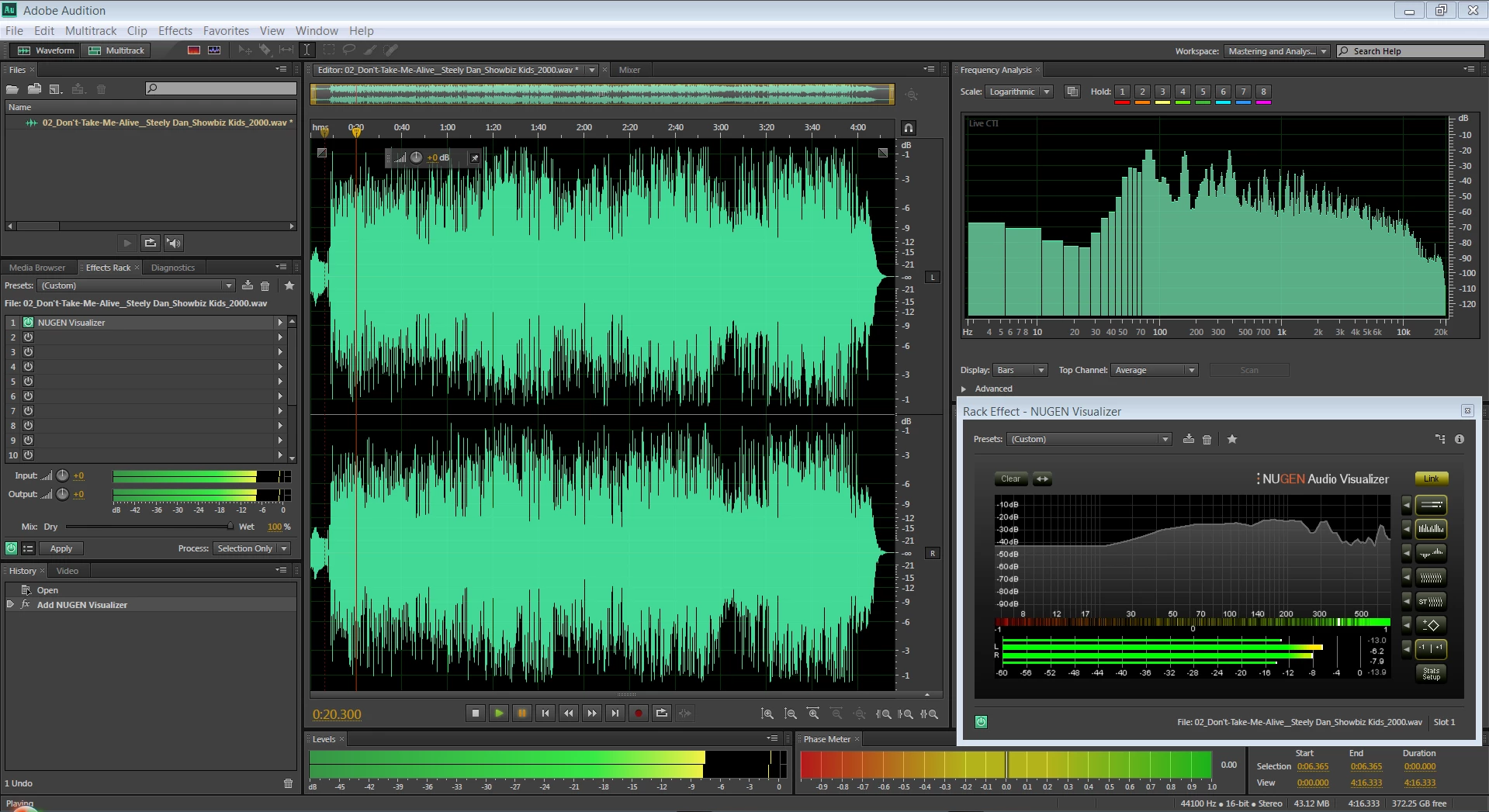
What could be causing the noise below 20Hz? This occurs on any file type, no matter whether I'm using the laptop's sound card or a USB audio interface.

Any comments and suggestions are greatly appreciated.

Thank you,

Eric

This topic has been closed for replies.

2 replies

Charles VW
Inspiring
January 10, 2017

this might be an indication of a DC component to your signal (mathematically the same as 0 Hz) and that it isn't centered around zero.

Eric Holtz
Known Participant
January 10, 2017

Charles VW​ - I was wondering whether there might be something happening "under the hood" in regards to the DC component. How would I alleviate a zero centering issue?

SteveG_AudioMasters_
Community Expert
Community Expert
January 10, 2017

Eric Holtz wrote:

How would I alleviate a zero centering issue?

That's easy. Go to Effects>Amplitude and Compression>Normalize, and you have an option there.

I can see a very small offset on the file with the 0-5Hz signal whereas I can't see one in the other file. Whether that rather small offset would make that much difference to the analysis isn't clear to me, but it might, possibly. There are a couple of other things to note about the whole business though. Firstly that with the best will in the world, an FFT analysis is never going to be perfect across the board - that first F stands for 'Fast' and that invariably means a compromise in the way that the window is analysed. The greater the FFT number, the smaller the sampling 'Window' is, and rather perversely, the less accurate the extreme bass analysis is; indeed any analysis where the window size is smaller than the wavelength of a frequency being analysed is potentially inaccurate, and that's where the problems with having DC in your waveforms comes into play.

On its own, all the DC would do is offset your speaker cone very slightly - assuming that everything in your system up to that point is DC-coupled. But that does lead me onto the other thing, which is in effect a sanity check. If there really is the level of signal between 0 and 5Hz shown, it's going to lead very definitely to bass unit speaker-cone flap - pretty severe cone flap at that. So if you can't see any, then it's almost definitely an analysis anomaly. If you have cone flap, then you should definitely get rid of that part of the signal - it saps power from your amplifier, and restricts the amount of cone movement available for 'real' sounds higher up the frequency range; it's not healthy!

SteveG_AudioMasters_
Community Expert
Community Expert
January 9, 2017

In the Audition Frequency Analysis window, can you show us the advanced settings? Can't comment about your plugin, but response anomalies at the bottom of a FFT window aren't that unusual. Also, if you shift the waveform up so that we can see the Spectral Frequency display with the spectral resolution increased to max, (Ctrl+Shift+Up Arrow) do you get the same result?

ryclark
Participating Frequently
January 9, 2017

As Steve suggests by showing us the Advanced Settings of Audition's Frequency Analyser window we will be able to see what the FFT size settings are. For more accurate LF display you really need to have the highest FFT size available. but even that will be inaccurate for the lowest few bars unless you can have an infinite FFT size.

Eric Holtz
Known Participant
January 19, 2017

Audition's native bit depth for processing is 32 bit float, even if you open a 16 bit file into it. There is unlikely to be any DC Offset in a file these days but a High Pass filter below about 30Hz would remove any anyway as well as getting shot of any VLF anomalies. There wouldn't normally be any useful audio down there, but there can be sub harmonic intermodulation caused if the audio originated from an analogue source.


Thank you for the information. I have a question regarding Audition's internal 32 bit (float) processing that hopefully I can get answered here. Most of my work involves the transfer and archiving of analog sources, primarily LP (and 78) records, cassettes, and reel-to-reel. The original sources were recorded as 16bit/44.1k, 24 bit/88.2k, and some 32bit(float)/88.2k files. I primarily apply effects (noise reduction, light click repair, EQ, etc.) to copies of the files themselves using the Waveform editor window, and may save over the same edited file several times. How does Audition's 32bit float environment handle re-saving a 16bit, 24bit, or 32bit(float) file? I understand that Audition performs all calculations in 32 bit float, so does it automatically apply dither each time I save the file, or does it simply truncate the file back to the original bit depth?

I've read many threads about how integer files are handled by 32bit (float) DAWs, but they almost all relate to mixing in a Multitrack window, and not editing the files themselves. If this question should be posted as another thread, please let me know and I will follow accordingly.