


#SockPuppetProblems (I/O Buffer Size)
Hello Ladies and Gentleman,
I hope my monologue finds you in good spirits. If you are an experienced Adobe Audition (or just audio) expert, please, hunker down, grab a coffee and come with me. I'm just going to basically vomit a bunch of random information and then be like, "Oh my, what do I do now?"
I'm part of a company of players who are in process of completing a sock puppet play video. It's very adult, I assure you, there are deaths and romance and drugs. During the course of production, since we do not work out of a big studio, we work out of someone's home, we have suffered two major production events. Setbacks, or rather, challenges, if you will. We know that in an ideal world, all audio should be recorded in the same studio environment, on the same computer, using the same settings, and that importing/exporting and moving around can alter the texture of sound in infinite ways. But here we are.
First Problem: We recorded in two studios, and additionally, one of the microphones (a BLUE Yeti Pro USB) was set half of the time to mono, and half the time to stereo. In the original DAC we were using, Mixcraft Home Studio 7, we were able to take some of the mono files and triplicate the track, applying two tracks of quiet subtle reverb effects, one panned all the way to the left and one panned all the way to the right, along with normalization on the original track, which produced a similar sound to what the other studio environment sounded like. But now, as we are starting to mix to video using Adobe Audition CC 2017 with 5.1 surround sound, we actually think that for all characters except the narrator, mono sound actually is more realistic and appropriate to the scenes. IS THERE A FILTER PRESET THAT CAN BE EASILY APPLIED TO CONVERT ALL THE STEREO DIAGLOGUE INTO MONO, THAT WILL STILL ALLOW ME LATER TO PAN AS I SEE FIT IN 5.1 ONCE THE VIDEO IS DONE?
Second Problem: The computer we had all the data on, was wiped clean and reverted back to Windows 8 from Windows 10. Although all the files were on an external hard drive, the software on the computer had to be re downloaed and lost all of it's preferences and settings. I'm mixing all stems down so I can bring them to Adobe Audition. Here's my mixcraft:
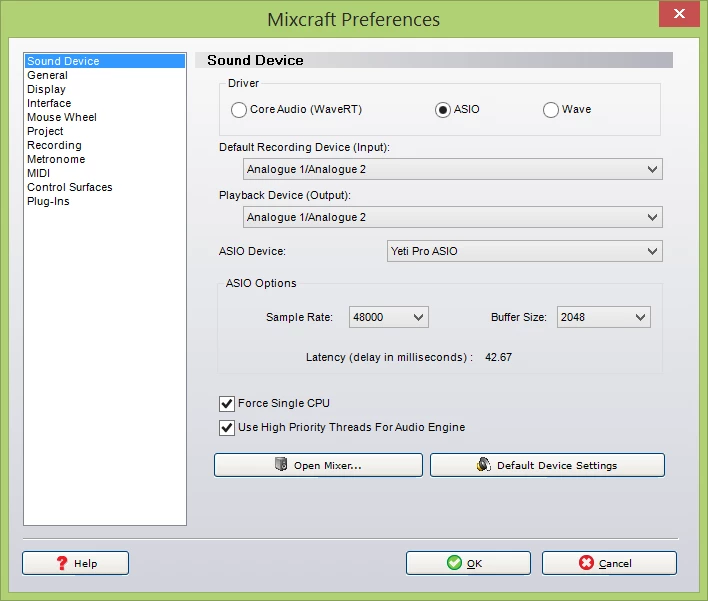
When I adjust these settings at all, whether lowering the buffers or switching to CoreAudio WaveRT mode, if I play the audio it sounds terribly slow and distorted. But it will play just fine with these settings.
I just want to bring the stems over and for all future editing and mastering use Adobe Audition CC 2017. I just completed a five hour beginners course on Lynda.com on it, but I'm still learning as I go. I'm willing to watch pretty much any videos though to learn whatever I need to learn to finish. It's a long project but I want to know all this stuff for future projects.
so here's my issue: WHEN I UPLOAD THE STEMS INTO AN ADOBE AUDITION MULTITRACK FILE I GET THE SAME TERRIBLE DISTORTION UNLESS THE FILES ARE SET TO EXACTLY THE SAME SETTINGS (ASIO, 48K, 2048 BUFFER SIZE) WHICH IS FINE BECAUSE I CAN EDIT AND MASTER EVERYTHING IN ADOBE. BUT I'M AFRAID THAT THIS HIGH BUFFER SETTING IS GOING TO CAUSE PROBLEMS IF I HAVE TO DO ANY RE-RECORDING OF LINES. I FEEL LIKE WHEN I WAS RECORDING BEFORE IN MIXCRAFT I NEEDED A MUCH LOWER BUFFER SETTING TO GET THE LATENCY LOW ENOUGH SO THAT THE ACTOR COULD HEAR THEMSELVES IN REAL TIME IN THE HEADPHONES. THE LONG DELAY IN MONTIORED AUDIO DISRUPTS SOME OF THE ACTRESSES AND ITS IMPORTANT FOR THEM TO RECORD QUALITY PERFORMANCES TO BE ABLE TO HEAR THEMSELVES IN THE HEADPHONES. IS THERE SOMETHING WRONG WITH A BUFFER SIZE I/O OF 2048? IS THAT GOING TO GIVE ME PROBLEMS LATER? IS THERE A WAY TO REDUCE LATENCY IF I NEED TO TROUBLE SHOOT WHEN I START RECORDING WITHOUT DESCTRUCTIVELY EDITING THE PROJECT FILES AND STEMS? here's my interface in Adobe Audition CC 2017.
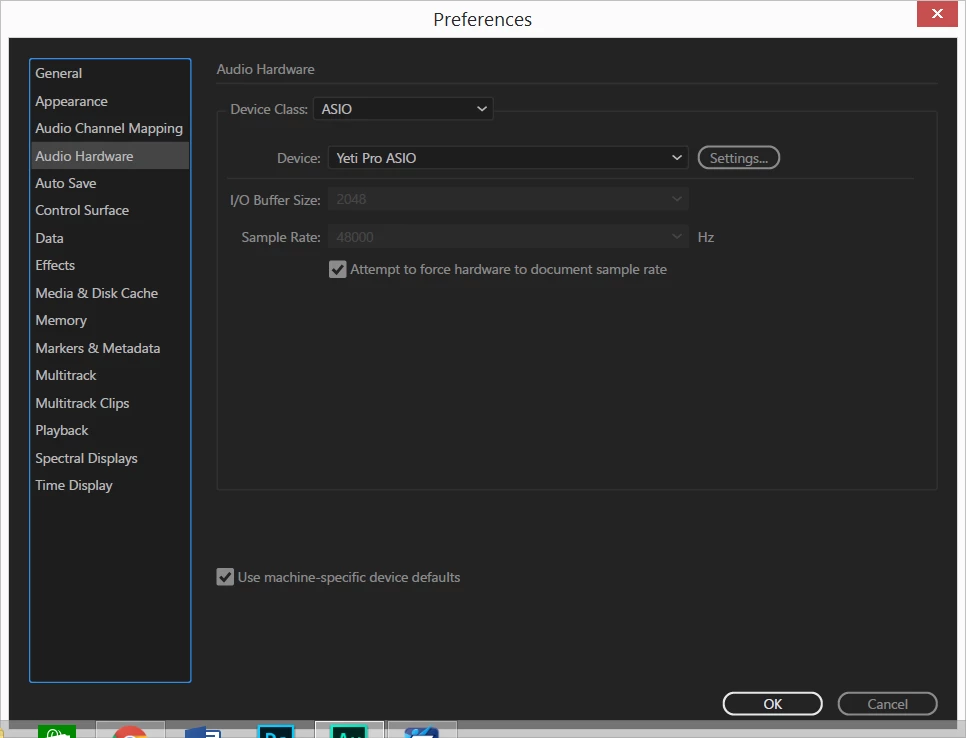
Some please help me to understand this stuff.
Sincerely,
Newcomer Sarah
 AdChoices