Legend
November 11, 2025
Answered

Is it possible to have 32bit EXR Smart Objects inside 16bit files?

  • November 11, 2025
  • 1 reply
  • 127 views

Hi There, probably using incorrect search terms so sorry if this is easy.


I have 3D rendered 32bit HDR exr files I'd like to tone map in Photoshop.


Currently I'm...

  • Opening the 32bit EXR in Photoshop
  • Converting to 16bit via Exposure & Gamma (Local Adaptation looks weid as a starting point)
  • Then converting to a smart object
  • Adding the Camera Raw effect
  • Adjusting then exporting images to various formats


Questions

  1. Is there a way of doing this while keeping the 32bit image editable?
  2. And is there a way of tweaking the 32bit while seeing the 16bit output?


I don't have experience with 32bit images so keen to hear how others do this.


Cheers, Ben

Correct answer rayek.elfin

Camera Raw's output is 8bit or 16bit (which can be set in the preferences-->File Handling-->Camera Raw Preferences.

This means an automatic conversion to 16bit (or in Photoshop's case: effective 15bit). Which isn't an issue if your master file is also 16bit with the 32bit file placed as a smart object. (That is: if we do not care about Photoshop's limited 16bit image mode...)


Here is the result with me opening a 32bit rendered EXR scene from Blender directly in Photoshop, converting the layer as a smart object, switching the main file to 16bit image mode, and finally applying the Camera Raw plugin:
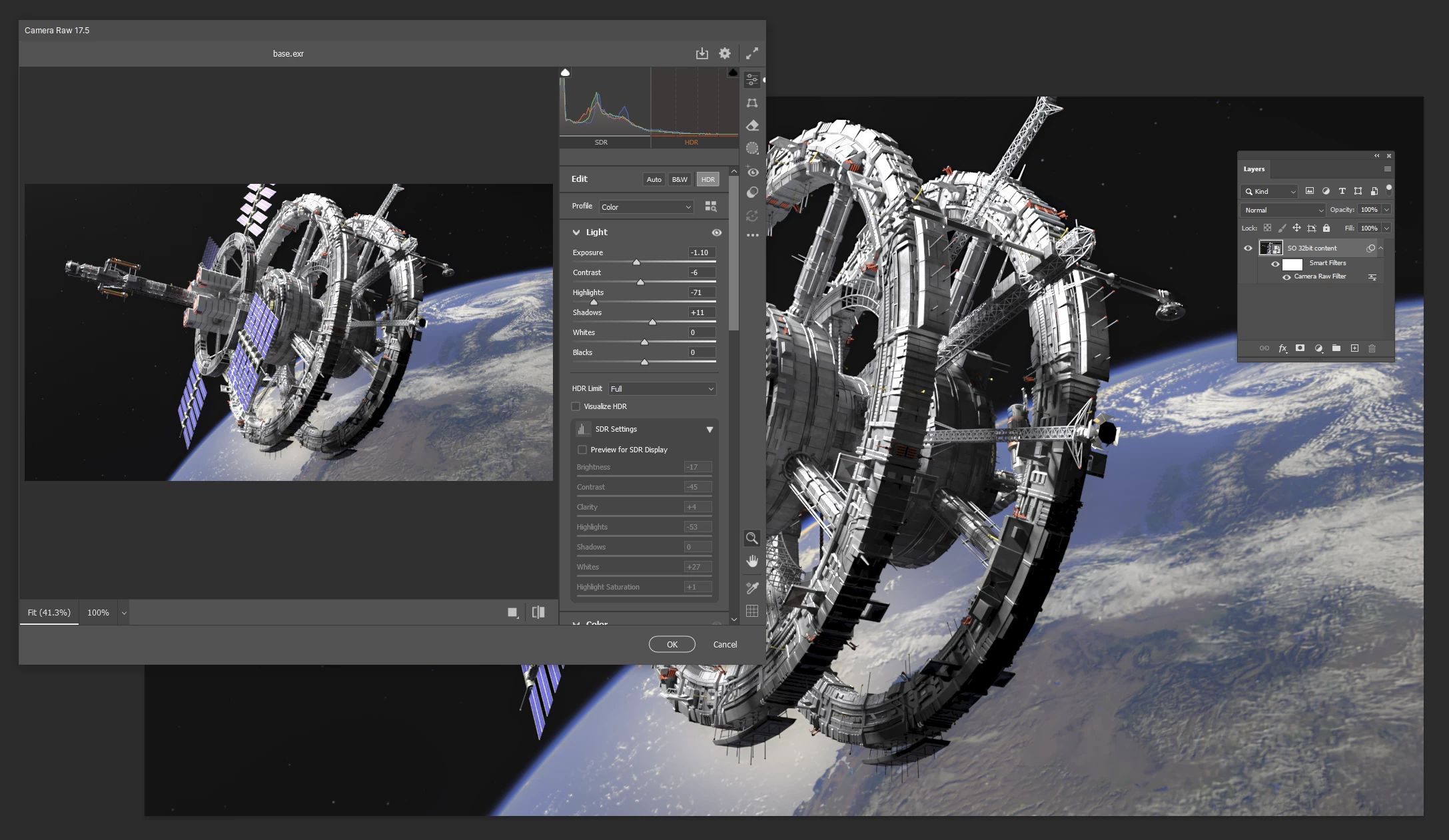
 

Full HDR support, as you can see.


And here the same file but placed as an embedded smart object:
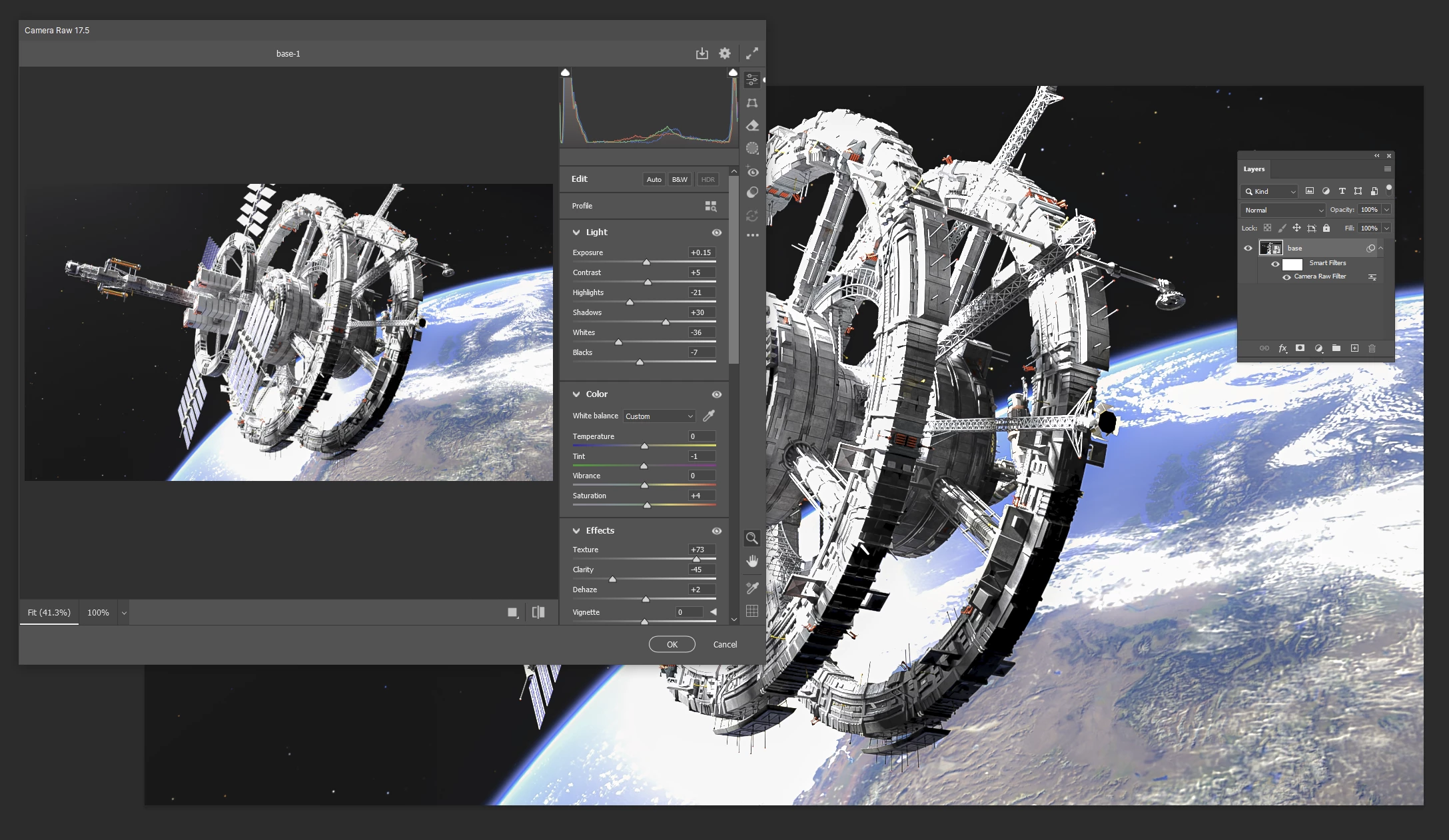
 

No HDR support. It is deactivated. The quality sharply degrades, and it is no longer possible to edit in HDR mode. It is impossible to colour grade this properly as it (seemingly) only works in 8bit.


Based on my testing here, I wouldn't place it directly as an embedded smart object via File-->Open As Smart Object.


By the way, if I may ask: why use Photoshop at all for this work? I avoid Photoshop for jobs like these, because it adds another layer of potential mismatch and conversion issues as well as Photoshop's limitations in regard to 32bit files and in particular 16bit files. 


Instead, I use Blender's compositor to take care of this, and it also allows me to keep the pipeline a closed loop in regards to colour management and colour grading. For example, here is the above scene composited and edited in Blender's compositor:
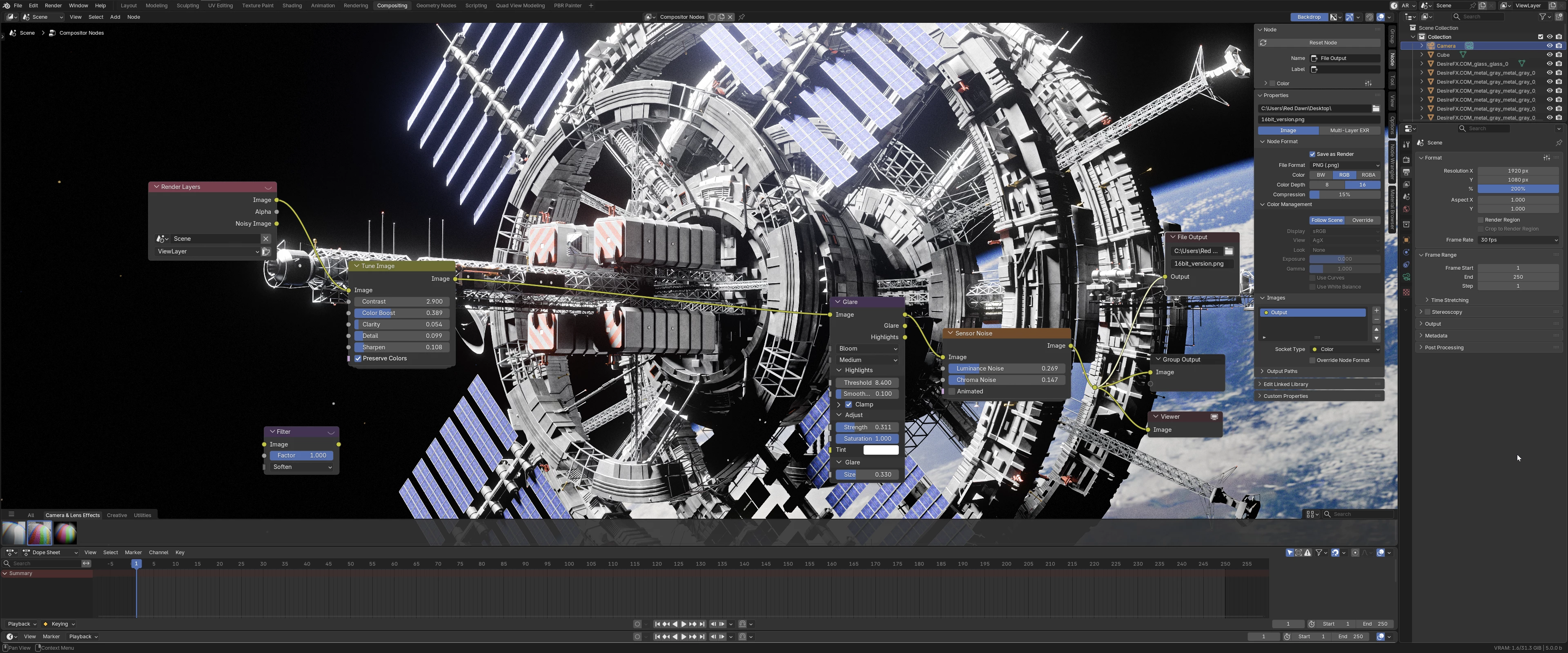
 

This avoids the conversion step in Photoshop, and allows me to output a higher grade 16bit PNG. And tonemapping in Blender happens in full 32bit and supports Filmic, ACES, and AgX out of the box with various transforms. 


Of course, I am unsure which 3D software or rendering process was used to generate your @csscms EXR images. But even if you do not work in Blender for 3D rendering, you can still open the EXR files directly in the compositor. 

Ideally we want to stick to a 32bit workflow until the very end when we output the final 16bit PNG file - something that isn't possible in Photoshop. Davinci Resolve can also be used for this, but is a tad overkill for still images perhaps.


1 reply

rayek.elfin
Legend
November 13, 2025

Why not convert the EXR to a smart object first, then convert the image to 16bit while retaining the layers (and avoid flattening the 32bit smart object layer)? Followed by assigning the Camera Raw effect as a live plugin to the smart object.


If need be, add the exposure and gamma to the 32bit version in the smart object.


Sidenote: Be aware that Photoshop doesn't convert to a full range 16 bit file. It converts (silently) to a 15bit +1bit range instead which means you will lose half the potential values of a full range 16 bit conversion.

Strictly speaking: 0-32767 + 1 = 0 - 32768 values. Any other image editor with 16bit support supports a range of 0-65535 values.


Photoshop turns a full range 0-1-2-3-4-5-6-7-8-9--etc to 0-0-2-2-4-4-6-6-8-8---, which can be an issue depending on what the file is supposed to be used for.


For photographic renders generally not an issue, but for HDR work, medical imaging work, and displacement mapping (for example) it could turn ugly.


If you need a full range 16bit file the 32bit conversion will need to be done outside of Photoshop.

csscmsAuthor
Legend
November 13, 2025

@rayek.elfin 

quote

Why not convert the EXR to a smart object first, then convert the image to 16bit while retaining the layers (and avoid flattening the 32bit smart object layer)? Followed by assigning the Camera Raw effect as a live plugin to the smart object.


That's what I tried first but when I edited the smart object using the camera raw effect, the preview in camera raw was no longer HDR, so I assumed it was no longer 32bit? Or is HDR something different?


Or is all the 32bit data there, it just previews as 16bit?


Sorry, haven't done this before so not sure what to expect. Cheers, Ben

rayek.elfin
rayek.elfinCorrect answer
Legend
November 13, 2025

Camera Raw's output is 8bit or 16bit (which can be set in the preferences-->File Handling-->Camera Raw Preferences.

This means an automatic conversion to 16bit (or in Photoshop's case: effective 15bit). Which isn't an issue if your master file is also 16bit with the 32bit file placed as a smart object. (That is: if we do not care about Photoshop's limited 16bit image mode...)


Here is the result with me opening a 32bit rendered EXR scene from Blender directly in Photoshop, converting the layer as a smart object, switching the main file to 16bit image mode, and finally applying the Camera Raw plugin:


Full HDR support, as you can see.


And here the same file but placed as an embedded smart object:


No HDR support. It is deactivated. The quality sharply degrades, and it is no longer possible to edit in HDR mode. It is impossible to colour grade this properly as it (seemingly) only works in 8bit.


Based on my testing here, I wouldn't place it directly as an embedded smart object via File-->Open As Smart Object.


By the way, if I may ask: why use Photoshop at all for this work? I avoid Photoshop for jobs like these, because it adds another layer of potential mismatch and conversion issues as well as Photoshop's limitations in regard to 32bit files and in particular 16bit files. 


Instead, I use Blender's compositor to take care of this, and it also allows me to keep the pipeline a closed loop in regards to colour management and colour grading. For example, here is the above scene composited and edited in Blender's compositor:


This avoids the conversion step in Photoshop, and allows me to output a higher grade 16bit PNG. And tonemapping in Blender happens in full 32bit and supports Filmic, ACES, and AgX out of the box with various transforms. 


Of course, I am unsure which 3D software or rendering process was used to generate your @csscms EXR images. But even if you do not work in Blender for 3D rendering, you can still open the EXR files directly in the compositor. 

Ideally we want to stick to a 32bit workflow until the very end when we output the final 16bit PNG file - something that isn't possible in Photoshop. Davinci Resolve can also be used for this, but is a tad overkill for still images perhaps.
