
Participating Frequently
December 2, 2018
Answered

File Import Error

  • December 2, 2018
  • 2 replies
  • 2248 views

I have video projects that were edited on Premiere CC 2017 on a Windows 7 computer.  I could not upgrade any farther than that due to Premiere's removal of audio support for some video files.  I recently built a new Windows 10 editing computer and it has the latest version of Premiere.  Now, one of my clients wants me to make some modifications to the projects edited in 2017.  The projects were copied to the new computer, but Premiere lost the links to all of the source material files (as would be expected).  But, quite unexpectedly gives a File Import Error trying to link any file (MTS, JPG, TIF, etc.) from the moved projects.  The error message part of the box does not include any additional information.  Here's a screen capture of the error (redacted for client security).
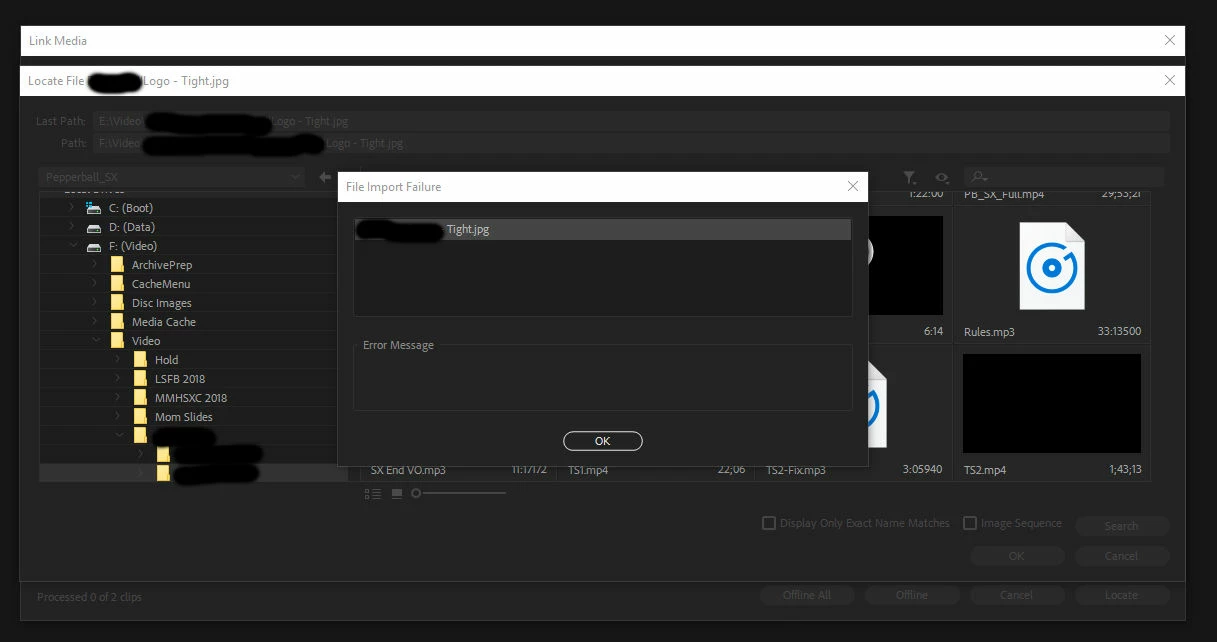
Am I missing something?  I've moved projects before and re-linking one file and allowing the system to auto link the remainder has always worked.  I tried a second project and the same thing happened.  If I cannot get the source files linked, this is going to be a disaster!  I've seen similar topics about this issue when people move a project from team to stand-alone, but not this.

Any help would be greatly appreciated.

Mike

    This topic has been closed for replies.
    Correct answer Ann Bens

    It's embedded in titles.

    I am no expert when it comes to the Titler, but AFAIK there is no way to relink embedded .jpg´s in titles.

    Ann, do you have a solution to this?


    If the titler shows a placeholder one needs to add the still again.

    2 replies

    mikenie1Author
    Participating Frequently
    December 2, 2018

    I checked and the color space was RGB.  I changed it to CMYK and there was no difference.  The file is already set to 72 DPI.

    Thanks for all of the help so far!

    Mike

    Averdahl
    Community Expert
    Community Expert
    December 2, 2018

    I changed it to CMYK and there was no difference.

    RGB is what you really want, not CMYK.

    How do you use the .jpg file, directly on the timeline or embedded in a title created by the Titler?

    mikenie1Author
    Participating Frequently
    December 2, 2018

    It's embedded in titles.

    Averdahl
    Community Expert
    Community Expert
    December 2, 2018

    What version of Premiere Pro do you use?

    If CC 2019, use CC 2018 instead since there have been too many issues with importing old projects into CC 2019. Or, instead of just opening the old project, create a new project in CC 2019 and then go to File > Import and import the old project file. Have patience, it may take a while.

    mikenie1Author
    Participating Frequently
    December 2, 2018

    OK, I was wrong and misinterpreted the import screen.  All but one file imported.  It is a JPG file of a logo.  It is still a problem because it is inserted into text in titles all through the video.  I was able to import a copy of it into the project fine, so Premiere can handle it.  However, it is replaced by a placeholder in all of the titles where inserted.  So, it's not as bad as first thought.  Having to go through every location and re-insert the graphic will still be a major PITA.  If it wasn't inserted into text and was just used as a graphic, I could replace a clip from bin.  I do not know how to do that or if it's even possible inserted into text.

    I am using Windows 10 Pro 64-bit version1803 (Build 17134.407).  I tried Premiere Pro 2018 and just now Premiere Pro 2019 (Version 13.0.1 (Build 13)).  Both do exactly the same thing.

    Thanks!

    Averdahl
    Community Expert
    Community Expert
    December 2, 2018

    Make sure that the .jpg is RGB and not CMYK. Since you mention that it is a logo it is likely that the file is CMYK instead of RGB and that will indeed cause troubles. So, convert the file to RGB and re-save it using the same file name and open premiere pro and link the file/s.

    Take a backup of the original .jpg file/s before so you have the originals.