


New Participant
November 13, 2024
Question

Exporting from Excel, importing to InDesign document

  • November 13, 2024
  • 3 replies
  • 2427 views

A pretty vague title I know. Here are the details of what I want to achieve...


I'm creating a catalogue for a book chain. I have the layout of the catalogue set up in InDesign including linked text boxes from page 1 to the end. I also have data for each book in an Excel spreadsheet (title, author, price, description).


I would like to export those 4 fields from the Excel document, and then import them into ID, with each of the 4 fields appearing on their own line, and adopting the unique paragraph style (already set-up in the ID template) that each field requires.


An example of the Excel data I want to export...

TitleAuthorPriceDescription
TITLE 1Author 1 $34.99Description will go here
TITLE 2Author 2 $9.99Description will go here
TITLE 3Author 3 $27.99Description will go here


An example of how I want the data to look upon importing it into InDesign...
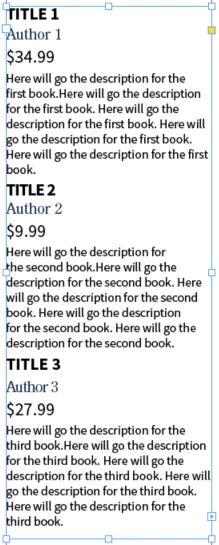
As you can see, the title, author etc. has adopted the desired paragraph style after it has been imported.


I used to a similar thing in Quark XPress 10+ years ago but am a bit out of the loop, and I'm not finding Google searches to be very helpful, or only provide a portion of what I need. My guess is that the Excel data needs to be exported to a txt file with formatting (XML?) that ID understands and then imported.


Any help would be appreciated.

This topic has been closed for replies.

3 replies

Dave Creamer of IDEAS
Braniac
November 14, 2024

Here is a way you can do it cheaply and get flowing text. It's not that difficult as it looks.

In Excel, add columns in front of each data category. Add the code <ParaStyle:StyleName> with the style name matching your InDesign style names. Use Excel's autofill to fill up each row of data.

Save as either tab-delimited or comma separated (csv). I used CSV in this example.


Open the file in Word, clean up with Replace, and replace your field names with <ASCI-WIN> or <ASCI-MAC> depending on your platform.

Your text should look like this:

Save as a text file. Be sure to keep the .txt extension on a Mac.

Import into InDesign (with preexisting styles matching the names you used in Excel).

Of course, you can format the paragraph styles any way you wish.


I've attache the InDesign Tagged Text PDF. It's old but hasn't changed in ages.


David Creamer: Community Expert (ACI and ACE 1995-2023)
Robert at ID-Tasker
Braniac
November 14, 2024

@Dave Creamer of IDEAS


Yeah, one more way - but isn't it overkill?


Unless OP will have way more text only data. 


And there is one problem - Tagged Text doesn't support importing images.


Dave Creamer of IDEAS
Braniac
November 14, 2024

Not really. It only takes a few minutes to do. The reason I discussed this method was because the OP mentioned they did something similar in Quark. Quark had both XData and X-tags. 


The OP hasnt mentioned or displayed images at all. Obviously I would not have suggested this method if there were numerous images. 


David Creamer: Community Expert (ACI and ACE 1995-2023)
Dave Creamer of IDEAS
Braniac
November 14, 2024

I would use Em Software's InData. They used to make the identical plugin XData for Quark.


There are other database plugins, such as Teacup Software and 64bit, but this is the one I use most often.


David Creamer: Community Expert (ACI and ACE 1995-2023)
Brad @ Roaring Mouse
Inspiring
November 14, 2024

Another vote for Em Software's InData. I use it to create an annual 160-page corporate directory in less than 20 minutes. The "hardest" part is setting up the "template" the imported data will use, and of course making sure the Excel file is as clean as possible, but once you get that down, it's so fast.

Yes, these plugins can be a bit pricey, but mine paid for itself immediately.

Robert at ID-Tasker
Braniac
November 14, 2024

But for now - OP has only 4x columns with simple text... 


Joel Cherney
Braniac
November 13, 2024

Your guess is pretty much right on the money. The tool in InDesign is called "Data Merge" and it lets you take a CSV file exported from Excel and imported into InDesign. It only accepts a few formats - when you "Select Data Source" in the Data Merge panel, there's a little "Import Options" box, which will tell you all of the formats that Data Merge will accept. I think that your only choices are comma-delimited straight ASCII, tab-delimited Unicode, and I think one comma-delimited Japanese encoding. You also have to specify whether your CSV is Mac-encoded or Windows-encoded. But if you can export your file successfully from Excel, it's not hard to build the layout you describe with Data Merge.


... assuming, that is, that there's nothing fancier in your layout than exactly what you described. Anything fancier usually requires a third-party tool, such as a catalog plugin like EasyCatalog or InCatalog. 


You could also do this layout with XML import, which would add a little bit of formatting flexibility at the cost of some severe restrictions on your imports, but it's totally doable if Data Merge doesn't work for you. 

New Participant
November 13, 2024

Thanks for your help. You've steered me in a better direction than I was on.


There is more to the layout (images etc.) but I'll worry about that when I can do the above.


Thanks again. I might be back for more questions.

Robert at ID-Tasker
Braniac
November 13, 2024

@caring_play2031


You should start "worrying" about extra elements right now - as they might be imported automatically as well.


You could also import your tables without using DataMerge - place or copy&paste your table into InDesign - as a table - then apply separate ParaStyles to columns - then just convert table to text.