

Robert at ID-Tasker
Brainiac
March 30, 2025
Answered

(Most common) signature folding patterns

  • March 30, 2025
  • 5 replies
  • 632 views

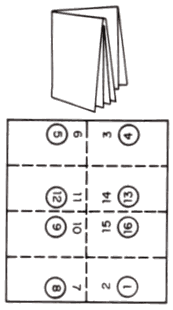
Unfortunately, I don't have access to a big printing facilities - so, can anyone suggest (most common) folding patterns? 


Something linke this: 
 

TIA 

 

Correct answer Colin Flashman

Consult the CIP4 guide - https://www.cip4.org/files/cip4-2022/Documents/Specifications/XJDF%20Specification%202.1.pdf

Starts at page 425. Programs like Fuji XMF and Agfa APOGEE imposing software do reference the fold patterns referenced such as F16-6.

5 replies

Dave Creamer of IDEAS
Adobe Expert
March 30, 2025

Here is another simplier breakdown of a 16-page sig:

Source: https://www.chinabestprinting.com/blog/post/print-signatures


Take total page count of document, divide by 16. If you end up with fractional sigs, you will need to run an 8 and/or 4 page sig. For example, if a 64 page document, that would be four 16-page sigs; if a 68 page document, that would be four 16-page sigs and one 4 page sig. (Covers are usually printed separately as 4-page sigs.) Larger sigs are generally less expensive that smaller sigs, depending on the press of course.

Here is how the page numbering is affected...

Perfect Bound: the signatures are just run sequentially, with the page numbers increasing incrementing. For example: 1-16, 17-32, etc.

Saddle-Stitch: Page number is broken down as follows: each spread should add up to the total page count plus 1, but the last 8 pages from each sig starts from the back. For example, the first sig would be 1-8, 64-57; the second sig would be 9-16, 56-49, and so on. Note that in a 64-page document, pages 64 and 1 are together (=65), 2 and 63 (=65), etc. 


David Creamer: Community Expert (ACI and ACE 1995-2023)
Colin Flashman
Colin FlashmanCorrect answer
Adobe Expert
March 30, 2025

Consult the CIP4 guide - https://www.cip4.org/files/cip4-2022/Documents/Specifications/XJDF%20Specification%202.1.pdf

Starts at page 425. Programs like Fuji XMF and Agfa APOGEE imposing software do reference the fold patterns referenced such as F16-6.

If the answer wasn't in my post, perhaps it might be on my blog at colecandoo!
Robert at ID-Tasker
Brainiac
March 30, 2025
quote

Consult the CIP4 guide - https://www.cip4.org/files/cip4-2022/Documents/Specifications/XJDF%20Specification%202.1.pdf

Starts at page 425. Programs like Fuji XMF and Agfa APOGEE imposing software do reference the fold patterns referenced such as F16-6.


By @Colin Flashman


THAT'S GOLD 😄 😄 THANKS 😄


I hope I can use this info - it's not copyrighted or something? There is a Copyright Notice at the beginning.


Dave Creamer of IDEAS
Adobe Expert
March 31, 2025

While the publications layout and presentation may be copyright, the raw data is not. That data has been around for over 100 years.


David Creamer: Community Expert (ACI and ACE 1995-2023)
Robert at ID-Tasker
Brainiac
March 30, 2025

@James Gifford—NitroPress, @Dave Creamer of IDEAS


Pretty much - anything you have / know / can share. 


Just to know more. 


James Gifford—NitroPress
Brainiac
March 30, 2025

Not sure what you're asking. Is this for booklet? brochure? cut-down? What's your end goal, that is?

Dave Creamer of IDEAS
Adobe Expert
March 30, 2025

What bindery method? 

If saddle-stitch, the signature page count would matter (4, 8, 16, 32) and over all project page count would matter.

If perfect bound, the signature page count would matter.


David Creamer: Community Expert (ACI and ACE 1995-2023)