New Participant
November 2, 2022
Answered

Using tabs to align sentences

  • November 2, 2022
  • 2 replies
  • 717 views

Hi all, I'm tring to align these words for a poster I'm making using tabs so it spells "VOTE" vertically inside, Though trying this the tabs have been unpredictable with trying to get the alignment I want, and could use advice for tabs, or if there's an easier way to achieve this.


This topic has been closed for replies.
Correct answer Bevi Chagnon - PubCom.com

Generally, I agree.

But turning each line into a separate paragraph kills the ability for digital reading and machine readability.


The concept of the words should be maintained as one paragraph, not multiple paragraphs.


@Eugene Tyson's example is an excellent way to do this.


Another is this example I use in my accessible InDesign classes: it's one sentence and each word is in a separate text frame that's threaded to the next frame.


 

This allows me, as designer, to easily manipulate the alignment of each frame's text and format (in this example) with different colors, fonts, and sizes — and it keeps the sentence intact so that it will reflow correctly into various devices for digital publishing (PDF, EPUB, XML, etc.).




2 replies

James Gifford—NitroPress
Braniac
November 3, 2022

The only time you need technical precision for things like this is when it's for multiple/repeated styling. A poster, a one-shot layout... use whatever hack is needed. Make each line its own paragraph, then use left-indent to precisely line up the letters on a vertical guideline. Normally, that would be an amateur hack, but again... for one, unusual, one-off layout, it's the efficient way to go.


Bevi Chagnon - PubCom.com
Braniac
November 4, 2022

Generally, I agree.

But turning each line into a separate paragraph kills the ability for digital reading and machine readability.


The concept of the words should be maintained as one paragraph, not multiple paragraphs.


@Eugene Tyson's example is an excellent way to do this.


Another is this example I use in my accessible InDesign classes: it's one sentence and each word is in a separate text frame that's threaded to the next frame.


This allows me, as designer, to easily manipulate the alignment of each frame's text and format (in this example) with different colors, fonts, and sizes — and it keeps the sentence intact so that it will reflow correctly into various devices for digital publishing (PDF, EPUB, XML, etc.).



|    Bevi Chagnon   |  Designer, Trainer, & Technologist for Accessible Documents ||    PubCom |    Classes & Books for Accessible InDesign, PDFs & MS Office |
Joel Cherney
Braniac
November 4, 2022

It's a poster. (ETA: whose message relies on a tricky visual layout.) It seems unlikely to be viewed on an adaptive reading device.


But sure, threaded frames would work as well for the graphic end and retain accessibility.


In my day-to-day usage of InDesign, I constantly encounter work by designers who thought their files were going to print, once, in English only. Much of my career (20%?) could be automated away with some clever XSL transforms if English-language graphic designers always thought in the way that Bevi would like them to think. 


As a practial matter, James, I am in 100% agreement with you; if it's just going to be a one-off print job, there is no need to think about accessibility. Any hack is a valid hack, right? The problem with that conclusion is that you really have no idea what the OP's poster is going to be. You've heard that it is a poster, sure, but at no point did Marcus Bunchanumbers say "This is only going to print, in English only, and the files will be destroyed immediately after a successful print run." Once Marcus comes back and says "Yes, this is only going to print, these files will be deleted" then I would say that you're totally correct, Mr Bunchanumbers can use hard returns to separate lines, or even soft returns as Eugene suggests. Separate unthreaded frames? Sure! Doesn't matter, if no one ever needs to use that file ever again. 


But the freqency with which "just plain ol' posters destined for print, in one language only " show up in my inbox, with request to translate into twenty-odd languages, has to be seen to be believed.  Such clients, upon successful receipt of twenty-odd posters, have this habit of saying "Oh hey, can you turn these into ads for socials? Can you provide these in standard Facebook banner size? Like, in ten minutes, in all twenty-odd languages?"  So I gotta back up Bevi on this one.


Except: soft returns may fly just fine in screen-readers, but most translation environments trip over 'em, so I can't globally endorse Bevi endorsing Eugene's soft returns. 😛


Braniac
November 3, 2022

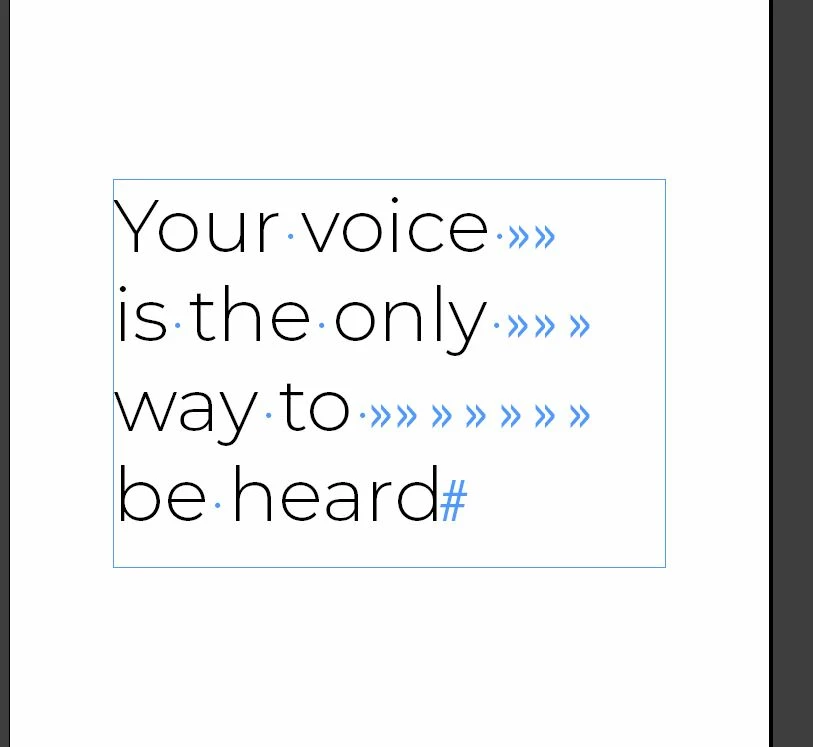
You have multiple tabs at the end there - which is not helping


In my opinion it has to be done each line as a paragraph

then adjust the Tab Stop for each paragraph


Personally I'd style the letters and leave the spacing alone


Comparing the two methods


or you could insert this special character


Break the lines up with Forced Line Breaks


`