


Participating Frequently
February 23, 2017
解決済み

How do I place the value of a paragraph tag in the body of my document without using a cross reference

  • February 23, 2017
  • 返信数 1.
  • 690 ビュー

FRAMEMAKER 2017, Unstructured

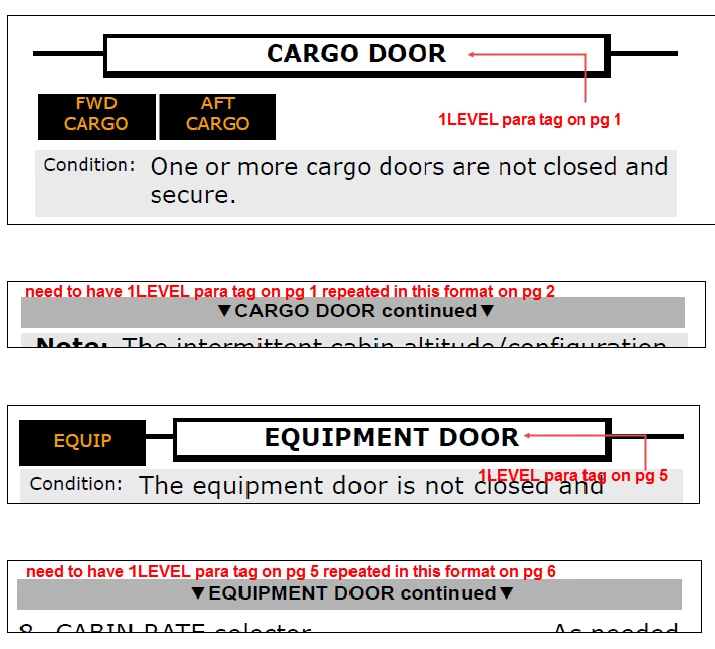
I need to pick up the value of a previous paragraph tag and put it on the following page, along with some symbols and text. I would like to set this up as a paragraph tag, if possible.

For example, top of page 1 has the title "TITLE A". On page 2, I need to place "< TITLE A continued >" (using downward triangle symbols in place of the angled brackets I've shown here). Then, say page 5 has a title of "TITLE B", on page 6, I need to insert "< TITLE B continued >" - preferably with one or two clicks which will automatically change A to B and insert the symbols. Please see attached example. Any help would be appreciated as doing it manually with a cross reference is prone to error. Thank you.
    このトピックへの返信は締め切られました。
    解決に役立った回答 Barb Binder

    Any help would be appreciated as doing it manually with a cross reference is prone to error.

    If something is "prone to error", I'm guess you mean it works sometimes and not others? That tends to fall into the user error category. It might be set up correctly in one document, but not in another, or the X-ref is being added differently in different parts of the file.

    In any case, here's what I'd do:

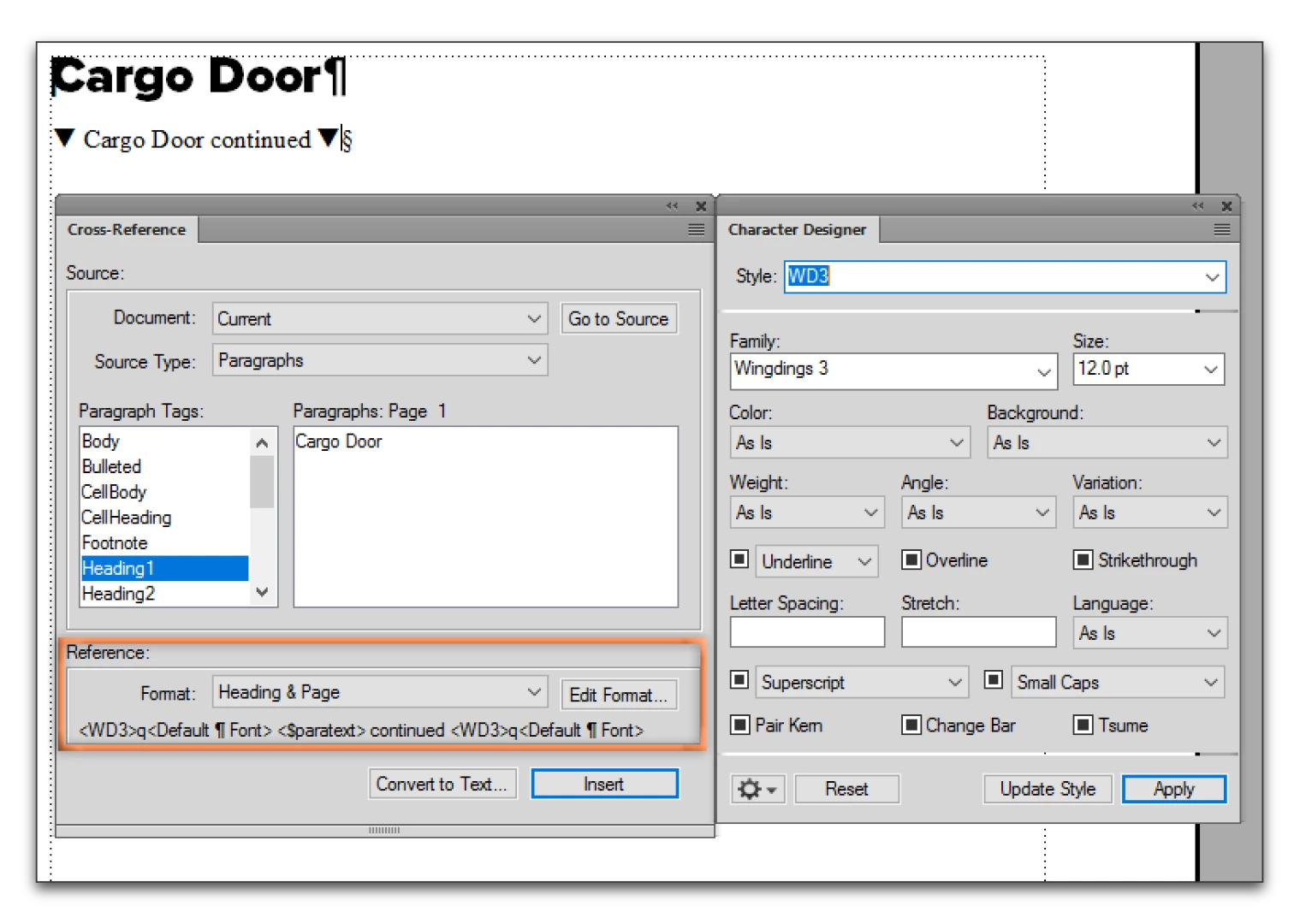
    1. Add the Heading1 "Cargo Door"
    2. Set up a Character style to change "q" to a downward pointing error (I called mine WD3 for Wingdings 3)
    3. Set up an X-ref format:
      1. Add "q" to the beginning and end of the x-ref format.
      2. Change the character style for the "q" to WD3 before and back to Default ¶ font after, on both sides.
      3. Add the word continued.

    Once the X-ref format is defined, Esc s c is the shortcut to add an x-ref.

    It's pretty darn quick and will be consistent.

    返信数 1

    Bob_Niland
    Community Expert
    Community Expert
    February 24, 2017

    I presume these Headings all appear in the Body page Flow A?


    (If in Master Page background text frames, other options and challenges arise - ditto for as Tables).

    What's the problem with using cross-references (other than that it would be nice for it to be automatic).

    blh5作成者
    Participating Frequently
    February 24, 2017

    Hi, Bob

    Thanks for replying. Yes, all on the body pages.

    Brenda

    Brenda Haynes

    Operations Administrator, Flair Airlines Ltd.

    blh5作成者
    Participating Frequently
    February 24, 2017

    re: Set up a Character style to change "q" to a downward pointing error [arrow?] (I called mine WD3 for Wingdings 3)

    Using Unicode character:
    U+25BC (\u25bc,▼) BLACK DOWN-POINTING TRIANGLE
    would avoid some of the baggage that comes with Character Formats, not to mention workflows that don't end up as document types that don't properly support random fonts and/or legacy overlays.

    When font overlays are unavoidable, but the glyphs are defined in Unicode (just perhaps not in your present body fonts) I suggest implementing them as Variables. The Character ▼ is also available in Zapf Dingbats at codepoint \x74 ("t"), so:
    Character Designer:
    Tag: ZapfDingbats
    Family: ZapfDingbats
    {all else blank or As-Is}

    New Variable:

    Name: U+25BC BLACK DOWN-POINTING TRIANGLE

    Definition: <ZapfDingbats>t

    It doesn't even need the <Default ¶ Font> element. Using Unicode formal notation and Name makes it easy to be consistent from document to document. Having the Variable name start with U convenienty bunches all these provisionals way down on the insert-Var menu.

    This makes these legacy codepoint overlay instances easier to find and migrate to native Unicode in the future (otherwise, for the Zapf instance of ▼, you'd have to examine every instance of "t" to see what Character Format or local override might have been applied).

    Meanwhile, the heading continuation requirement could also be more or less automated with those banners in a background Header frame, using a Running H/F X system variable, picking up $MarkerY (inserted as Marker "Header/Footer $Y" in the Body flow), but it gets fairly complicated, possibly hackish (much like the TPLIB hack, which I'm using in a current project, so that hack would not be available for any other use in the same project).


    I have the triangle characters set up correctly, and I think I’ll just stick with cross referencing. It seems to be the easiest method.

    Thanks very much for your time and help.

    Cheers

    Brenda

    Brenda Haynes

    Operations Administrator, Flair Airlines Ltd.