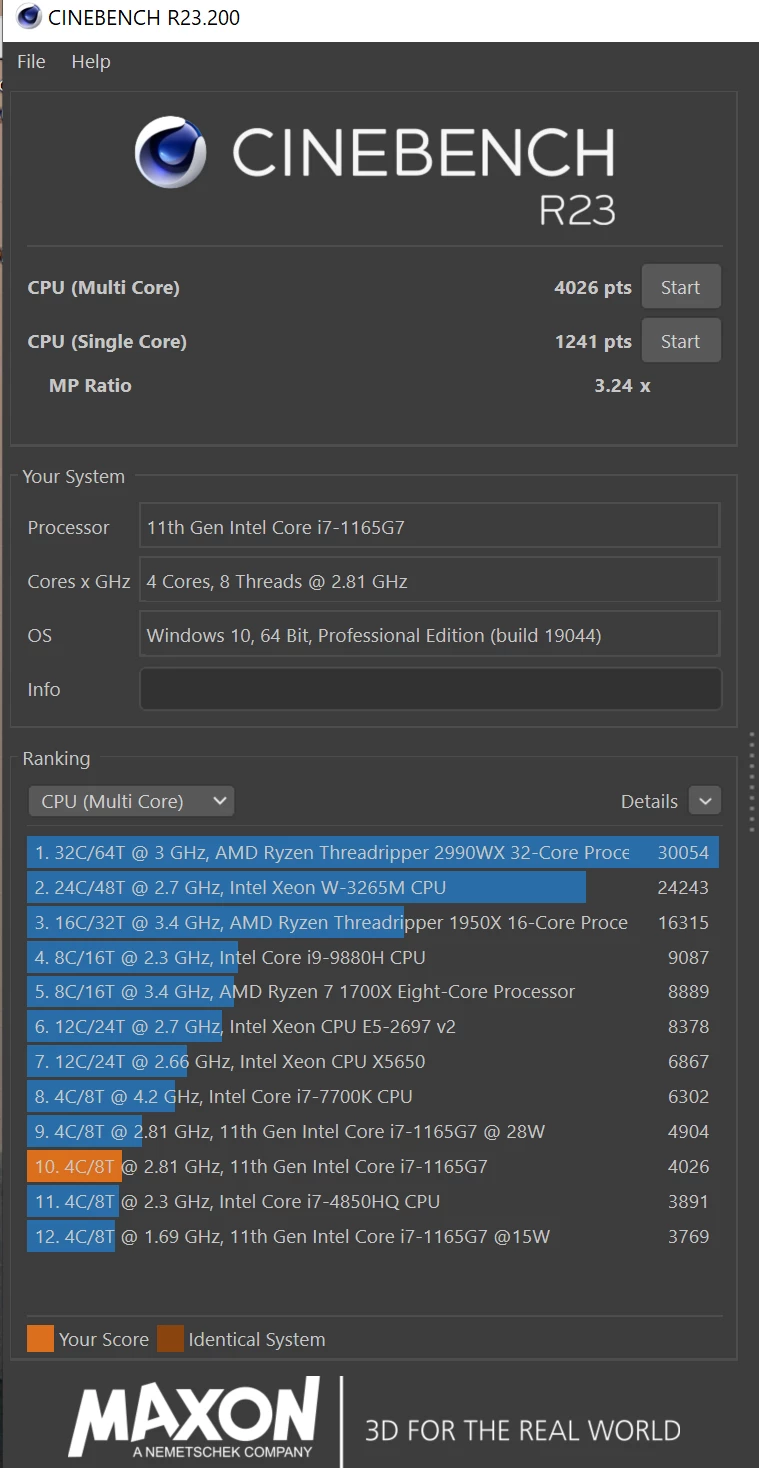
According to the screenshot shared by defaultfrzzkd6qqsht, the Ryzen 7 1700X CPU belongs to the Ryzen 1000 series released on Mar 2, 2017. On the other hand, the Ryzen 5 5600X is part of the Ryzen 5000 series that was released on Nov 5, 2020. Therefore, the difference in performance is due to the technology gap between these two CPU series.
I am summarizing how to look for CPU & GPU based on the generation and looking at the model suffix:
Intel:

Suffixes indicating CPUs for desktops:
| X/XE |
Highest performance, unlocked |
| K |
High performance, unlocked |
| F |
Requires discrete graphics |
| S |
Special edition |
| T |
Power-optimized lifestyle |
Suffixes indicating CPUs for laptops:
| HX |
Highest performance, all SKUs unlocked |
| HK |
High performance, unlocked |
| H |
High performance |
| P |
Performance for thin & light |
| U |
Power efficient |
| Y |
Extremely low-power efficient |
| G1-G7 |
Graphics level (processors with newer integrated graphics technology) |
AMD:
Suffixes indicating CPUs for desktops:
| WX |
|
| X3D |
Highest performance
|
|
XT
|
Higher-clocked desktop processor with even better performance than X
|
|
|
Higher-clocked desktop processor (threadripper version more powerful)
|
|
G
|
Has integrated AMD Radeon Graphics
|
|
GE
|
Has integrated AMD Radeon Graphics, but lower performance
|
|
S
|
Energy-efficient desktop processor with integrated AMD Radeon Vega Graphics
|
Suffixes indicating CPUs for laptops:
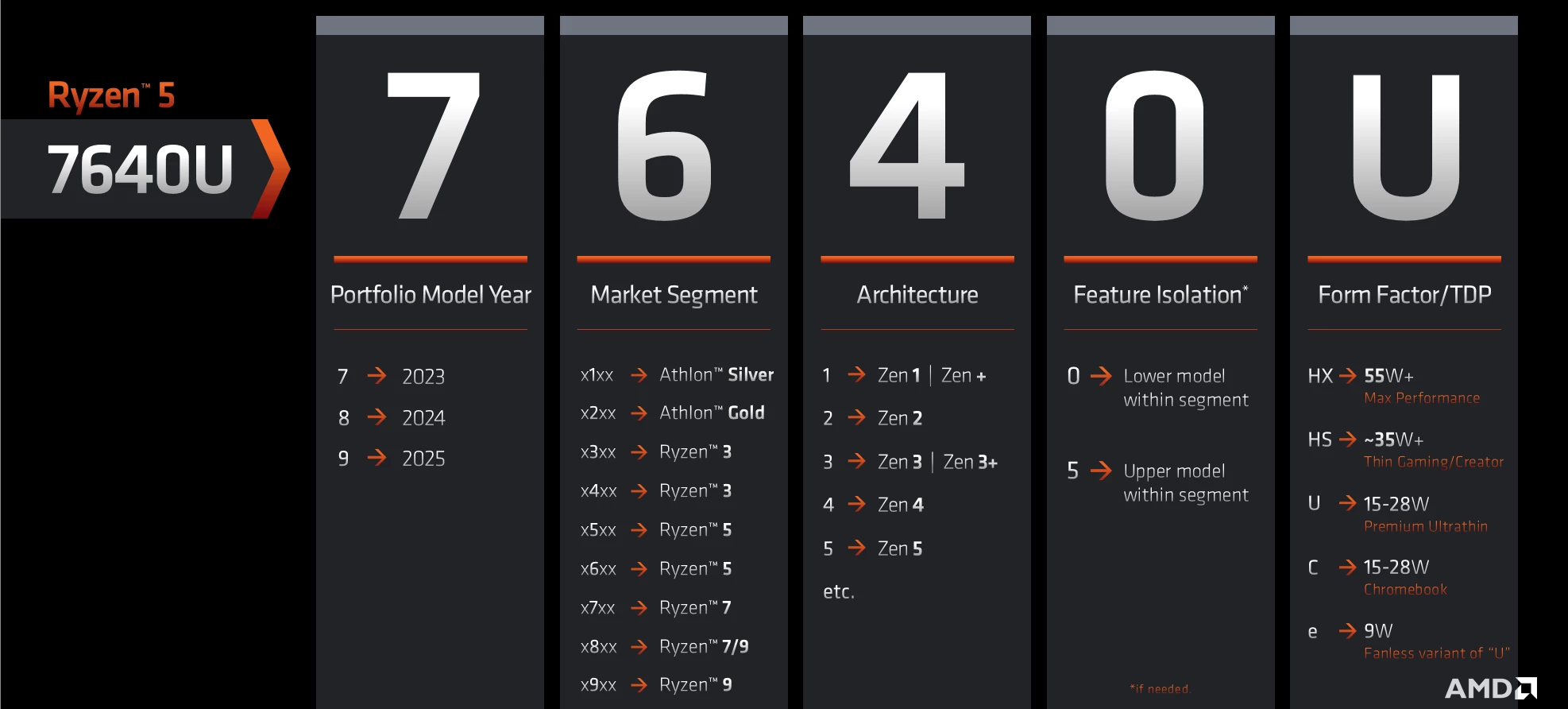
AMD GPU naming scheme:
For workstation:
- AMD Radeon Pro WX series (e.g. WX 8200, WX 7100): high-end workstation GPUs for professional applications such as CAD, video editing, and 3D modeling.
For desktop:
- AMD Radeon RX series (e.g. RX 6900 XT, RX 6800 XT): high-end desktop gaming GPUs with support for real-time ray tracing and high refresh rates.
- AMD Radeon R9 and R7 series (e.g. R9 390, R7 370): mid-range desktop GPUs for gaming and general use.
For mobile:
- AMD Radeon Pro and Radeon RX series (e.g. Radeon Pro 5500M, Radeon RX 580): mobile GPUs for high-performance laptops, capable of handling demanding tasks such as video editing and gaming.
Nvidia GPU naming scheme:
For workstation:
- Nvidia Quadro RTX series (e.g. Quadro RTX 8000, Quadro RTX 4000): high-end workstation GPUs for professional applications such as CAD, video editing, and 3D modeling.
- Nvidia Titan series (e.g. Titan RTX, Titan Xp): powerful GPUs for both professional and gaming use, with support for real-time ray tracing and AI acceleration.
For desktop:
- Nvidia GeForce RTX series (e.g. GeForce RTX 3090, GeForce RTX 3080): high-end desktop gaming GPUs with support for real-time ray tracing and high refresh rates.
- Nvidia GeForce GTX series (e.g. GeForce GTX 1650, GeForce GTX 1060): mid-range desktop GPUs for gaming and general use.
For mobile:
- Nvidia Quadro RTX series (e.g. Quadro RTX 5000M, Quadro RTX 3000M): mobile GPUs for high-performance laptops, capable of handling demanding tasks such as video editing and gaming.
- Nvidia GeForce GTX and RTX series (e.g. GeForce GTX 1660 Ti, GeForce RTX 3080): mobile GPUs for gaming laptops, with support for real-time ray tracing and high refresh rates.
Suffixes and their meanings:
- M: indicates a mobile GPU, designed for use in laptops.
- Ti: a higher-end version of a GPU, with increased performance over the non-Ti version.
- Max-Q: a power-optimized version of a GPU, designed for use in thin and light laptops.
- Super: a higher-end version of a GPU, with increased performance over the non-Super version.
- Quadro: a GPU specifically designed for professional applications such as CAD and 3D modeling.
- Titan: a high-end GPU designed for both professional and gaming use.
- RTX: a GPU with hardware support for real-time ray tracing, used for realistic lighting and shadows in games and applications.
- GTX: a GPU without hardware support for real-time ray tracing, designed for gaming and general use.
I hope this help @ryancloud. Please feel free to reach out if you have any further questions.
Best,
Anshul Saini



 AdChoices