


Participating Frequently
November 21, 2024
Answered

Extending time of evolution

  • November 21, 2024
  • 2 replies
  • 1527 views

HI


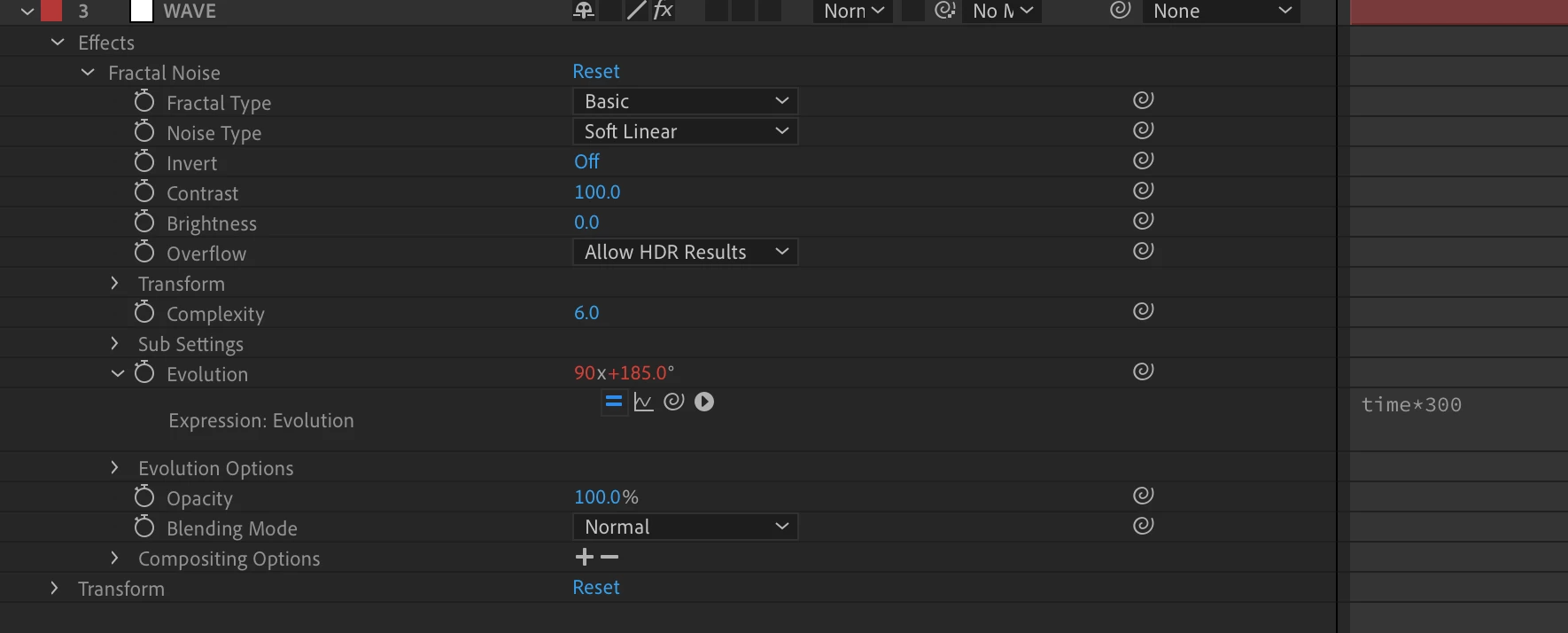
So I have a fractal noise effect, I alt-clicked the evolution stopwatch and typed the expression 'time*300'. The speed of the aniamtion is fine, but the time length of the animation is too short. What should the expression be to extend the time-length of the evolution animation, maybe make it infinite?

Hope that made sense.
 

Cheers

This topic has been closed for replies.
Correct answer stacey_7964

To extend the time-length of your fractal noise animation, you can adjust the Evolution parameter's expression. For an infinite loop, use time*300 % 360. To slow down ADP RUN the animation, reduce the multiplier, such as time*30. Experiment with different values to achieve your desired effect.

2 replies

stacey_7964Correct answer
Participating Frequently
November 22, 2024

To extend the time-length of your fractal noise animation, you can adjust the Evolution parameter's expression. For an infinite loop, use time*300 % 360. To slow down ADP RUN the animation, reduce the multiplier, such as time*30. Experiment with different values to achieve your desired effect.

Participating Frequently
November 22, 2024

Hi Stacey


Thanks for your response. I'm glad you said that because I actually did come across the solution on youtube that is pretty much what you described. I basically typed in 'time*300%32768' as was stated in the video. Didn't know why it was '32768'. What would the difference be if it was 'time*300%32768' vs 'time*300%360'?

Dan Ebberts
Braniac
November 22, 2024

The largest positive integer you can represent in 15 bits is 32767, which is where Evolution stops. Doing modulo (%) 32768 division allows it to effectively start over, so 32768 gives the same result as 0. However, there will be a glitch at the transition point, which may or may not be an issue for you.

Dan Ebberts
Braniac
November 21, 2024

Maybe run it backwards (ping pong) after the number gets close to the maximum?

angle = time*360
maxAngle = 90*360;
n = Math.floor(angle/maxAngle);
n%2 ? maxAngle - angle%maxAngle : angle%maxAngle
Participating Frequently
November 22, 2024

Hi Dan


Thanks for your response. I'll try this out next time.


Best