











A community for Substance 3D Designer users.
Recently active
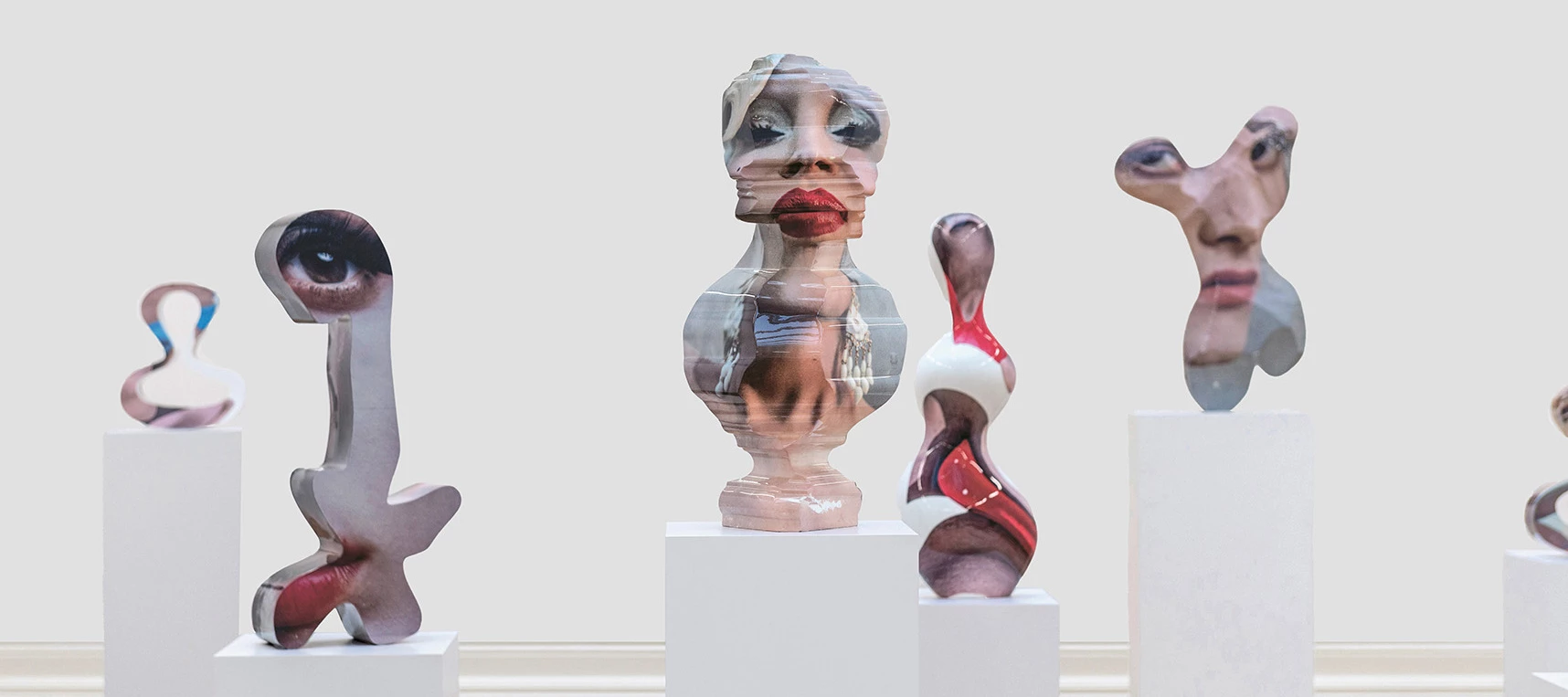
Nick Hornby is a London-based sculptor whose works are conceived entirely in digital space before being realised as monumental physical sculptures in bronze, steel, and marble. In this piece for the Adobe blog, he discusses the creative process behind his Zygotes and Confessions series — including how he uses Adobe Substance 3D to test materials and surfaces, and how the boundary between digital model and finished artwork becomes increasingly blurred.
Hi.. I’m following a course on Udemy, and got to this point where what I see in the UI doesn’t match the course… E.g., I’m missing the ‘Tesselation + Displacement” flyout in the menu… I also noticed the view title indicates ‘OpenGL’ in the tutorial… whereas mine does not. Can someone help get me back on trackThanks!
Was using Substance Designer to transfer/bake textures from one UV to another.Previous version (v13.1.2) was using 512x512 tiles in baker, while current one (v16.0.0) uses 64x64 pixel render tiles and takes way more time to complete same task.Is there some kind of hidden setting that I have to change in order to achieve same performance from 2026 version of Substance Designer compared to 2023 ?
With the recent trackpad support in the MacOS version of Substance Designer, the mouse controls are now different than in Windows and downgraded in my opinion:-The scroll wheel scrolls up and down instead of zooming in and out in GRAPH, 2D VIEW and 3D VIEW. This is completely useless. Graphs are usually horizontal, not vertical, so moving up and down just makes us lose focus on the nodes we’re working on. Same for the 2D view, it’s more useful to zoom in and out and pan around rather than scrolling.I understand that the trackpad works better like this, but most professional users use mice. Please give us the option to switch the mouse controls to work like before instead of making us hold the Cmd key the whole day to zoom. Thank you!
dv
I don’t know if this is the right place to post this, but after playing with Houdini’s Copernicus for a while I’ve come to the realization that Substance Designer is starting to feel obsolete and is seriously falling behind. I’ve used this software since the Allegorithmic days, I never liked it to be honest, but given the fact that this program won a special place in the industry I’m somehow forced to use it quite often, also studios would rather pay a Designer license than Houdini’s so then again, I’m basically forced to use this software all day. Not gonna lie this is most likely a rant, but I want to know if there are people out there that share my frustrations with this program:Please for the love god! Implement a code based system: One of the things that I seriously dislike about designer is that everything is node based. Designer is now a technical tool and is something that most artists avoid, they would rather use Painter instead. Some of you may say “Well you have Python!” NO!
Hi Substance Team, Substance Designer used to be able to export the tessellated mesh straight with Export SceneAs seen in this post here from Adobe Substance 3D: https://www.linkedin.com/posts/substance3d_export-tesselated-mesh-with-substancedesigner-activity-6761308676545376257-NAN1That functionality has since been lost and it would be great if it was brought back. Thank you!
Feature Request: Light UI Theme AlternativeIs there any plan to add a white/light UI theme as an alternative option?My workstation is located right next to a bright window in the office. For the sake of eye care and general screen visibility, I rely on light themes everywhere. Currently, Substance Designer and Painter are the only exceptions in my pipeline—I already use light themes in Maya, Blender, ZBrush, Houdini, and Photoshop.I believe many users working in similar lighting conditions would greatly appreciate the ability to customize their UI.
I have a material where I use a RTAO node. In substance designer the material looks correct, but when I import it via Substance 3D Plugin in UE and generate a material from it, the textures are broken.Here are some examples of Substance Designer:(Working base color)(Correct normals) (Wrong base color after import to UE via Substance 3D Plugin)(Wrong normals, it is as if the normals have not been calculated further than before the first RTAO node) When swapping the RTAO with a HBAO node it is working but of course does not have the same look.I’m using substance designer steam edition:Version: 13.1.2 build 7745 commit 1e6555a8 Release (04/06/2024) - Steam editionEngine Version: [Direct3D 11] 9.0.3 commit 0x41325881 (04/06/2024)Bakers Version: 2.5.7 commit 0xe9235188Substance in UE5 Plugin Version: 5.7.1 The Substance Designer sbs is attached.
We’re excited to share that Frame.io now supports 3D files natively — and it’s free on every plan. You can upload GLB, USDZ, FBX, OBJ, STEP, SBSAR materials, and 14+ other 3D formats directly to Frame.io. It auto-generates a high-fidelity turntable so anyone on your team — even people without 3D software — can review, leave degree-stamped comments, and approve. Spin. Share. Ship. This is the same review workflow you may already be using for video. Now for 3D. "Can I get a quick look at that 3D file?" has just become easier to answer than ever before. If you’re using Frame.io, give it a spin!
The latest Substance 3D releases are out. Designer 16 expands procedural capabilities with an improved Shape Splatter node and new SDF tools. Sampler 6 focuses on faster, more consistent material creation, including new templates and better HP Z Captis capture integration. And with ZBrush 2026.2.0 and Painter 12.0.2, you can now transfer meshes between the two apps in a single click. OpenPBR support is also now live across Designer and Sampler, and in beta in Painter. Head over to our post on the Adobe blog for more info!
Currently, the Polygon fill tool is very useful for editing base color and masks.I do not see an obvious technical reason why it can’t also affect Height, Roughness, Normal and other channels, as well as erase things.Please add this feature.
I have attached two images. On is a screenshot of my material inside Designer. That's the one with the cube. And I've attached a second image that is a screenshot of what that same material looks like in Painter. No other materials are active or are being blended. It should be a 1 to 1. How do I fix this? PS. I have the Steam versions of both these softwares latests 2025 versions
Tessellation settings (resolution/factor) missing from the the main renderer settings but do appear in the material settings on the openGL renderer. This has persisted for the last 2 versions of SD
From what I see so far it still have same disadvantages over FXmap node as before: Stepped aliazed Z combine, bad aliased alpha for small details like small twigs , grass blades etc . It has quite a lot of redundant stuff I would never use probably , like SDF or maybe just don’t understand how it’s useful yet. So if somebody could share experience what’s new and cool there I would be appreciative.
I mean not just like “export to PSD” but rather an ability to re-export to certain layers while not overwriting Painter file entirely and all the work done there . In a word a way to cash selected nodes rasterized in Designer and update them as layers and masks in Painter . Doing sbsars is such a pain. I could do all this manually probably by exporting a set of outputs , bring them to painter layers and update on demand there but would be nice to have it all automated one click solution . Maybe some python script in Painter or something . I think chat GPT could easily do such script for Photoshop but I never managed to make it to do anything working for Painter.
Hi,I've been with support for hours and hours trying to get the Exclude Pattern in the Preferences > Projects > Library paths to work with no success. My objective is to specify a root directory for an asset library which has a bunch of assets shared among artists. I want Recursive enabled so it would automatically scan the subdirectories for all the assets. LibraryRoot/Asset1/LibraryRoot/Asset2/LibraryRoot/Asset3/...Each asset subdirectory will look something like:LibraryRoot/Asset1/asset.sbsLibraryRoot/Asset1/WIP/asset1.sbsLibraryRoot/Asset1/WIP/asset2.sbsLibraryRoot/Asset1/WIP/asset3.sbs... WIP will contain development save iterations of the asset and should be excluded from the Recursive scan.I've tried the following Exclude Patterns:WIPWIP/*/WIP/**/WIP/*.*[\\\/](?:WIP)(?:[\\\/].*)?$also with and without quotations. Nothing works, it seems like it's completely ignoring everything in this field. Can anyone confirm if this works or doesn't work for
I am trying to create a packed texture - Color_AO In some cases I don’t need an AO and so I want to pack the alpha channel with all white so my in game shader will still render correctly When I plug a uniform white into the alpha and export the alpha channel is not exported It will only export the alpha channel when I have some value range in whats being plugged into the Alpha of the RGBA Merge node I am exporting as TGA in RAW color space
When selecting the Rasterizer Renderer, baked normal maps does not render correctly on symmetric models. The OpenGL can render it correctly, but it was recently marked as deprecated and added a warning that it will be removed.Updating drivers didn’t made any change.No issues with the normal map on any other app, including PainterOn Substance Painter the maps looks fine.
The latest release of Substance 3D Designer brings a set of targeted updates focused on improving procedural shape workflows, expanding OpenPBR support, and improving access to displacement settings in the 3D view.This release introduces the Shape Spatter v2 node, allowing you to scatter raytraced 3D shapes individually in real time, enabling per-instance control over properties such as shape, orientation, and size. Shape Spatter v2 supports atlas inputs, allowing artists to scatter an unrestricted range of shapes from a single atlas without the limitations of the previous workflow. In addition, this version brings significant improvements over the original node, with enhanced controls for scatter randomness, rotation randomness, size variation, and distribution. To complement the new scattering capabilities, the node comes with an expanded Signed Distance Field (SDF) toolkit, introducing a range of new nodes for creating, combining, and manipulating custom 3D SDF shapes. Finally, t
Hi, recently I upgraded to Substance Designer 15, and now when I try to create a new project or open an existing one, the program crashes. It seems like an issue with the 3D view because when the crush window appears, my 3D view is blank.What I tried so far:updated drivers for my video card (put studio drivers for Nvidia) reinstalled substance changed to OpenGl and Iray checked python libraries installed and uninstalled ReShade libraries because saw it as a potential fix from another post
Hello from Ukraine!:) I have an issue with SD 15 - it started to crash on loading the project.Yesterday I worked on a several projects, and all was well. Then, today I tried to open SD (I tried my projects, and even blank new scene, doesn't matter), and it crashes on loading. After some tests I discovered that this is caused by rasterizer renderer initializing. If I disable 3d view before loading the project, I can use Designer, move and connect nodes and see 2D outut, all works as before. But if I initialize 3d view (no matter - using rmb on Output node or from window>new 3d view), it shows me black 3d view for a second and then crashes. I even can't switch to OpenGL, even if I set OpenGL as default renderer in settings, it still tries to initialize Rasterizer first (why?). The issue is I've already updated all my important projects to 15 version so I even can't open them in older versions of Designer. I tried 14 version, it works well with OpenGL ev
I can already create a graph input parameter of type Float4 through Python.The problem is different:I cannot make the corresponding Input node become Float4.What I need is the Designer UI Input node whose editor shows 4 float components, not just a graph parameter of type Float4.What I observed:Creating the graph input as Float4 worksCreating the Input node worksBut the Input node still behaves as a plain float/value input, not as a Float4 inputSo my question is:Through the Substance Designer Python API, is it possible to change the type of an Input node to Float4?More specifically:Is there an API call to set the Input node type to Float4?If not, is the node type determined only when the node is created?If it is possible, what is the correct Python API sequence?I am asking about the Input node type itself, not the graph input parameter type.
Title says it all. I’d provide more information if I could. I wish designer would tell me what exactly the problem is but I just get a small window that tells me: “Error publishing package. Check the console for details”. And if I check the console nothing is there. Where should I look?Thanks in advance
Remix with Firefly Community Gallery
Thousands of free creations to fall in love with and remix in Firefly.
Already have an account? Login
No account yet? Create an account
Enter your E-mail address. We'll send you an e-mail with instructions to reset your password.